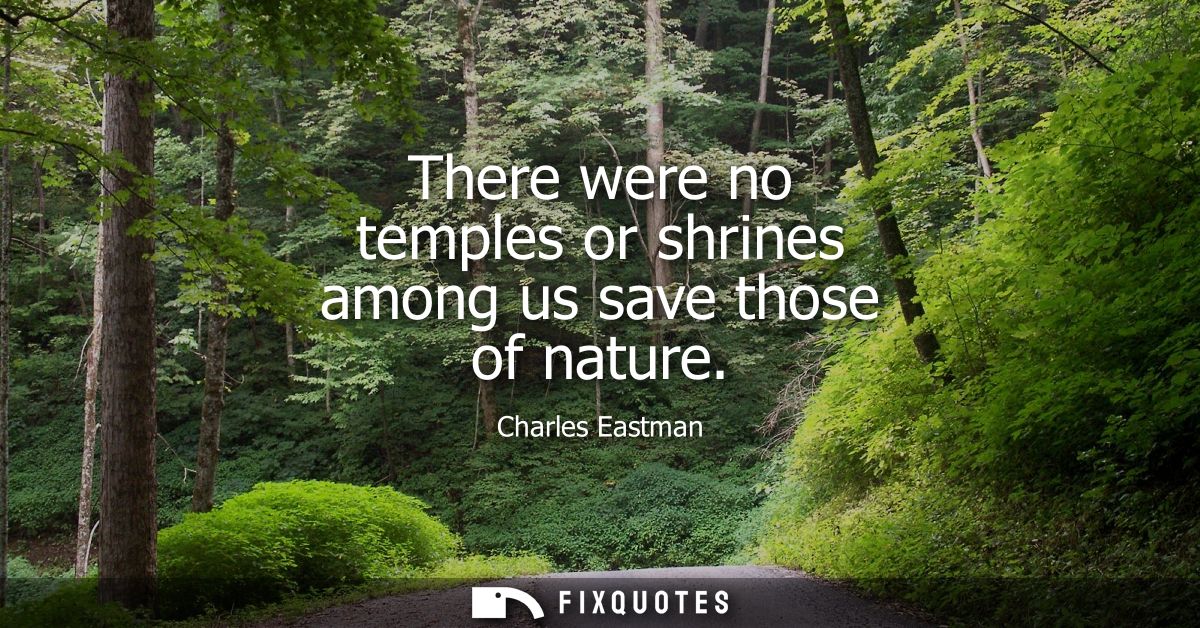
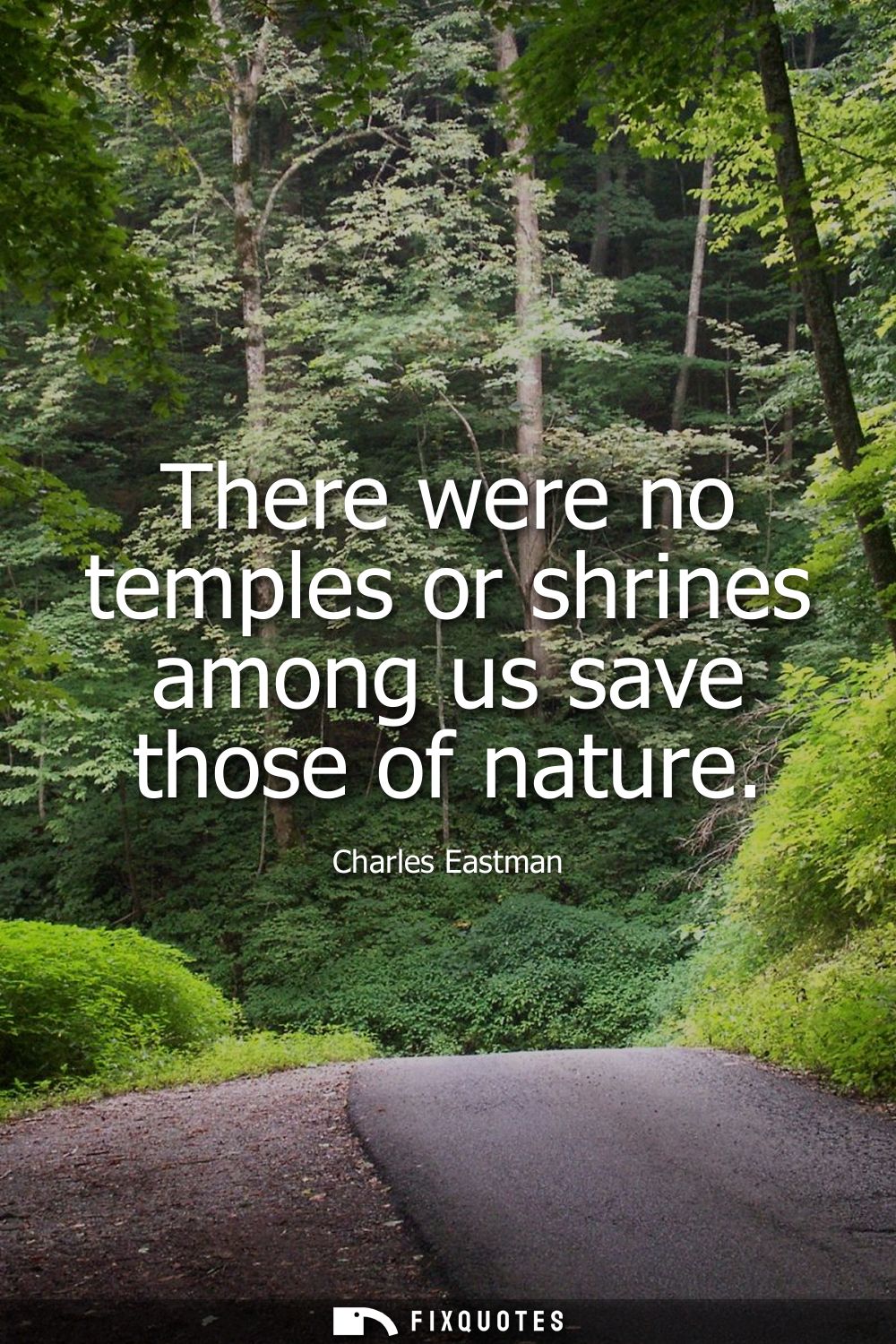
"There were no temples or shrines among us save those of nature"
About this Quote
A quiet flex is hiding in Eastman’s plainspoken line: if you went looking for “religion” in Indigenous life through the usual colonial checklist (buildings, altars, sanctioned priests), you were already asking the wrong question. “No temples or shrines” isn’t a confession of absence; it’s an indictment of a measurement system that equates the sacred with real estate. Eastman flips that logic with one crisp pivot - “save those of nature” - turning the supposed lack into an abundance so vast it can’t be enclosed.
The intent is partly corrective and partly strategic. Writing as a Dakota author in an era when Native spirituality was routinely dismissed as superstition and actively suppressed by boarding schools and federal policy, Eastman offers a translation that non-Native readers can’t easily ignore. He borrows their vocabulary (“temples,” “shrines”) only to reassign it, inviting empathy while refusing the premise that holiness requires architecture.
The subtext carries a politics of land. If nature is the shrine, then land is not property; it’s kin, memory, and moral order. That’s why the sentence still lands now: it quietly rebukes the commodifying impulse that can admire “spirituality” while taking the ground it stands on. Eastman’s restraint is the rhetorical power. He doesn’t romanticize; he normalizes a worldview where reverence is practiced in public, daily, and everywhere - a spirituality that can’t be regulated by doors, deeds, or fences.
The intent is partly corrective and partly strategic. Writing as a Dakota author in an era when Native spirituality was routinely dismissed as superstition and actively suppressed by boarding schools and federal policy, Eastman offers a translation that non-Native readers can’t easily ignore. He borrows their vocabulary (“temples,” “shrines”) only to reassign it, inviting empathy while refusing the premise that holiness requires architecture.
The subtext carries a politics of land. If nature is the shrine, then land is not property; it’s kin, memory, and moral order. That’s why the sentence still lands now: it quietly rebukes the commodifying impulse that can admire “spirituality” while taking the ground it stands on. Eastman’s restraint is the rhetorical power. He doesn’t romanticize; he normalizes a worldview where reverence is practiced in public, daily, and everywhere - a spirituality that can’t be regulated by doors, deeds, or fences.
Quote Details
| Topic | Native American Sayings |
|---|---|
| Source | Help us find the source |
| Cite |
Citation Formats
APA Style (7th ed.)
Eastman, Charles. (2026, January 17). There were no temples or shrines among us save those of nature. FixQuotes. https://fixquotes.com/quotes/there-were-no-temples-or-shrines-among-us-save-44369/
Chicago Style
Eastman, Charles. "There were no temples or shrines among us save those of nature." FixQuotes. January 17, 2026. https://fixquotes.com/quotes/there-were-no-temples-or-shrines-among-us-save-44369/.
MLA Style (9th ed.)
"There were no temples or shrines among us save those of nature." FixQuotes, 17 Jan. 2026, https://fixquotes.com/quotes/there-were-no-temples-or-shrines-among-us-save-44369/. Accessed 27 Mar. 2026.
More Quotes by Charles
Add to List