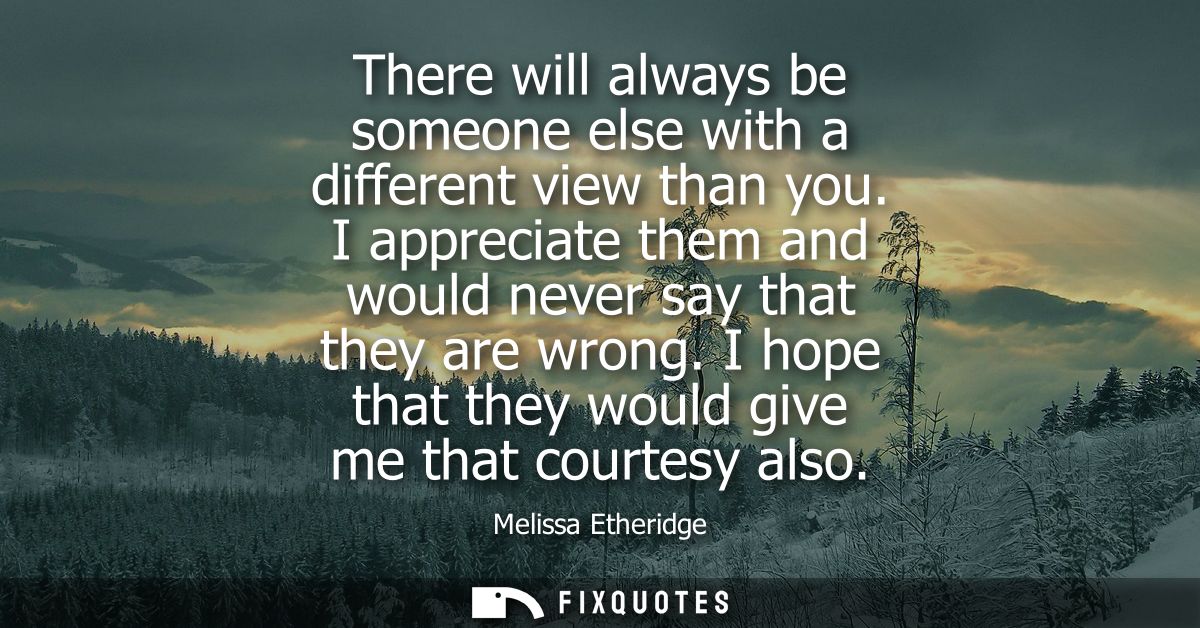
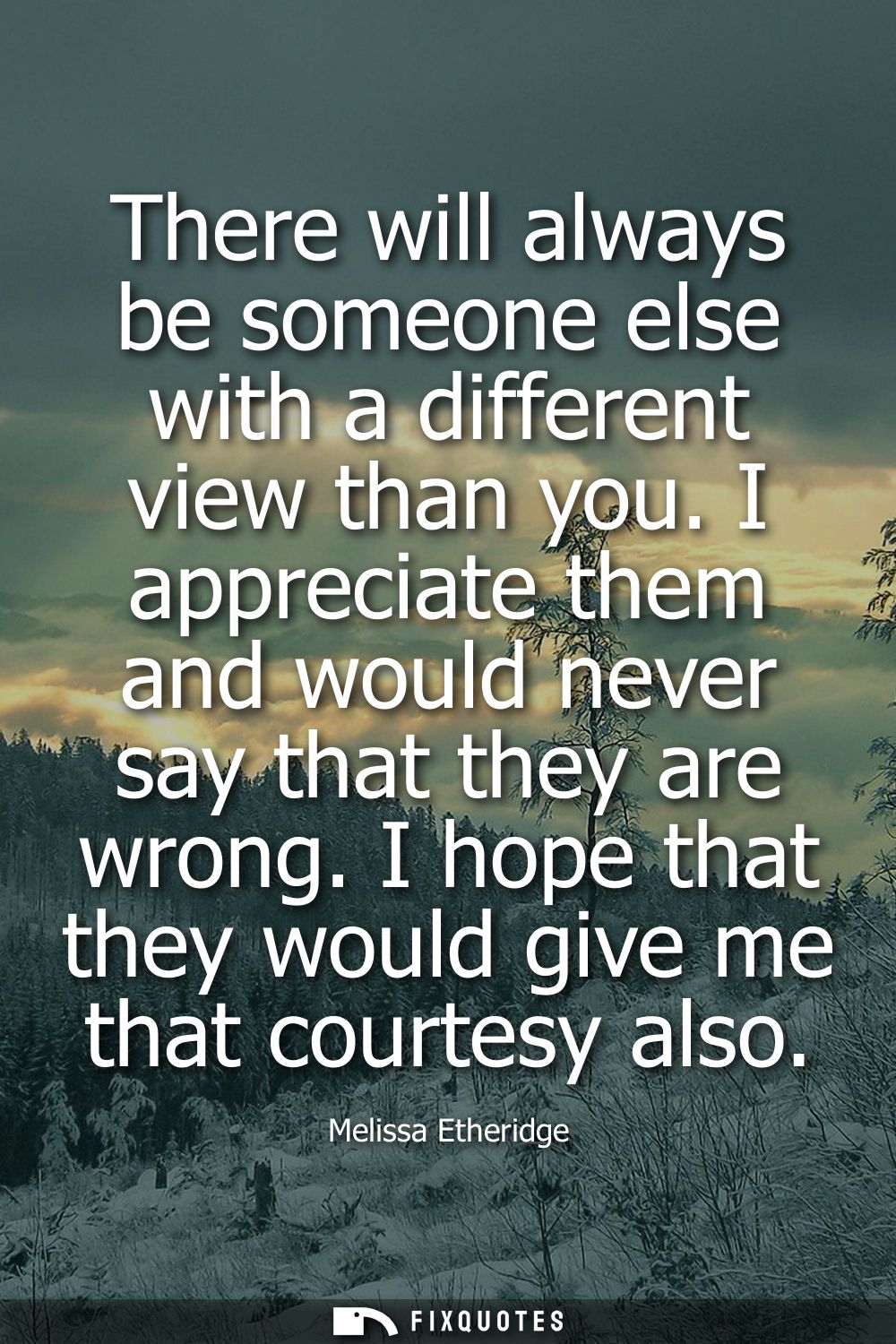
"There will always be someone else with a different view than you. I appreciate them and would never say that they are wrong. I hope that they would give me that courtesy also"
About this Quote
The key move is the refusal to call the other person “wrong.” On its face, that reads generous. Underneath, it’s also defensive architecture. Etheridge came up as an openly queer artist when “different views” weren’t abstract opinions but moral verdicts with real consequences. By framing dissenters as people she can “appreciate,” she claims the moral high ground without escalating the fight. It’s a posture that signals strength: I’m stable enough not to need your agreement to validate me.
The last sentence is the tell: courtesy isn’t truth; it’s reciprocity. She’s not asking critics to endorse her worldview, just to stop treating difference as a license for contempt. That makes the line feel culturally current in an era where disagreement is monetized and outrage is a business model. Etheridge’s subtext is blunt: I’ll grant you dignity if you stop confusing conviction with permission to dehumanize. It’s less a plea for harmony than a boundary, elegantly phrased.
Quote Details
| Topic | Respect |
|---|---|
| Source | Help us find the source |
| Cite |
Citation Formats
APA Style (7th ed.)
Etheridge, Melissa. (2026, January 15). There will always be someone else with a different view than you. I appreciate them and would never say that they are wrong. I hope that they would give me that courtesy also. FixQuotes. https://fixquotes.com/quotes/there-will-always-be-someone-else-with-a-159203/
Chicago Style
Etheridge, Melissa. "There will always be someone else with a different view than you. I appreciate them and would never say that they are wrong. I hope that they would give me that courtesy also." FixQuotes. January 15, 2026. https://fixquotes.com/quotes/there-will-always-be-someone-else-with-a-159203/.
MLA Style (9th ed.)
"There will always be someone else with a different view than you. I appreciate them and would never say that they are wrong. I hope that they would give me that courtesy also." FixQuotes, 15 Jan. 2026, https://fixquotes.com/quotes/there-will-always-be-someone-else-with-a-159203/. Accessed 22 Mar. 2026.