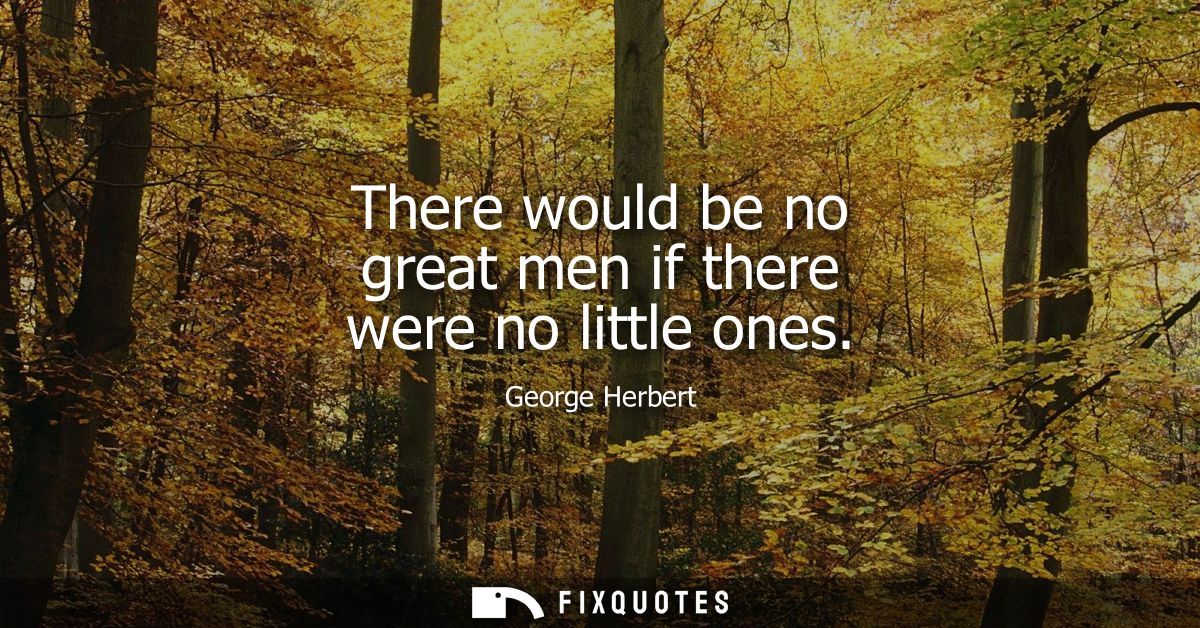
"There would be no great men if there were no little ones"
About this Quote
Greatness, Herbert suggests, is less a personal halo than a social arrangement. "There would be no great men if there were no little ones" flips the flattering story of exceptional individuals and exposes the scaffolding underneath: hierarchy needs an audience, a workforce, a comparison class. "Great" only reads as great against a backdrop of the "little" - not merely shorter in stature, but smaller in power, status, and voice. The line works because it’s compact and faintly barbed: it sounds like a compliment to humility while quietly indicting the machinery that manufactures heroism.
Herbert writes as a devotional poet in early 17th-century England, a world thick with rank, patronage, and divine order. In that context, the statement can be heard as Christian corrective: pride is parasitic, and the mighty should remember their dependence on those they command. Yet Herbert is too shrewd to offer simple moralism. The subtext is that "great men" are not self-made; they’re collectively made. Their grandeur is propped up by deference, labor, and the everyday concessions of people trained to see themselves as "little."
Read now, it lands like an early critique of celebrity and "great man" history. We still crave singular geniuses and visionary leaders, but Herbert’s aphorism insists on the ecosystem: the assistants, the voters, the fans, the underpaid staff. It doesn’t deny excellence; it questions the politics of elevation - and asks who had to kneel for someone else to stand tall.
Herbert writes as a devotional poet in early 17th-century England, a world thick with rank, patronage, and divine order. In that context, the statement can be heard as Christian corrective: pride is parasitic, and the mighty should remember their dependence on those they command. Yet Herbert is too shrewd to offer simple moralism. The subtext is that "great men" are not self-made; they’re collectively made. Their grandeur is propped up by deference, labor, and the everyday concessions of people trained to see themselves as "little."
Read now, it lands like an early critique of celebrity and "great man" history. We still crave singular geniuses and visionary leaders, but Herbert’s aphorism insists on the ecosystem: the assistants, the voters, the fans, the underpaid staff. It doesn’t deny excellence; it questions the politics of elevation - and asks who had to kneel for someone else to stand tall.
Quote Details
| Topic | Humility |
|---|
More Quotes by George
Add to List