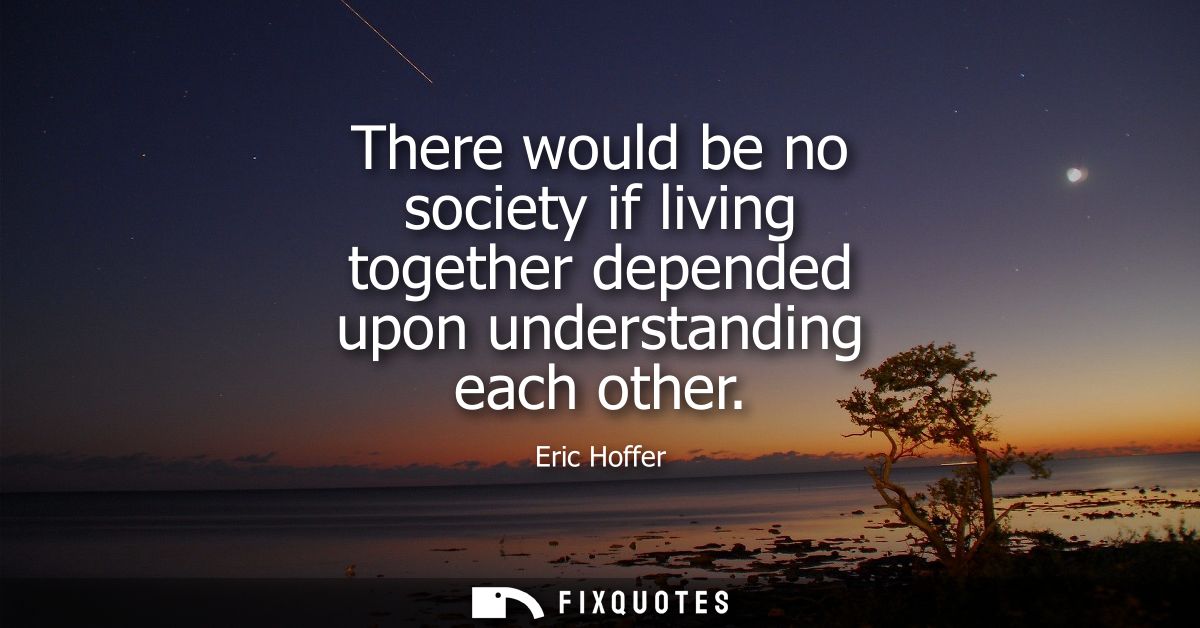
"There would be no society if living together depended upon understanding each other"
About this Quote
The subtext is almost mischievous. If we waited to “understand” one another - across class, religion, temperament, trauma, ideology - we’d never get past the first argument. Understanding is slow, partial, and often self-serving; it’s too fragile a foundation for something as blunt and necessary as coexistence. Hoffer is also hinting at the darker corollary: societies can function on misunderstanding, projection, even convenient stereotypes. People cooperate because incentives and institutions corral them, not because their inner lives line up.
Context matters: Hoffer wrote in an era shadowed by fascism, communism, and the mid-century American anxiety about conformity and belonging. His work repeatedly warns how easily humans trade nuance for certainty, especially in groups. The quote reads as a corrective to both utopian politics and interpersonal moralism. It doesn’t dismiss understanding as worthless; it demotes it. The real miracle, Hoffer implies, is not that we “get” each other, but that we keep showing up anyway.
Quote Details
| Topic | Wisdom |
|---|---|
| Source | Help us find the source |
| Cite |
Citation Formats
APA Style (7th ed.)
Hoffer, Eric. (2026, January 18). There would be no society if living together depended upon understanding each other. FixQuotes. https://fixquotes.com/quotes/there-would-be-no-society-if-living-together-15692/
Chicago Style
Hoffer, Eric. "There would be no society if living together depended upon understanding each other." FixQuotes. January 18, 2026. https://fixquotes.com/quotes/there-would-be-no-society-if-living-together-15692/.
MLA Style (9th ed.)
"There would be no society if living together depended upon understanding each other." FixQuotes, 18 Jan. 2026, https://fixquotes.com/quotes/there-would-be-no-society-if-living-together-15692/. Accessed 9 Mar. 2026.