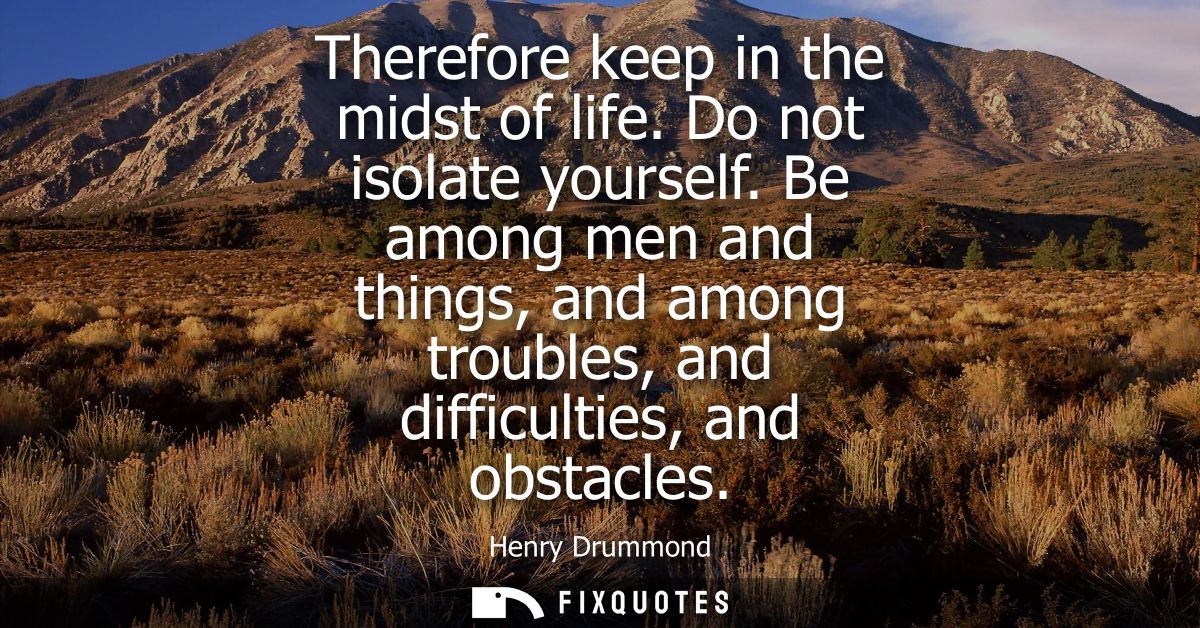
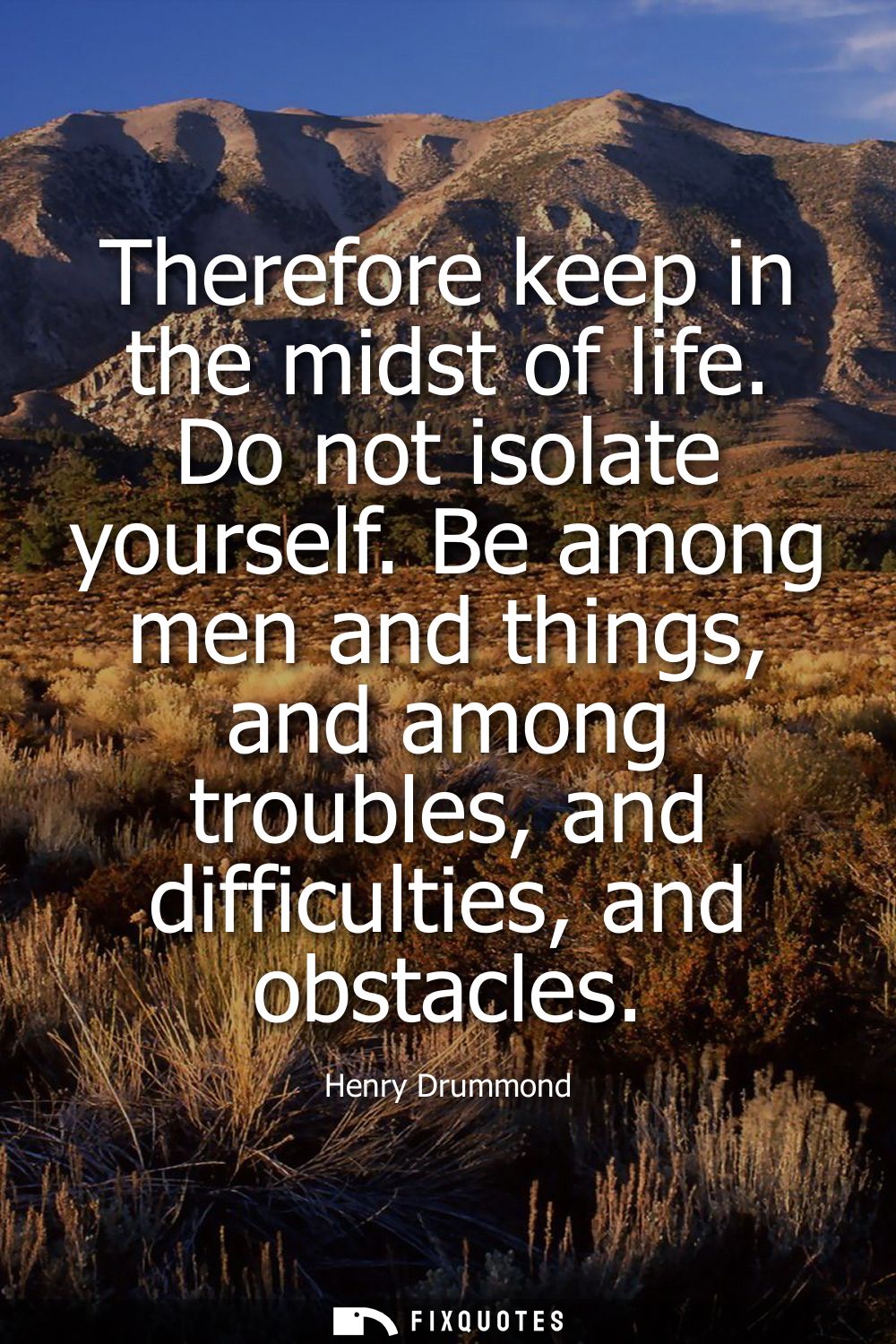
"Therefore keep in the midst of life. Do not isolate yourself. Be among men and things, and among troubles, and difficulties, and obstacles"
About this Quote
“Keep in the midst of life” reads like a rebuke to the Victorian temptation to treat virtue as a private indoor sport. Drummond isn’t offering cozy mindfulness; he’s pushing against withdrawal, cloistered self-improvement, the fantasy that character can be perfected in a quiet room. The sentence structure does the work: short imperatives, then a widening circle of company. First “men and things” (the ordinary mess of social and material life), then the harder inventory: “troubles, and difficulties, and obstacles.” The repetition of “and” stacks reality in front of you, refusing the reader an exit ramp.
Drummond wrote as a religious-minded public thinker in an era that prized moral earnestness and feared moral contamination. His twist is that the “contamination” is the point. Trouble isn’t an unfortunate interruption to living; it’s the medium where living happens. Subtext: isolation masquerades as purity, but it’s often just self-protection dressed up as principle. “Do not isolate yourself” sounds personal, yet it’s also civic: a warning against becoming the sort of person (or class) that watches hardship from a safe balcony.
The intent is practical and almost corrective. Drummond is prescribing proximity: to people, to friction, to responsibility. He implies that empathy, resilience, even faith are not abstract beliefs but learned behaviors, acquired by staying present when life turns inconvenient. It’s an ethic of immersion, not escape, delivered with the calm authority of someone who thinks the world, not the self, is the proper classroom.
Drummond wrote as a religious-minded public thinker in an era that prized moral earnestness and feared moral contamination. His twist is that the “contamination” is the point. Trouble isn’t an unfortunate interruption to living; it’s the medium where living happens. Subtext: isolation masquerades as purity, but it’s often just self-protection dressed up as principle. “Do not isolate yourself” sounds personal, yet it’s also civic: a warning against becoming the sort of person (or class) that watches hardship from a safe balcony.
The intent is practical and almost corrective. Drummond is prescribing proximity: to people, to friction, to responsibility. He implies that empathy, resilience, even faith are not abstract beliefs but learned behaviors, acquired by staying present when life turns inconvenient. It’s an ethic of immersion, not escape, delivered with the calm authority of someone who thinks the world, not the self, is the proper classroom.
Quote Details
| Topic | Overcoming Obstacles |
|---|---|
| Source | Help us find the source |
More Quotes by Henry
Add to List