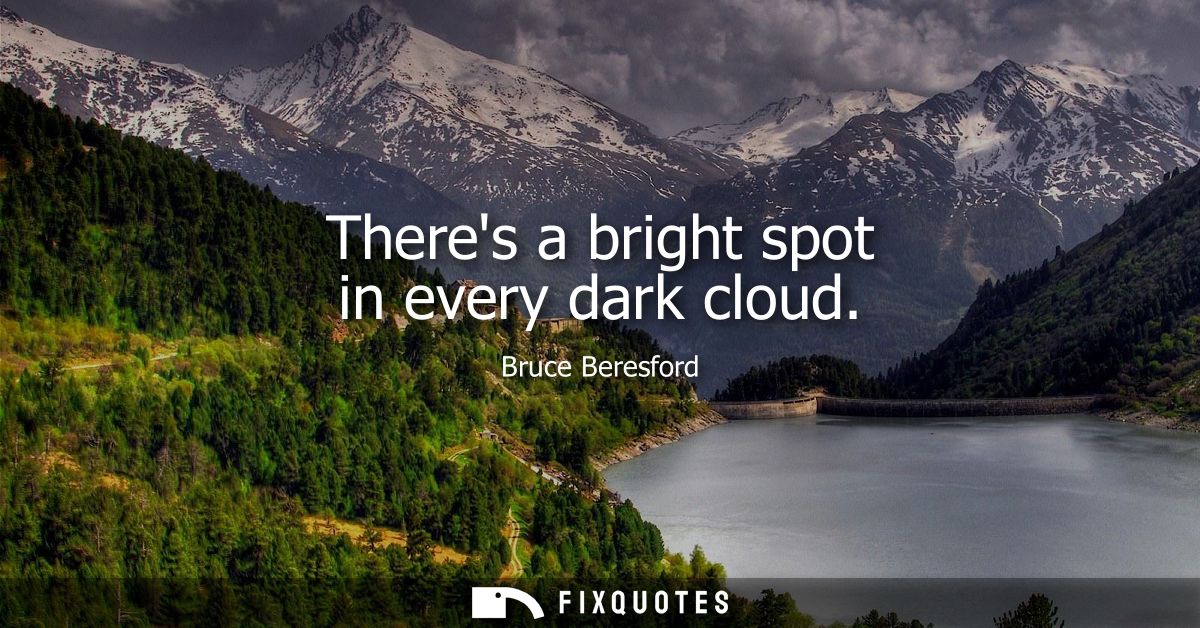
"There's a bright spot in every dark cloud"
About this Quote
Optimism is rarely as innocent as it sounds, and "There's a bright spot in every dark cloud" works because it smuggles grit inside a greeting-card shape. As a director, Bruce Beresford isn’t paid to deny darkness; he’s paid to stage it, pace it, and then locate the one element that can tilt an audience from despair into attention. The line’s power is visual before it’s philosophical: you can see it. Cloud, dark, bright spot. It’s a miniature storyboard that turns suffering into something frameable, something you can hold at arm’s length and examine for contrast.
The intent isn’t to claim catastrophe is good. It’s to insist that catastrophe is rarely total. The “bright spot” is deliberately modest - not a sunburst, not redemption, just enough light to keep the scene legible. That restraint is the subtext: hope is a craft choice, not a mood. In filmmaking terms, it’s the cutaway that prevents a tragedy from becoming monotonous, the secondary character’s humor, the small act of decency that makes the larger cruelty feel sharper - and survivable.
Contextually, Beresford’s career spans decades when cinema grew more cynical, more explicit, more commercially pressured. A director working across genres and industries learns that audiences will follow you into bleak territory if you give them one credible handle: a human motive, a sliver of irony, a survival instinct. This isn’t naïveté; it’s narrative engineering.
The intent isn’t to claim catastrophe is good. It’s to insist that catastrophe is rarely total. The “bright spot” is deliberately modest - not a sunburst, not redemption, just enough light to keep the scene legible. That restraint is the subtext: hope is a craft choice, not a mood. In filmmaking terms, it’s the cutaway that prevents a tragedy from becoming monotonous, the secondary character’s humor, the small act of decency that makes the larger cruelty feel sharper - and survivable.
Contextually, Beresford’s career spans decades when cinema grew more cynical, more explicit, more commercially pressured. A director working across genres and industries learns that audiences will follow you into bleak territory if you give them one credible handle: a human motive, a sliver of irony, a survival instinct. This isn’t naïveté; it’s narrative engineering.
Quote Details
| Topic | Optimism |
|---|---|
| Source | Help us find the source |
| Cite |
Citation Formats
APA Style (7th ed.)
Beresford, Bruce. (2026, January 17). There's a bright spot in every dark cloud. FixQuotes. https://fixquotes.com/quotes/theres-a-bright-spot-in-every-dark-cloud-39865/
Chicago Style
Beresford, Bruce. "There's a bright spot in every dark cloud." FixQuotes. January 17, 2026. https://fixquotes.com/quotes/theres-a-bright-spot-in-every-dark-cloud-39865/.
MLA Style (9th ed.)
"There's a bright spot in every dark cloud." FixQuotes, 17 Jan. 2026, https://fixquotes.com/quotes/theres-a-bright-spot-in-every-dark-cloud-39865/. Accessed 27 Mar. 2026.
More Quotes by Bruce
Add to List