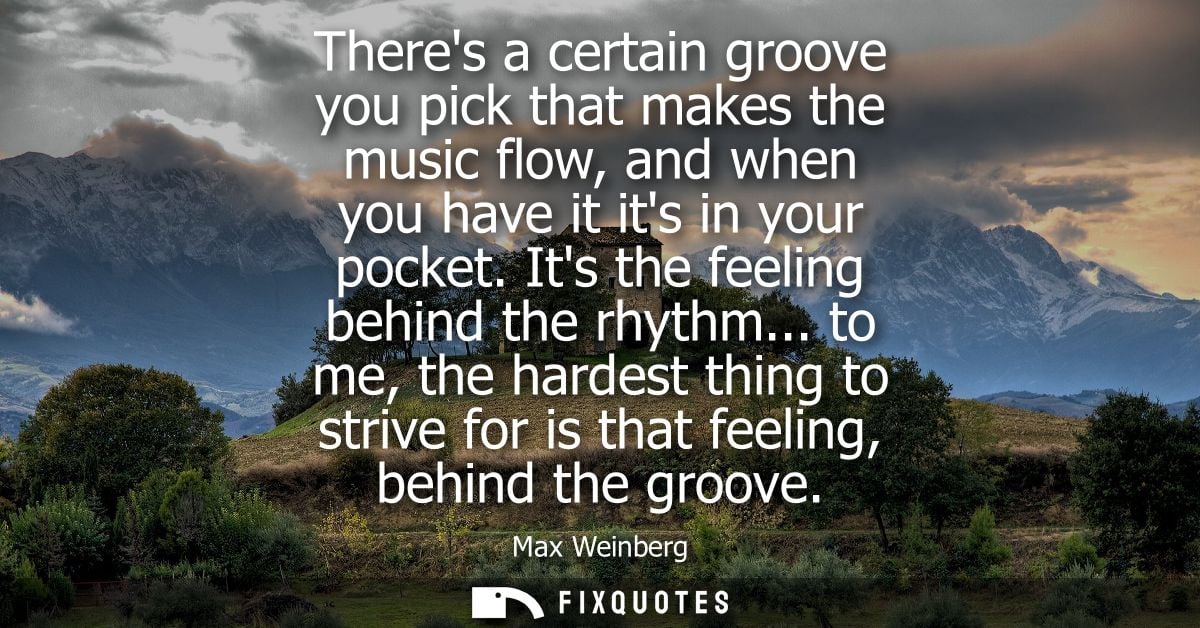
"There's a certain groove you pick that makes the music flow, and when you have it it's in your pocket. It's the feeling behind the rhythm... To me, the hardest thing to strive for is that feeling, behind the groove"
About this Quote
The key phrase is “the feeling behind the rhythm,” which quietly demotes technique from the main event to the delivery system. Weinberg is a drummer famous for stamina and precision, yet he’s insisting that the hardest part is not endurance, it’s intention. That subtext is almost moral: the job is to serve the song’s emotional weather, not your own virtuosity. A groove can be metrically correct and still feel dead; what he’s chasing is the particular human push-pull that communicates attitude: swagger, urgency, tenderness, menace.
Contextually, it tracks with Weinberg’s world - long nights of live performance where repetition is the test. When you play “Born to Run” for the thousandth time, the notes are muscle memory; the challenge is making the pulse mean something again. He frames “feeling” as a craft target, not a mystical accident: you strive for it, fail at it, then maybe, on a good night, you land it and the whole band locks in like a single organism.
Quote Details
| Topic | Music |
|---|---|
| Source | Help us find the source |
| Cite |
Citation Formats
APA Style (7th ed.)
Weinberg, Max. (2026, February 16). There's a certain groove you pick that makes the music flow, and when you have it it's in your pocket. It's the feeling behind the rhythm... To me, the hardest thing to strive for is that feeling, behind the groove. FixQuotes. https://fixquotes.com/quotes/theres-a-certain-groove-you-pick-that-makes-the-118130/
Chicago Style
Weinberg, Max. "There's a certain groove you pick that makes the music flow, and when you have it it's in your pocket. It's the feeling behind the rhythm... To me, the hardest thing to strive for is that feeling, behind the groove." FixQuotes. February 16, 2026. https://fixquotes.com/quotes/theres-a-certain-groove-you-pick-that-makes-the-118130/.
MLA Style (9th ed.)
"There's a certain groove you pick that makes the music flow, and when you have it it's in your pocket. It's the feeling behind the rhythm... To me, the hardest thing to strive for is that feeling, behind the groove." FixQuotes, 16 Feb. 2026, https://fixquotes.com/quotes/theres-a-certain-groove-you-pick-that-makes-the-118130/. Accessed 7 Apr. 2026.