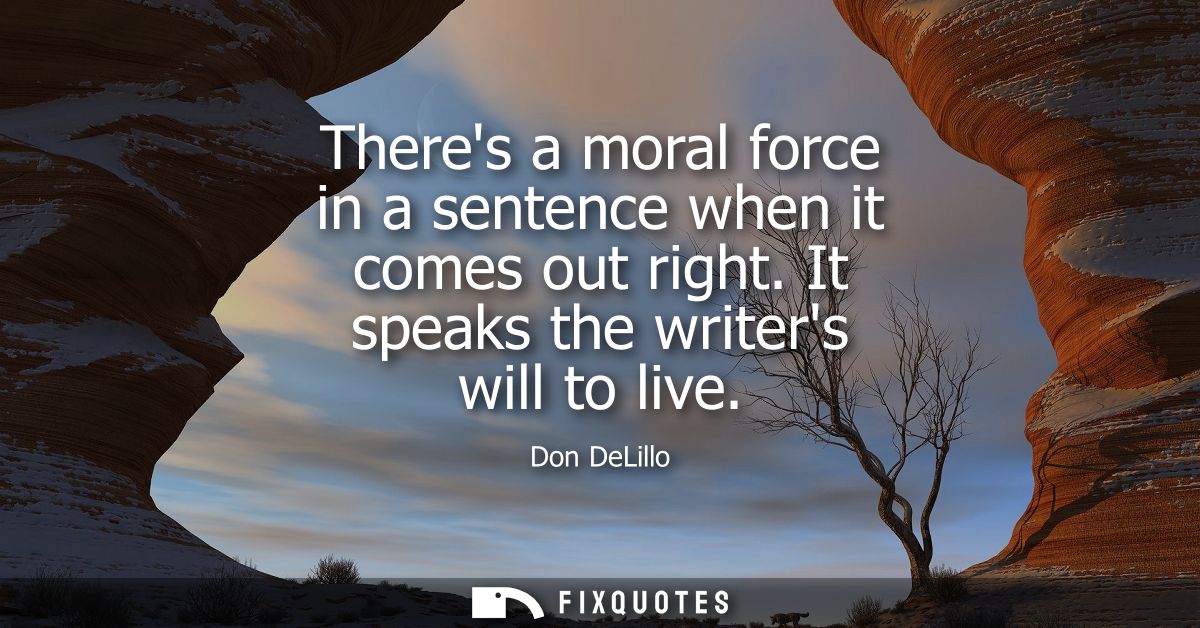
"There's a moral force in a sentence when it comes out right. It speaks the writer's will to live"
About this Quote
The subtext is a rebuke to the idea that writing is merely self-expression or entertainment. DeLillo's best work circles disaster, paranoia, and the numbing hum of American spectacle; to write a sentence that truly lands is to cut through that hum without pretending you can escape it. Moral force comes from exactness: naming what is there, refusing euphemism, refusing the softening blur of "content". A sentence that "comes out right" is an act of responsibility because it commits the writer to a version of reality that can be tested, doubted, argued with.
"It speaks the writer's will to live" turns style into survival. The stakes aren't publication or prestige; they're existential. To shape chaos into a line with rhythm and clarity is to insist that meaning can still be made, that attention is still possible, that the self hasn't been fully outsourced to the culture's static. For DeLillo, a good sentence is not a flourish. It's a pulse.
Quote Details
| Topic | Writing |
|---|---|
| Source | Help us find the source |
| Cite |
Citation Formats
APA Style (7th ed.)
DeLillo, Don. (2026, January 17). There's a moral force in a sentence when it comes out right. It speaks the writer's will to live. FixQuotes. https://fixquotes.com/quotes/theres-a-moral-force-in-a-sentence-when-it-comes-66224/
Chicago Style
DeLillo, Don. "There's a moral force in a sentence when it comes out right. It speaks the writer's will to live." FixQuotes. January 17, 2026. https://fixquotes.com/quotes/theres-a-moral-force-in-a-sentence-when-it-comes-66224/.
MLA Style (9th ed.)
"There's a moral force in a sentence when it comes out right. It speaks the writer's will to live." FixQuotes, 17 Jan. 2026, https://fixquotes.com/quotes/theres-a-moral-force-in-a-sentence-when-it-comes-66224/. Accessed 6 Mar. 2026.