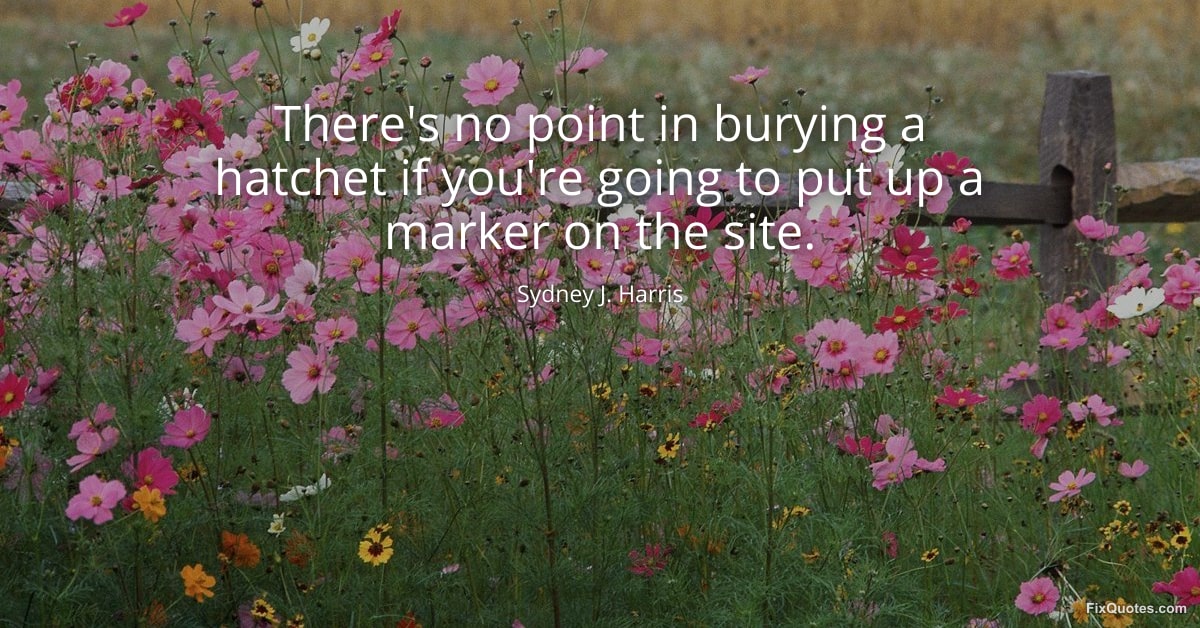
"There's no point in burying a hatchet if you're going to put up a marker on the site"
About this Quote
Harris was a mid-century American newspaper columnist, writing in an era that prized civic harmony on the surface and nursed plenty of private grudges underneath - Cold War anxieties, culture-war skirmishes, domestic tensions smoothed over with etiquette. In that climate, the pressure to “be reasonable” often meant performing reconciliation while quietly stockpiling resentments. The line skewers that performance. It’s not anti-forgiveness; it’s anti-theatrical forgiveness, the kind that keeps the other person permanently on probation.
The subtext is about power. A marker doesn’t just remember; it warns. It tells the offender: I may have stopped swinging, but I reserve the right to point to the spot where you made me bleed. Harris understands how people weaponize memory as identity - the grievance becomes proof of virtue, the scar becomes status. His sentence is short, plain, and devastatingly visual, which is why it reads like a proverb: if you need the monument, you’re not seeking peace, you’re curating a grievance.
Quote Details
| Topic | Forgiveness |
|---|---|
| Source | Help us find the source |
| Cite |
Citation Formats
APA Style (7th ed.)
Harris, Sydney J. (2026, January 15). There's no point in burying a hatchet if you're going to put up a marker on the site. FixQuotes. https://fixquotes.com/quotes/theres-no-point-in-burying-a-hatchet-if-youre-173050/
Chicago Style
Harris, Sydney J. "There's no point in burying a hatchet if you're going to put up a marker on the site." FixQuotes. January 15, 2026. https://fixquotes.com/quotes/theres-no-point-in-burying-a-hatchet-if-youre-173050/.
MLA Style (9th ed.)
"There's no point in burying a hatchet if you're going to put up a marker on the site." FixQuotes, 15 Jan. 2026, https://fixquotes.com/quotes/theres-no-point-in-burying-a-hatchet-if-youre-173050/. Accessed 28 Feb. 2026.