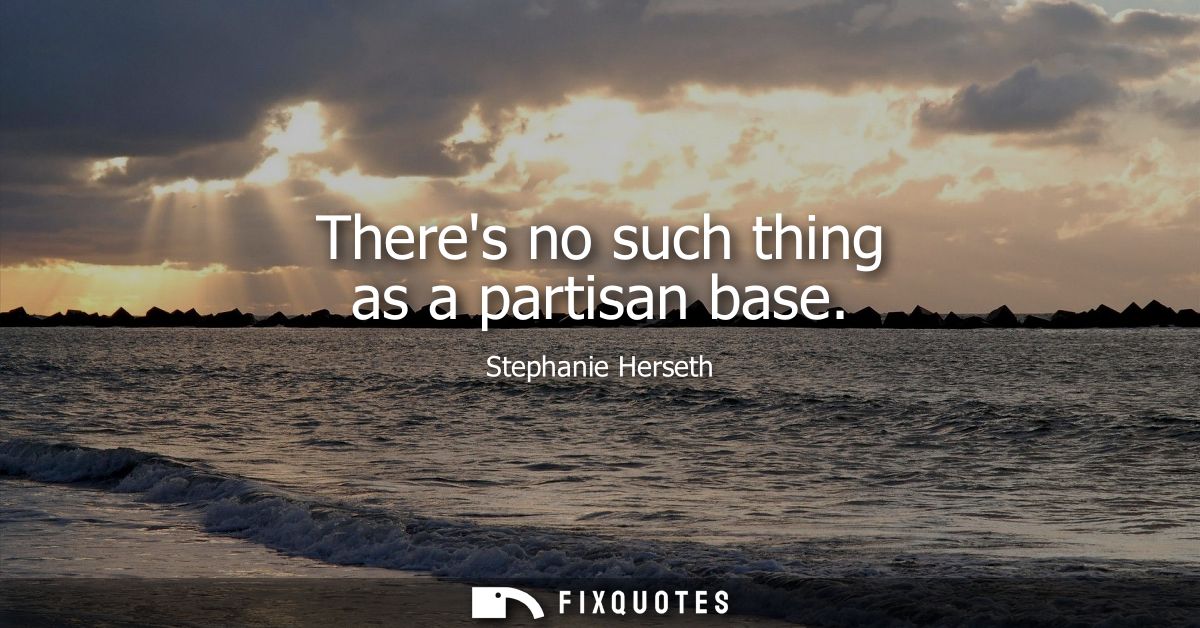
"There's no such thing as a partisan base"
About this Quote
"There's no such thing as a partisan base" is the kind of line a working politician uses to pry open a locked room. On its face, it rejects the now-standard political story that parties are powered by immovable blocs with fixed demands. The intent is practical: to give herself permission to talk past the loudest activists and toward persuadable voters, without sounding disloyal. It’s a permission slip for triangulation framed as common sense.
The subtext is sharper. Calling the "base" a myth isn’t neutral; it’s a rebuke to the modern incentives that elevate ideologues, donors, and primary electorates over the broader electorate. Herseth, a Democrat from a conservative-leaning state, came up in an era when survival depended on coalition politics: rural moderates, labor, business, churchgoing Democrats, and independents who didn’t experience politics as a permanent identity. For someone in that lane, "the base" is less a community than a trap - a set of expectations defined elsewhere, usually by national media narratives and party infrastructure.
Context matters: this is a statement that only makes sense as both strategy and self-defense. It signals independence from party branding while still claiming legitimacy within it. It also quietly reframes representation: not as servicing a faction, but as assembling temporary majorities around issues. The line works because it demotes partisan identity from destiny to marketing - and reminds voters that most of them don’t actually live inside the party’s most intense self-image.
The subtext is sharper. Calling the "base" a myth isn’t neutral; it’s a rebuke to the modern incentives that elevate ideologues, donors, and primary electorates over the broader electorate. Herseth, a Democrat from a conservative-leaning state, came up in an era when survival depended on coalition politics: rural moderates, labor, business, churchgoing Democrats, and independents who didn’t experience politics as a permanent identity. For someone in that lane, "the base" is less a community than a trap - a set of expectations defined elsewhere, usually by national media narratives and party infrastructure.
Context matters: this is a statement that only makes sense as both strategy and self-defense. It signals independence from party branding while still claiming legitimacy within it. It also quietly reframes representation: not as servicing a faction, but as assembling temporary majorities around issues. The line works because it demotes partisan identity from destiny to marketing - and reminds voters that most of them don’t actually live inside the party’s most intense self-image.
Quote Details
| Topic | Justice |
|---|---|
| Source | Help us find the source |
| Cite |
Citation Formats
APA Style (7th ed.)
Herseth, Stephanie. (2026, January 16). There's no such thing as a partisan base. FixQuotes. https://fixquotes.com/quotes/theres-no-such-thing-as-a-partisan-base-109916/
Chicago Style
Herseth, Stephanie. "There's no such thing as a partisan base." FixQuotes. January 16, 2026. https://fixquotes.com/quotes/theres-no-such-thing-as-a-partisan-base-109916/.
MLA Style (9th ed.)
"There's no such thing as a partisan base." FixQuotes, 16 Jan. 2026, https://fixquotes.com/quotes/theres-no-such-thing-as-a-partisan-base-109916/. Accessed 6 Mar. 2026.
More Quotes by Stephanie
Add to List