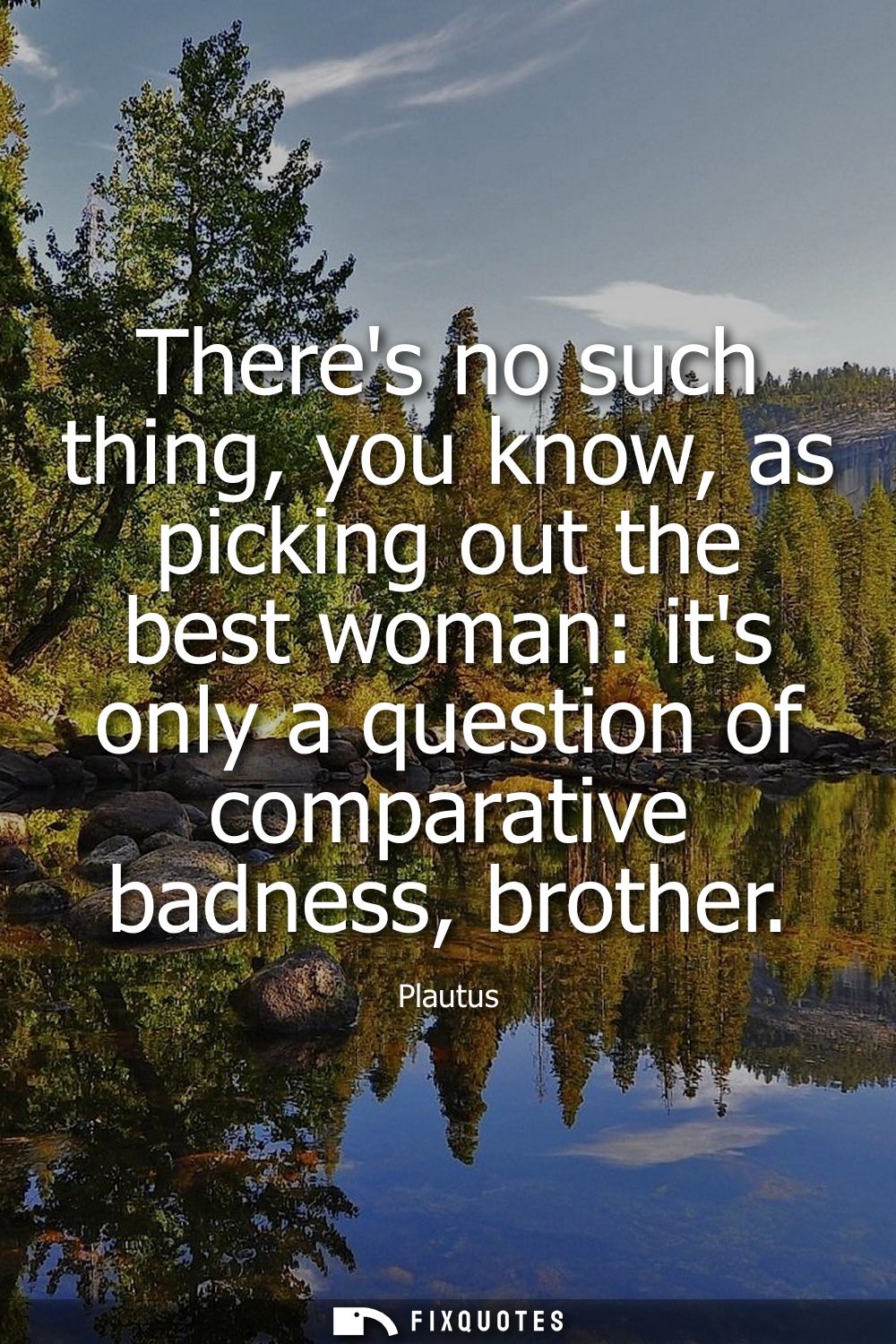
"There's no such thing, you know, as picking out the best woman: it's only a question of comparative badness, brother"
About this Quote
Plautus lands the punch with the casual intimacy of "you know" and "brother", as if this were timeless street wisdom passed over wine, not a line engineered for laughs. The joke is a bait-and-switch: the audience expects romantic discernment, the fantasy of "the best woman", and instead gets a marketplace metaphor of defects. Love becomes procurement. Choice becomes triage. The comedy isn’t just in the insult; it’s in the deflation of a noble ideal into a grim little algorithm: not excellence, just comparative badness.
That phrasing matters. "Picking out" sounds like shopping, and it quietly frames women as selectable goods while also mocking the male chooser who imagines he’s doing something elevated. Plautus loves this double exposure: the misogyny plays to a crowd trained to chuckle at women’s supposed unreliability, but the line also undercuts male vanity. The man who thinks he’s choosing wisely is really bargaining with disappointment. "Brother" invites complicity, recruiting the listener into a locker-room realism that flatters him as worldly even as it reduces his emotional life to cynicism.
Contextually, Plautine comedy borrows from Greek New Comedy and thrives on domestic battles, sex-as-economics, and the constant anxiety around marriage, dowries, and control of the household. The line works because it sounds like hard-earned truth while functioning as a pressure valve: it lets an audience laugh at the instability of desire and the risks of commitment in a society where marriage is as much transaction as romance.
That phrasing matters. "Picking out" sounds like shopping, and it quietly frames women as selectable goods while also mocking the male chooser who imagines he’s doing something elevated. Plautus loves this double exposure: the misogyny plays to a crowd trained to chuckle at women’s supposed unreliability, but the line also undercuts male vanity. The man who thinks he’s choosing wisely is really bargaining with disappointment. "Brother" invites complicity, recruiting the listener into a locker-room realism that flatters him as worldly even as it reduces his emotional life to cynicism.
Contextually, Plautine comedy borrows from Greek New Comedy and thrives on domestic battles, sex-as-economics, and the constant anxiety around marriage, dowries, and control of the household. The line works because it sounds like hard-earned truth while functioning as a pressure valve: it lets an audience laugh at the instability of desire and the risks of commitment in a society where marriage is as much transaction as romance.
Quote Details
| Topic | Witty One-Liners |
|---|---|
| Source | Help us find the source |
More Quotes by Plautus
Add to List