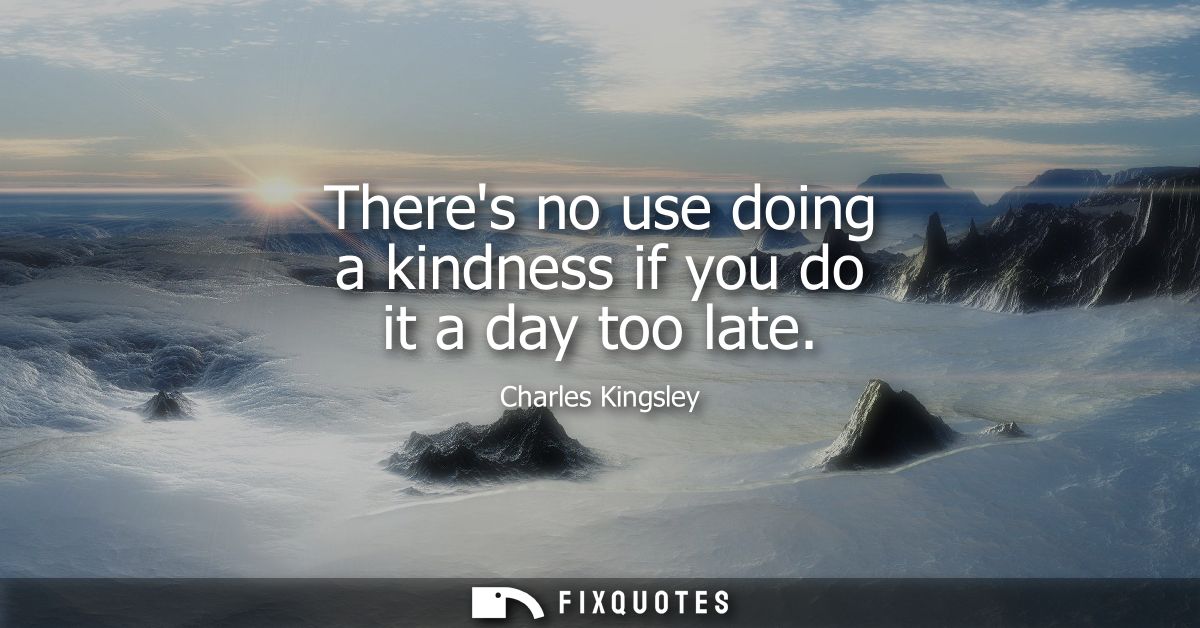
"There's no use doing a kindness if you do it a day too late"
About this Quote
Kindness, Kingsley reminds us, is not a halo you can polish at your leisure; it is a deadline. The line has the blunt moral force of a clergyman who spent his career watching good intentions arrive after the damage was done. It’s less a plea for generosity than an indictment of procrastinated virtue: the help that shows up when the crisis has passed is often just the giver’s need to feel decent, dressed up as charity.
The sentence works because it collapses sentiment into logistics. “No use” is deliberately utilitarian, almost anti-romantic, implying that moral acts are measured by consequence, not warmth. “A day too late” is deceptively domestic, the smallest imaginable delay, which sharpens the sting: if one day can nullify a kindness, then how many of our “good deeds” are really just tardy self-exoneration? Kingsley is also smuggling in a theology of presence. A kindness is not only what you do; it’s when you stand beside someone before loneliness calcifies into resignation.
Contextually, this fits a Victorian Anglican reformer attuned to industrial-era suffering, when need was immediate and systems were slow. The line reads like a rebuke to polite philanthropy that preferred committees to confrontation. It also anticipates a modern critique of performative care: condolences after the fact, donations after the headline fades, apologies when the relationship is already over. Kingsley’s point isn’t that kindness is fragile; it’s that timing is part of its truth.
The sentence works because it collapses sentiment into logistics. “No use” is deliberately utilitarian, almost anti-romantic, implying that moral acts are measured by consequence, not warmth. “A day too late” is deceptively domestic, the smallest imaginable delay, which sharpens the sting: if one day can nullify a kindness, then how many of our “good deeds” are really just tardy self-exoneration? Kingsley is also smuggling in a theology of presence. A kindness is not only what you do; it’s when you stand beside someone before loneliness calcifies into resignation.
Contextually, this fits a Victorian Anglican reformer attuned to industrial-era suffering, when need was immediate and systems were slow. The line reads like a rebuke to polite philanthropy that preferred committees to confrontation. It also anticipates a modern critique of performative care: condolences after the fact, donations after the headline fades, apologies when the relationship is already over. Kingsley’s point isn’t that kindness is fragile; it’s that timing is part of its truth.
Quote Details
| Topic | Kindness |
|---|---|
| Source | Charles Kingsley — attributed to The Water-Babies (novel); commonly cited source of the line "There's no use in doing a kindness if you do it a day too late." |
| Cite |
Citation Formats
APA Style (7th ed.)
Kingsley, Charles. (2026, January 15). There's no use doing a kindness if you do it a day too late. FixQuotes. https://fixquotes.com/quotes/theres-no-use-doing-a-kindness-if-you-do-it-a-day-139944/
Chicago Style
Kingsley, Charles. "There's no use doing a kindness if you do it a day too late." FixQuotes. January 15, 2026. https://fixquotes.com/quotes/theres-no-use-doing-a-kindness-if-you-do-it-a-day-139944/.
MLA Style (9th ed.)
"There's no use doing a kindness if you do it a day too late." FixQuotes, 15 Jan. 2026, https://fixquotes.com/quotes/theres-no-use-doing-a-kindness-if-you-do-it-a-day-139944/. Accessed 15 Mar. 2026.
More Quotes by Charles
Add to List