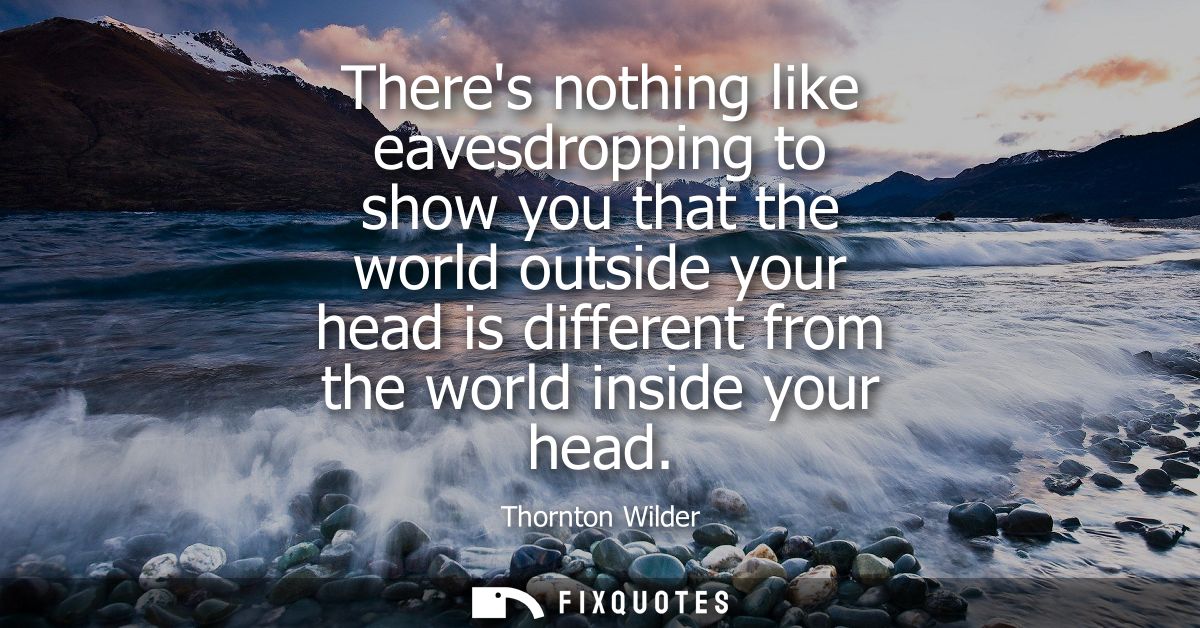
"There's nothing like eavesdropping to show you that the world outside your head is different from the world inside your head"
About this Quote
Wilder's intent isn't to endorse snooping so much as to name the everyday mechanism by which our fantasies of other people get punctured. We assume coherence and motive; we imagine conversations as versions of our own. Then we catch a fragment of talk on a train or through a thin apartment wall and realize how little of life is designed to make sense to us. The subtext is that empathy often begins in an awkward place: not in virtuous identification, but in the sudden recognition that other minds are not extensions of your own.
Context matters. Wilder, a playwright and novelist steeped in the theater of ordinary lives (Our Town, The Bridge of San Luis Rey), was obsessed with the gap between what people feel and what they can articulate. Eavesdropping is theatrical: you're in the audience, unseen, watching dialogue without stage directions. The quote flatters modern readers, too, in an age of podcasts, open-plan offices, and public oversharing: we're surrounded by other people's monologues, and still trapped in our own. Wilder's point is bracingly simple: reality doesn't consult your inner script.
Quote Details
| Topic | Wisdom |
|---|---|
| Source | Help us find the source |
| Cite |
Citation Formats
APA Style (7th ed.)
Wilder, Thornton. (2026, January 16). There's nothing like eavesdropping to show you that the world outside your head is different from the world inside your head. FixQuotes. https://fixquotes.com/quotes/theres-nothing-like-eavesdropping-to-show-you-137963/
Chicago Style
Wilder, Thornton. "There's nothing like eavesdropping to show you that the world outside your head is different from the world inside your head." FixQuotes. January 16, 2026. https://fixquotes.com/quotes/theres-nothing-like-eavesdropping-to-show-you-137963/.
MLA Style (9th ed.)
"There's nothing like eavesdropping to show you that the world outside your head is different from the world inside your head." FixQuotes, 16 Jan. 2026, https://fixquotes.com/quotes/theres-nothing-like-eavesdropping-to-show-you-137963/. Accessed 27 Mar. 2026.