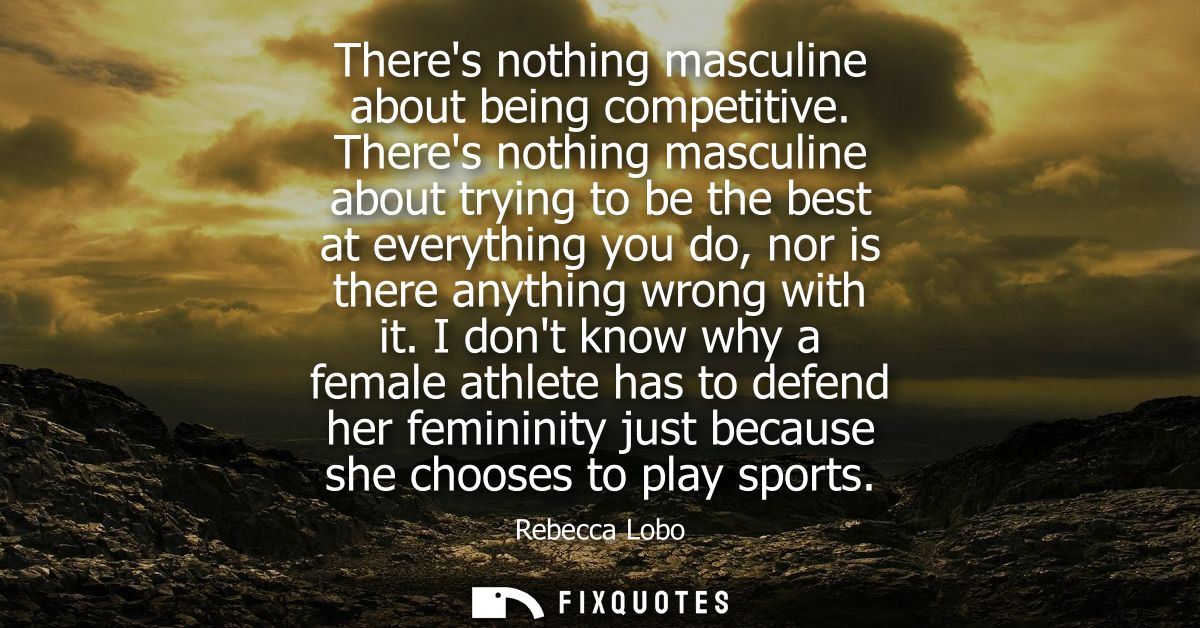
"There's nothing masculine about being competitive. There's nothing masculine about trying to be the best at everything you do, nor is there anything wrong with it. I don't know why a female athlete has to defend her femininity just because she chooses to play sports"
About this Quote
The key move is her double negative: "There's nothing masculine about... nor is there anything wrong with it". She is separating the behavior from the stigma without softening the ambition. That matters because female athletes are routinely forced into an exhausting two-sport event: performance on the court and performance of acceptable womanhood off it. Lobo names the absurdity in the last line, where "defend her femininity" captures a real, recurring demand - media questions, sponsor expectations, fan commentary - that treats women's bodies and presentation as part of the scoreboard.
Context does the rest. Lobo came up in an era when women's basketball was gaining mainstream visibility but still framed through anxieties about gender roles: the WNBA's early marketing leaned hard on "family-friendly" reassurance, and women in sports were often coded as suspiciously unfeminine unless they signaled otherwise. Her intent isn't just personal validation; it's a call to stop using femininity as a parole hearing. Let athletes be competitive because sport is competition - not a referendum on whether their ambition makes them "too much" of anything.
Quote Details
| Topic | Equality |
|---|---|
| Source | Verified source: The Home Team: Of Mothers, Daughters, and American Champions (Rebecca Lobo, 1996)ISBN: 9781568361406
Evidence: There's nothing masculine about being competitive. There's nothing masculine about trying to be the best at everything you do, nor is there anything wrong with it. I don't know why a female athlete has to defend her femininity just because she chooses to play sports.. The earliest PRIMARY-source attribution I could verify online points to Lobo's 1996 memoir/co-autobiography with her mother, "The Home Team: Of Mothers, Daughters, and American Champions" (Kodansha). Encyclopedia.com reproduces the line and explicitly says, “As she later wrote in The Home Team,” immediately before the quote, identifying the book as the originating source. I was not able to locate a searchable scan/preview of the book pages that contains this passage, so I cannot provide the exact page number or chapter from the printed edition from the web evidence gathered here. (The book’s bibliographic details, including ISBN-13 9781568361406 and publication timing in 1996, are corroborated by Publishers Weekly’s listing.) Other candidates (1) 50 Trailblazers of the 50 States (Howard Megdal, 2024) compilation86.7% ... There's nothing masculine about being competitive . There's nothing masculine about trying to be the best at ever... |
| Cite |
Citation Formats
APA Style (7th ed.)
Lobo, Rebecca. (2026, February 10). There's nothing masculine about being competitive. There's nothing masculine about trying to be the best at everything you do, nor is there anything wrong with it. I don't know why a female athlete has to defend her femininity just because she chooses to play sports. FixQuotes. https://fixquotes.com/quotes/theres-nothing-masculine-about-being-competitive-79460/
Chicago Style
Lobo, Rebecca. "There's nothing masculine about being competitive. There's nothing masculine about trying to be the best at everything you do, nor is there anything wrong with it. I don't know why a female athlete has to defend her femininity just because she chooses to play sports." FixQuotes. February 10, 2026. https://fixquotes.com/quotes/theres-nothing-masculine-about-being-competitive-79460/.
MLA Style (9th ed.)
"There's nothing masculine about being competitive. There's nothing masculine about trying to be the best at everything you do, nor is there anything wrong with it. I don't know why a female athlete has to defend her femininity just because she chooses to play sports." FixQuotes, 10 Feb. 2026, https://fixquotes.com/quotes/theres-nothing-masculine-about-being-competitive-79460/. Accessed 28 Mar. 2026.