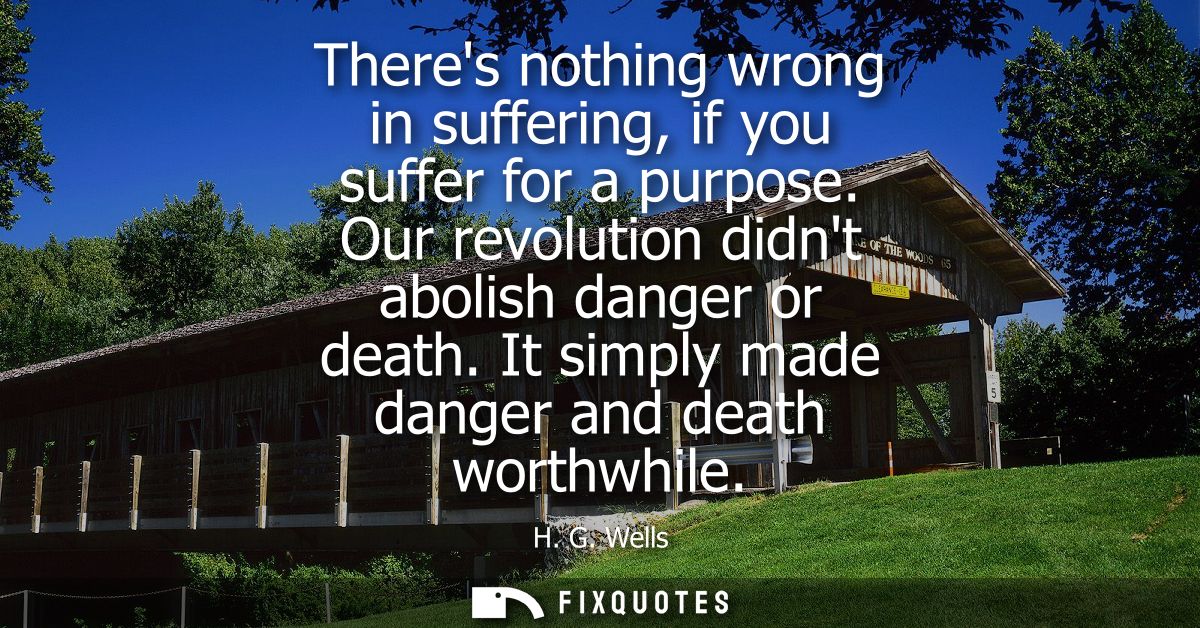
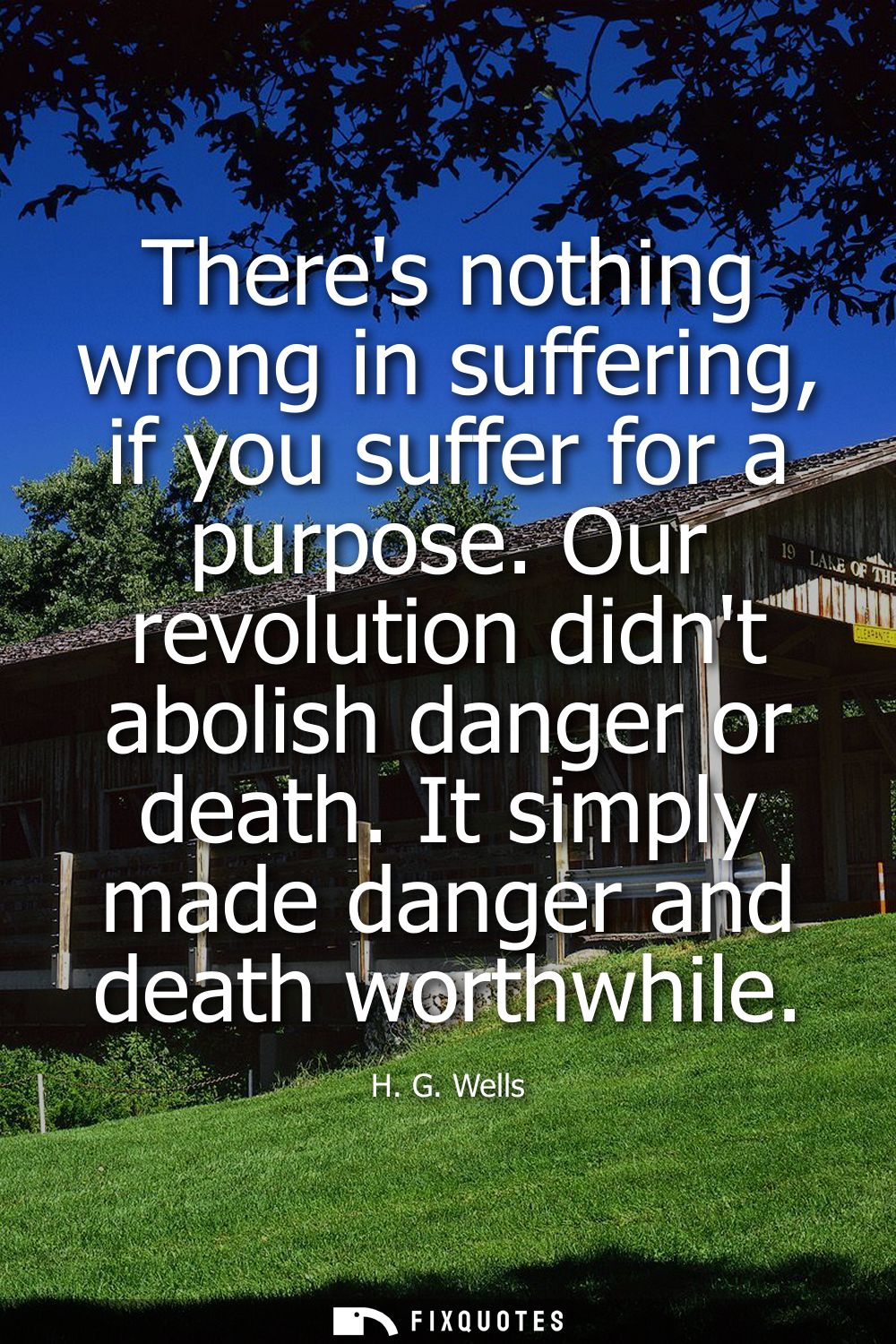
"There's nothing wrong in suffering, if you suffer for a purpose. Our revolution didn't abolish danger or death. It Simply made danger and death worthwhile"
About this Quote
The first sentence is a trapdoor. “There’s nothing wrong” sounds almost pastoral, then the clause “if you suffer for a purpose” snaps it into a conditional ethic. Pain isn’t sanctified; it’s audited. Wells is interested in the psychology that keeps people moving when history turns brutal: a story big enough to metabolize fear, hunger, and loss. That’s the subtext - the human appetite for justification, and the political uses of that appetite.
Then comes the sharper turn: “Our revolution didn’t abolish danger or death.” Wells punctures utopian expectations in one line, pre-empting the common post-revolution disappointment that the new world still bleeds like the old one. The final sentence is doing the real work. “Simply made danger and death worthwhile” is both rallying cry and warning label. Worthwhile to whom? By what measure? Wells understands how quickly “purpose” can become a moral solvent that dissolves individual lives into an abstract future.
Context matters: writing in the age of mass politics, industrial war, and grand ideologies, Wells is diagnosing the modern condition. Progress is not safety; it’s a narrative that persuades people to walk into danger with their eyes open.
Quote Details
| Topic | Freedom |
|---|---|
| Source | Help us find the source |
| Cite |
Citation Formats
APA Style (7th ed.)
Wells, H.G. (2026, February 20). There's nothing wrong in suffering, if you suffer for a purpose. Our revolution didn't abolish danger or death. It Simply made danger and death worthwhile. FixQuotes. https://fixquotes.com/quotes/theres-nothing-wrong-in-suffering-if-you-suffer-12844/
Chicago Style
Wells, H.G. "There's nothing wrong in suffering, if you suffer for a purpose. Our revolution didn't abolish danger or death. It Simply made danger and death worthwhile." FixQuotes. February 20, 2026. https://fixquotes.com/quotes/theres-nothing-wrong-in-suffering-if-you-suffer-12844/.
MLA Style (9th ed.)
"There's nothing wrong in suffering, if you suffer for a purpose. Our revolution didn't abolish danger or death. It Simply made danger and death worthwhile." FixQuotes, 20 Feb. 2026, https://fixquotes.com/quotes/theres-nothing-wrong-in-suffering-if-you-suffer-12844/. Accessed 27 Mar. 2026.