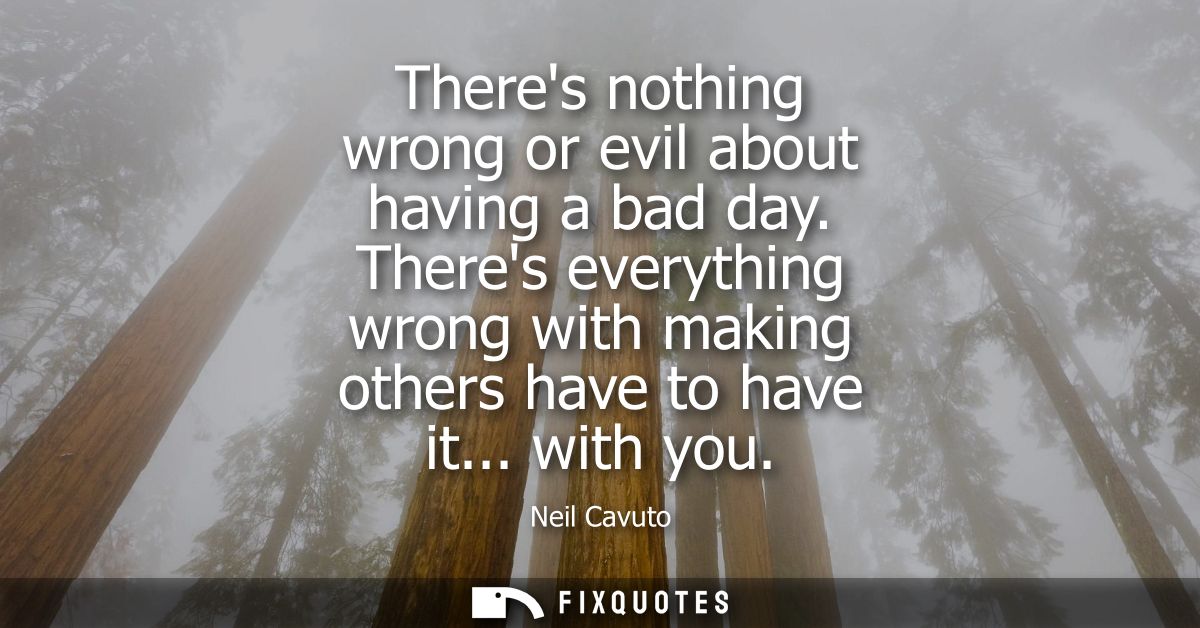
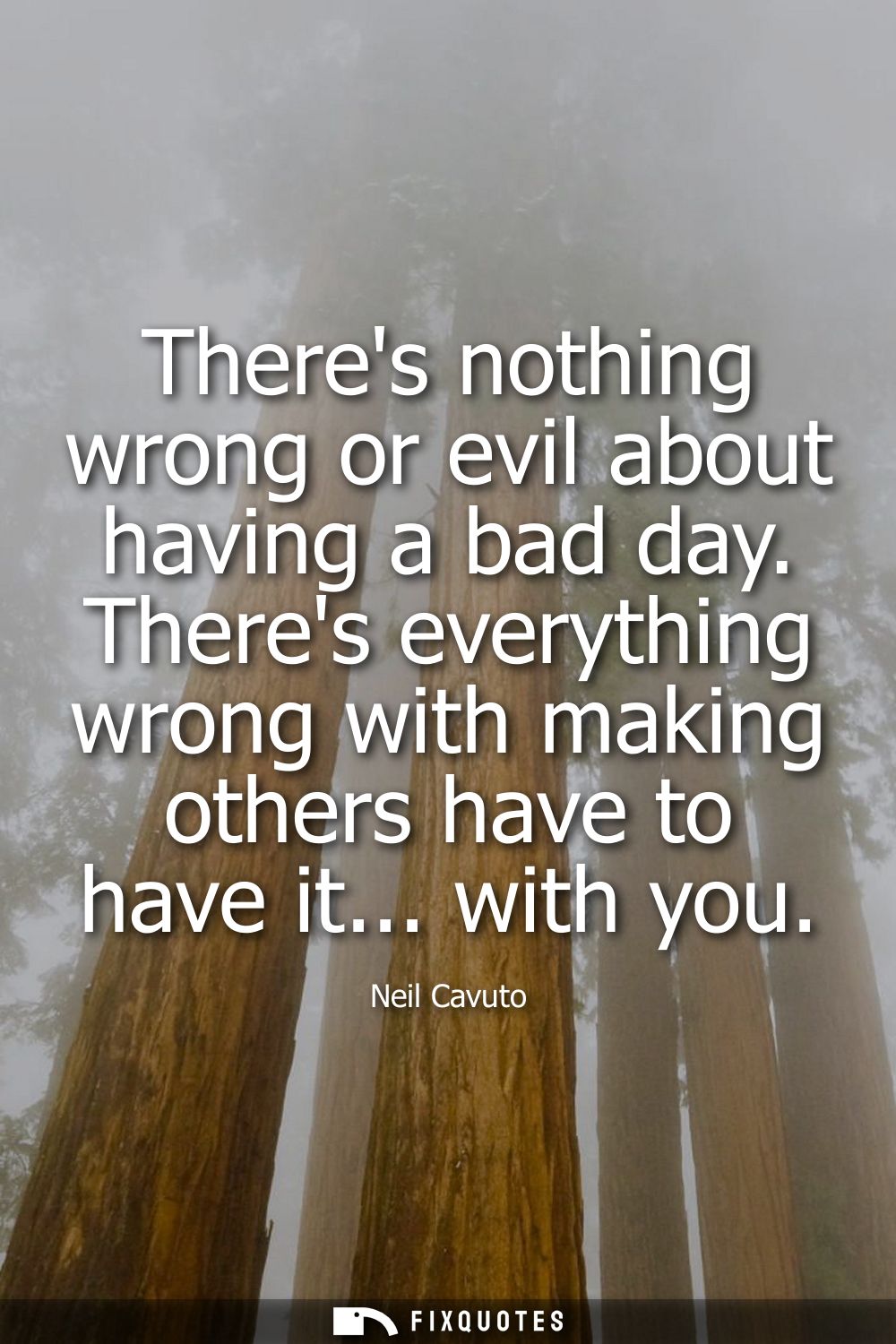
"There's nothing wrong or evil about having a bad day. There's everything wrong with making others have to have it... with you"
About this Quote
The small hinge word "with" does most of the work. It’s not just "making others have it", which would imply overt cruelty; it’s "have it... with you", the social coercion of insisting your mood set the room’s weather. That’s a workplace truth, a family truth, and a media truth: anger and anxiety travel fastest when someone demands an audience. Cavuto’s ellipsis signals the pause where self-awareness should appear, a beat of restraint. Instead of granting catharsis, he frames emotional spillover as a choice and, therefore, a responsibility.
Subtextually, it reads like a rebuke of grievance-as-identity. In contemporary culture, bad days are easily monetized or weaponized: the rant, the vague-post, the customer-service meltdown, the segment built to keep viewers mad. Cavuto’s intent is almost corrective: feel what you feel, but don’t conscript others into it. The ethic here isn’t stoicism; it’s containment. Compassion for the self, boundaries for everyone else.
Quote Details
| Topic | Kindness |
|---|---|
| Source | Help us find the source |
| Cite |
Citation Formats
APA Style (7th ed.)
Cavuto, Neil. (2026, January 16). There's nothing wrong or evil about having a bad day. There's everything wrong with making others have to have it... with you. FixQuotes. https://fixquotes.com/quotes/theres-nothing-wrong-or-evil-about-having-a-bad-89382/
Chicago Style
Cavuto, Neil. "There's nothing wrong or evil about having a bad day. There's everything wrong with making others have to have it... with you." FixQuotes. January 16, 2026. https://fixquotes.com/quotes/theres-nothing-wrong-or-evil-about-having-a-bad-89382/.
MLA Style (9th ed.)
"There's nothing wrong or evil about having a bad day. There's everything wrong with making others have to have it... with you." FixQuotes, 16 Jan. 2026, https://fixquotes.com/quotes/theres-nothing-wrong-or-evil-about-having-a-bad-89382/. Accessed 12 Feb. 2026.