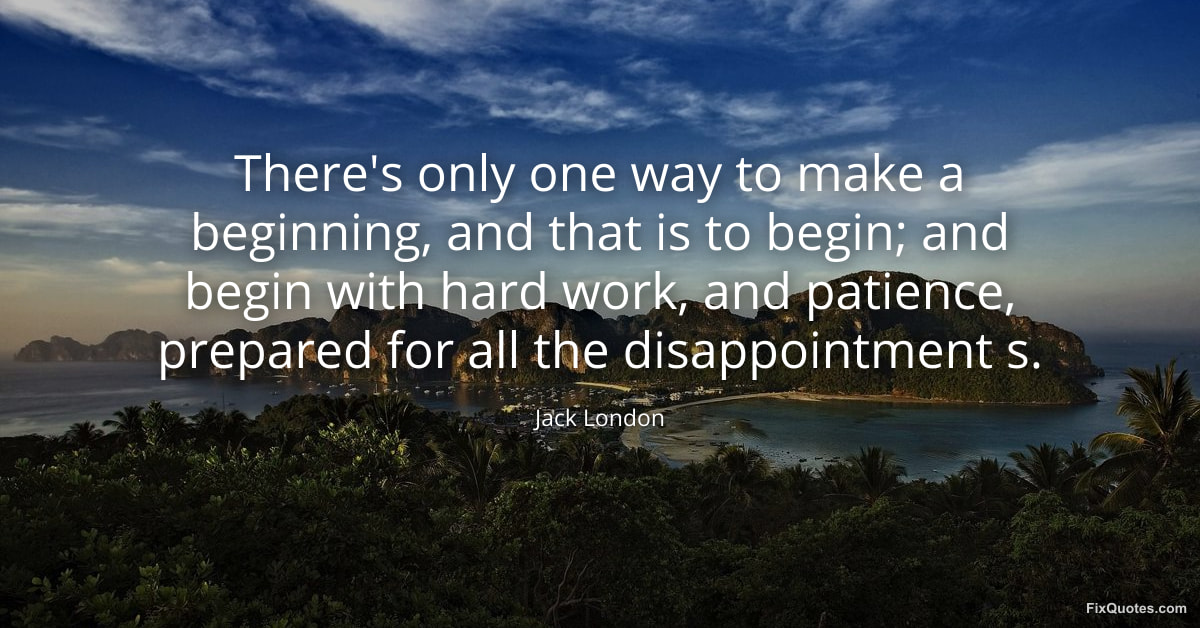
"There's only one way to make a beginning, and that is to begin; and begin with hard work, and patience, prepared for all the disappointment s"
About this Quote
The subtext is practical bordering on grim: if you’re waiting to feel ready, you’re already losing. London’s own career was built on that hard-earned suspicion of ease. He came out of poverty, worked brutal jobs, and wrote with the urgency of someone who understood that art can be a kind of survival labor. That history hums beneath “hard work” and “patience,” words that, in his mouth, aren’t self-help slogans but an admission price. The clause “prepared for all the disappointments” is the tell. He isn’t promising a payoff; he’s normalizing setback as the default climate of making anything worth making.
It works because it collapses motivation into a simple contract: start, then endure. London frames disappointment not as a sign to stop but as evidence you’re actually in the arena. The intent isn’t to comfort; it’s to steel the reader against the seductions of procrastination and the ego’s favorite defense mechanism: quitting before reality can grade your effort.
Quote Details
| Topic | New Beginnings |
|---|---|
| Source | Help us find the source |
| Cite |
Citation Formats
APA Style (7th ed.)
London, Jack. (2026, January 15). There's only one way to make a beginning, and that is to begin; and begin with hard work, and patience, prepared for all the disappointment s. FixQuotes. https://fixquotes.com/quotes/theres-only-one-way-to-make-a-beginning-and-that-173097/
Chicago Style
London, Jack. "There's only one way to make a beginning, and that is to begin; and begin with hard work, and patience, prepared for all the disappointment s." FixQuotes. January 15, 2026. https://fixquotes.com/quotes/theres-only-one-way-to-make-a-beginning-and-that-173097/.
MLA Style (9th ed.)
"There's only one way to make a beginning, and that is to begin; and begin with hard work, and patience, prepared for all the disappointment s." FixQuotes, 15 Jan. 2026, https://fixquotes.com/quotes/theres-only-one-way-to-make-a-beginning-and-that-173097/. Accessed 2 Apr. 2026.