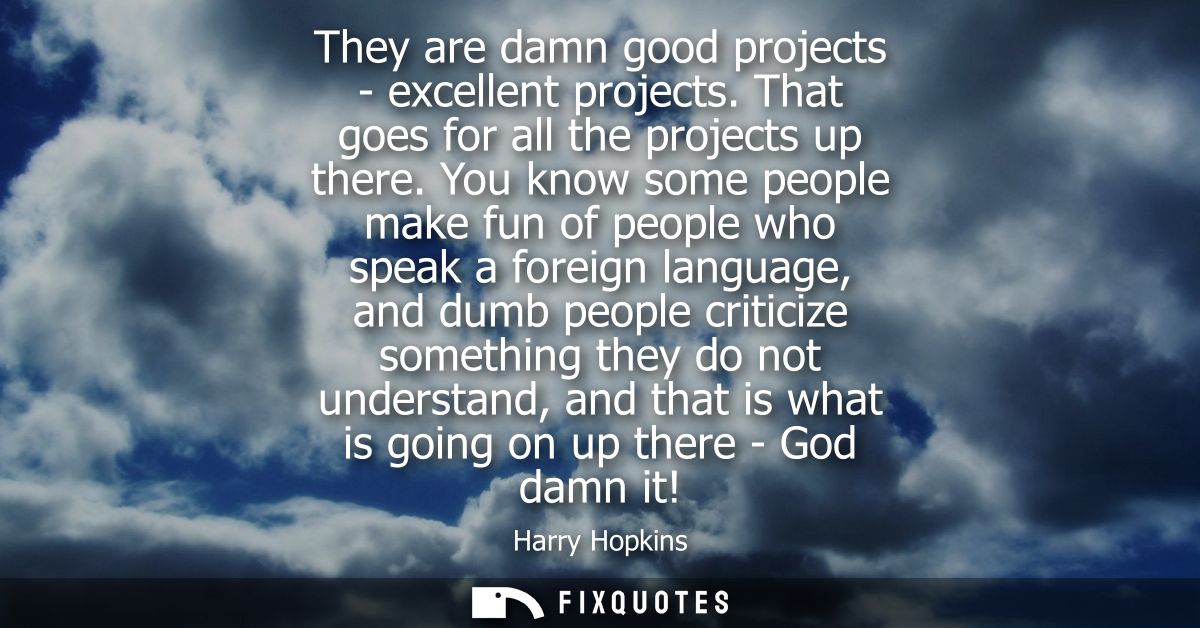
"They are damn good projects - excellent projects. That goes for all the projects up there. You know some people make fun of people who speak a foreign language, and dumb people criticize something they do not understand, and that is what is going on up there - God damn it!"
About this Quote
The subtext is pure New Deal trench warfare. Hopkins, FDR's hard-driving relief administrator turned wartime fixer, spent years facing accusations that federal programs were wasteful, alien, even un-American. Calling the critics "dumb people" isn't elegant, but it is strategic. He collapses opposition into a moral category - ignorance - rather than granting it technical standing. If you don't understand the language, you don't get to grade the poem.
"You know" and "up there" suggest an off-the-cuff defense, likely aimed at people at a distance from the work: legislators, editorialists, comfortable taxpayers. Hopkins isn't presenting data; he's policing the frame. The outburst "God damn it!" is the tell. It signals stakes beyond a budget line: a belief that mockery is a weapon used to keep ambitious public action illegible. In a moment when government was trying to invent new vocabulary for survival, Hopkins is insisting the translation effort is worth defending - and that contempt is the laziest form of critique.
Quote Details
| Topic | Respect |
|---|---|
| Source | Help us find the source |
| Cite |
Citation Formats
APA Style (7th ed.)
Hopkins, Harry. (2026, January 18). They are damn good projects - excellent projects. That goes for all the projects up there. You know some people make fun of people who speak a foreign language, and dumb people criticize something they do not understand, and that is what is going on up there - God damn it! FixQuotes. https://fixquotes.com/quotes/they-are-damn-good-projects-excellent-projects-12260/
Chicago Style
Hopkins, Harry. "They are damn good projects - excellent projects. That goes for all the projects up there. You know some people make fun of people who speak a foreign language, and dumb people criticize something they do not understand, and that is what is going on up there - God damn it!" FixQuotes. January 18, 2026. https://fixquotes.com/quotes/they-are-damn-good-projects-excellent-projects-12260/.
MLA Style (9th ed.)
"They are damn good projects - excellent projects. That goes for all the projects up there. You know some people make fun of people who speak a foreign language, and dumb people criticize something they do not understand, and that is what is going on up there - God damn it!" FixQuotes, 18 Jan. 2026, https://fixquotes.com/quotes/they-are-damn-good-projects-excellent-projects-12260/. Accessed 28 Mar. 2026.