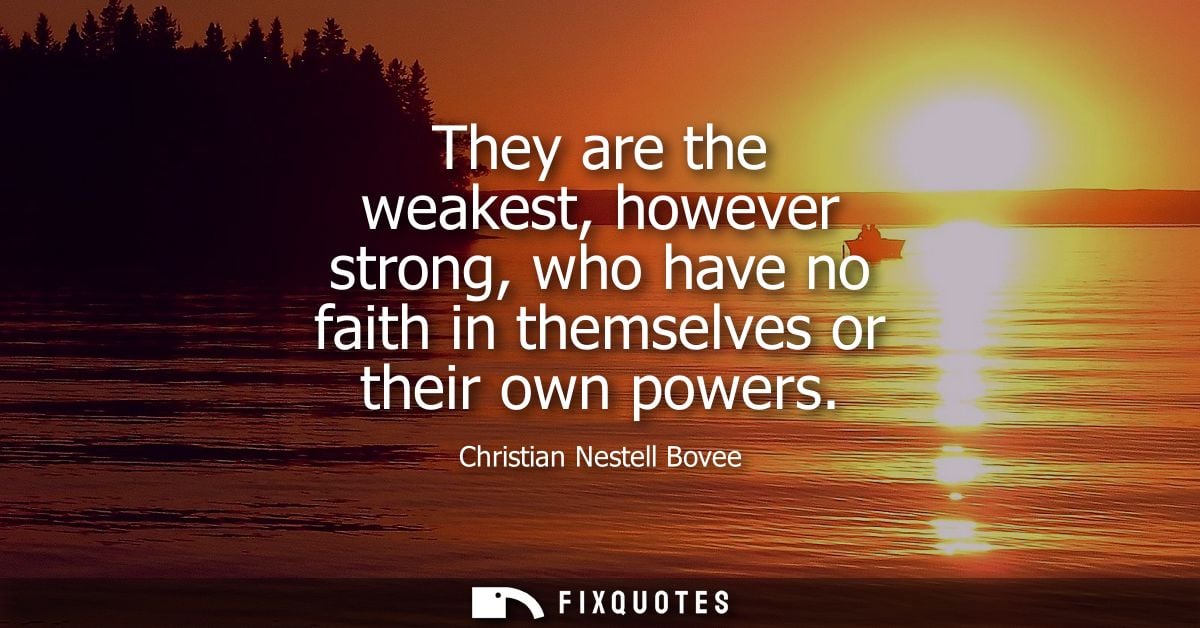
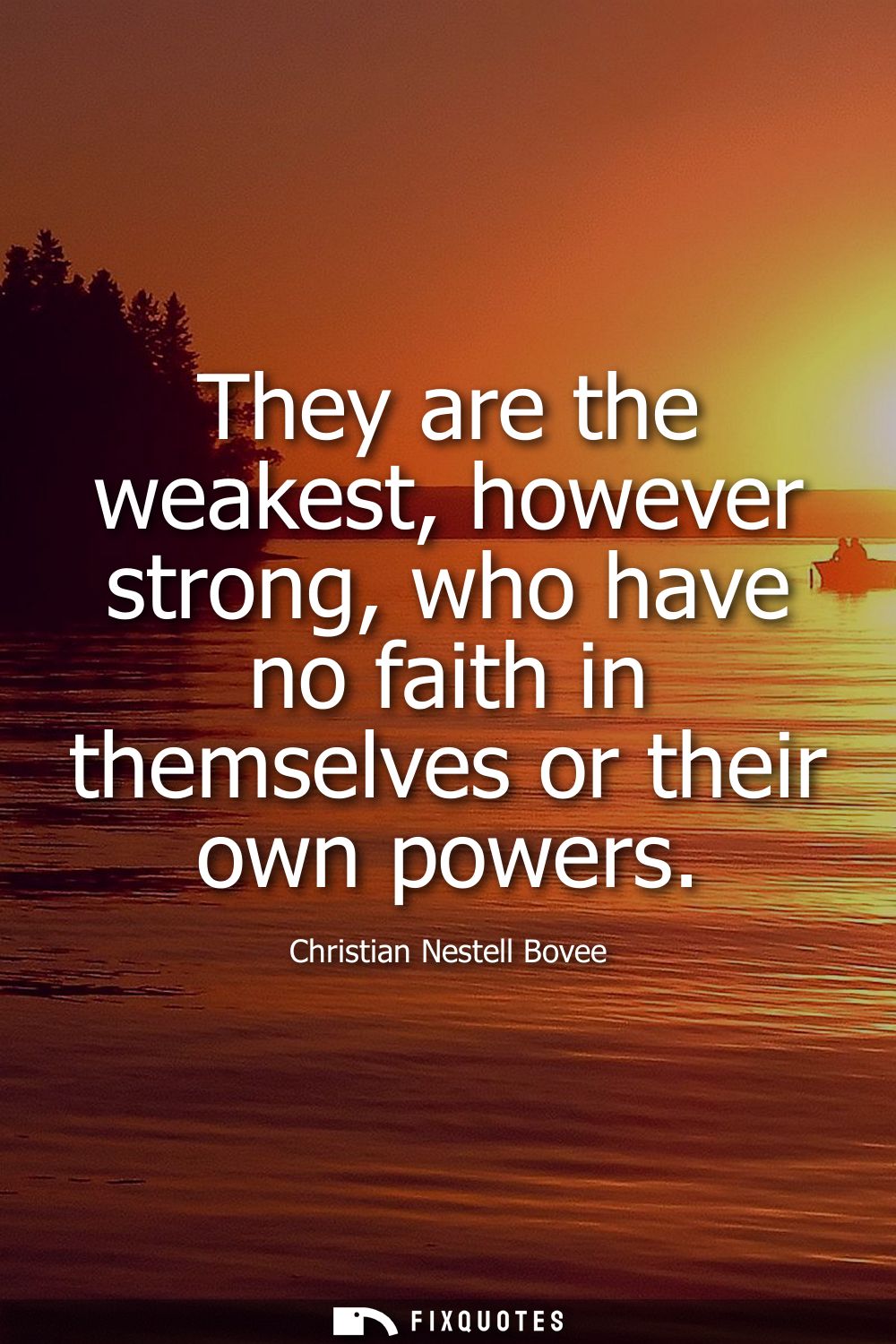
"They are the weakest, however strong, who have no faith in themselves or their own powers"
About this Quote
The intent isn’t soft encouragement; it’s a warning about a particular failure mode. A person without faith in their own powers becomes dependent on external validators, brittle under pressure, easily steered by louder wills. Bovee’s subtext is social as much as psychological: doubt is not just an inner feeling, it’s a vulnerability that institutions, rivals, even friends can exploit. The "weakest" are the ones who outsource their agency.
Context matters. Writing in 19th-century America, Bovee is in conversation with a culture busy canonizing self-reliance while also producing new forms of insecurity: competitive markets, shifting class identities, and public life as performance. The line reads like a corrective to that performance - a reminder that confidence isn’t bravado. It’s the private conviction that you can act, adapt, and recover. Without that, "strength" becomes costume armor: impressive until the first real blow lands.
Quote Details
| Topic | Confidence |
|---|---|
| Source | Help us find the source |
| Cite |
Citation Formats
APA Style (7th ed.)
Bovee, Christian Nestell. (2026, January 17). They are the weakest, however strong, who have no faith in themselves or their own powers. FixQuotes. https://fixquotes.com/quotes/they-are-the-weakest-however-strong-who-have-no-47576/
Chicago Style
Bovee, Christian Nestell. "They are the weakest, however strong, who have no faith in themselves or their own powers." FixQuotes. January 17, 2026. https://fixquotes.com/quotes/they-are-the-weakest-however-strong-who-have-no-47576/.
MLA Style (9th ed.)
"They are the weakest, however strong, who have no faith in themselves or their own powers." FixQuotes, 17 Jan. 2026, https://fixquotes.com/quotes/they-are-the-weakest-however-strong-who-have-no-47576/. Accessed 7 Apr. 2026.