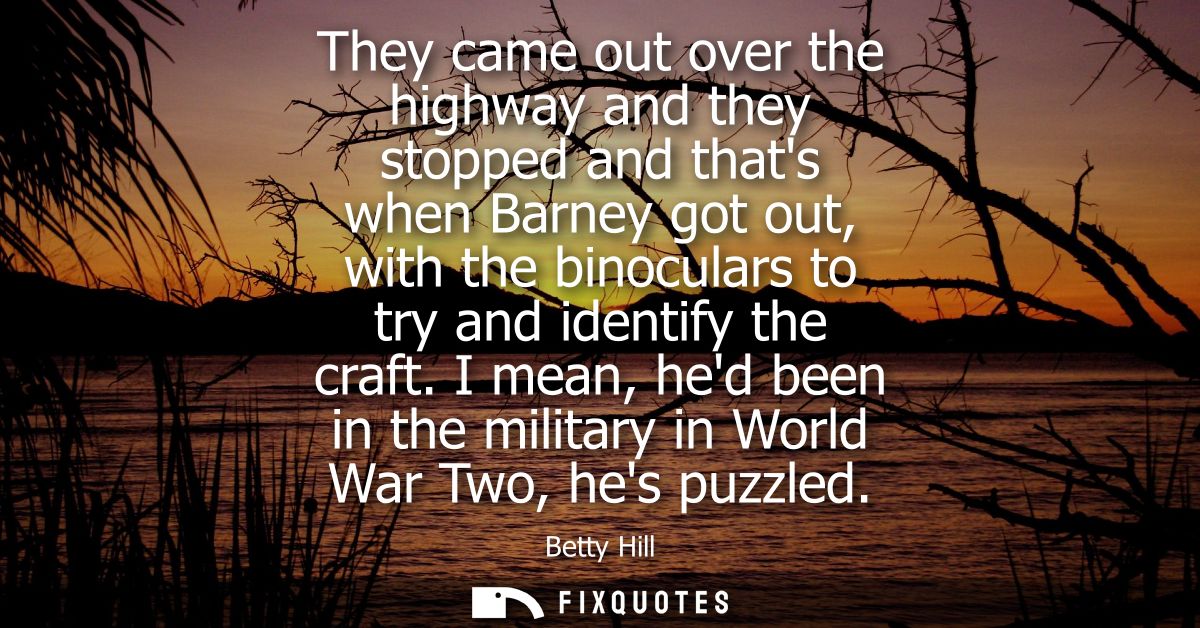
"They came out over the highway and they stopped and that's when Barney got out, with the binoculars to try and identify the craft. I mean, he'd been in the military in World War Two, he's puzzled"
About this Quote
The subtext runs through Barney. Hill doesn’t just mention him; she credential-checks him. “He’d been in the military in World War Two” is deployed like a seal of seriousness, a preemptive rebuttal to the snickering listener. In a culture that treats veteran status as a kind of moral and perceptual authority, his puzzlement becomes evidence: a trained man can’t place what he’s seeing, so it must be outside the usual categories. The sentence trails off - “he’s puzzled” - as if the only honest ending is uncertainty.
That uncertainty is also strategic. Hill frames the event as investigation, not belief: identify the craft, don’t commune with it. It’s a small but crucial distinction in the early-1960s UFO moment, when Cold War skies were crowded with secret aircraft, radar anxieties, and the fear that the government always knew more than it admitted. The quote’s intent is credibility through domestic realism: not prophets on a mountaintop, just two people on a road, trying to make sense of something that refuses to fit.
Quote Details
| Topic | Military & Soldier |
|---|---|
| Source | Help us find the source |
| Cite |
Citation Formats
APA Style (7th ed.)
Hill, Betty. (2026, January 17). They came out over the highway and they stopped and that's when Barney got out, with the binoculars to try and identify the craft. I mean, he'd been in the military in World War Two, he's puzzled. FixQuotes. https://fixquotes.com/quotes/they-came-out-over-the-highway-and-they-stopped-37919/
Chicago Style
Hill, Betty. "They came out over the highway and they stopped and that's when Barney got out, with the binoculars to try and identify the craft. I mean, he'd been in the military in World War Two, he's puzzled." FixQuotes. January 17, 2026. https://fixquotes.com/quotes/they-came-out-over-the-highway-and-they-stopped-37919/.
MLA Style (9th ed.)
"They came out over the highway and they stopped and that's when Barney got out, with the binoculars to try and identify the craft. I mean, he'd been in the military in World War Two, he's puzzled." FixQuotes, 17 Jan. 2026, https://fixquotes.com/quotes/they-came-out-over-the-highway-and-they-stopped-37919/. Accessed 18 Feb. 2026.