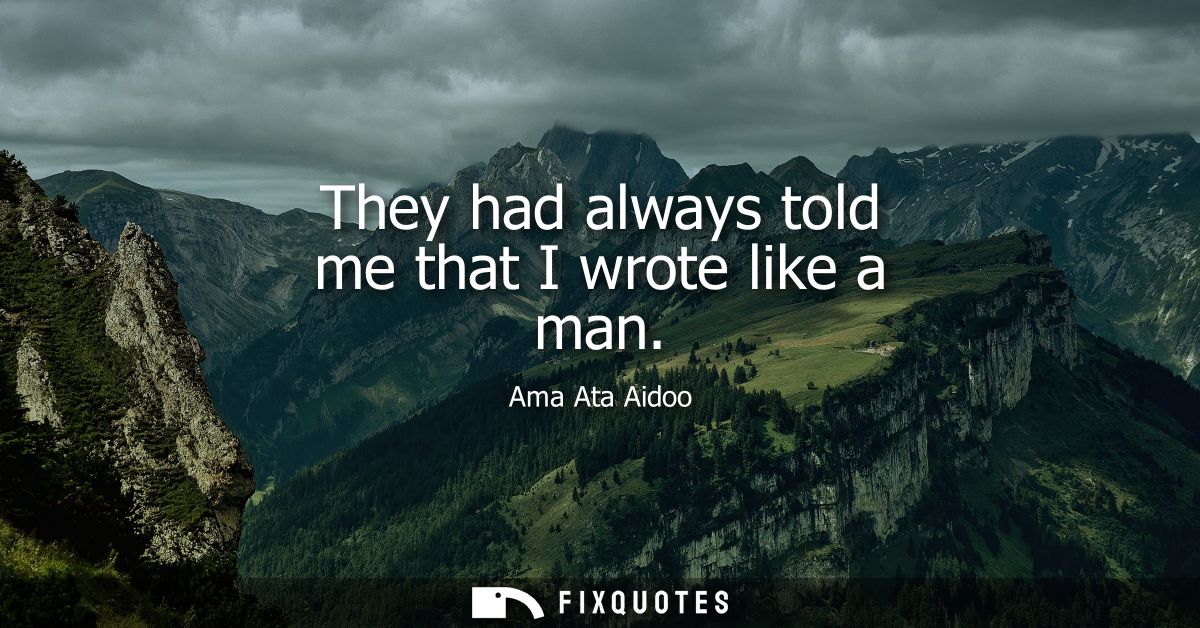
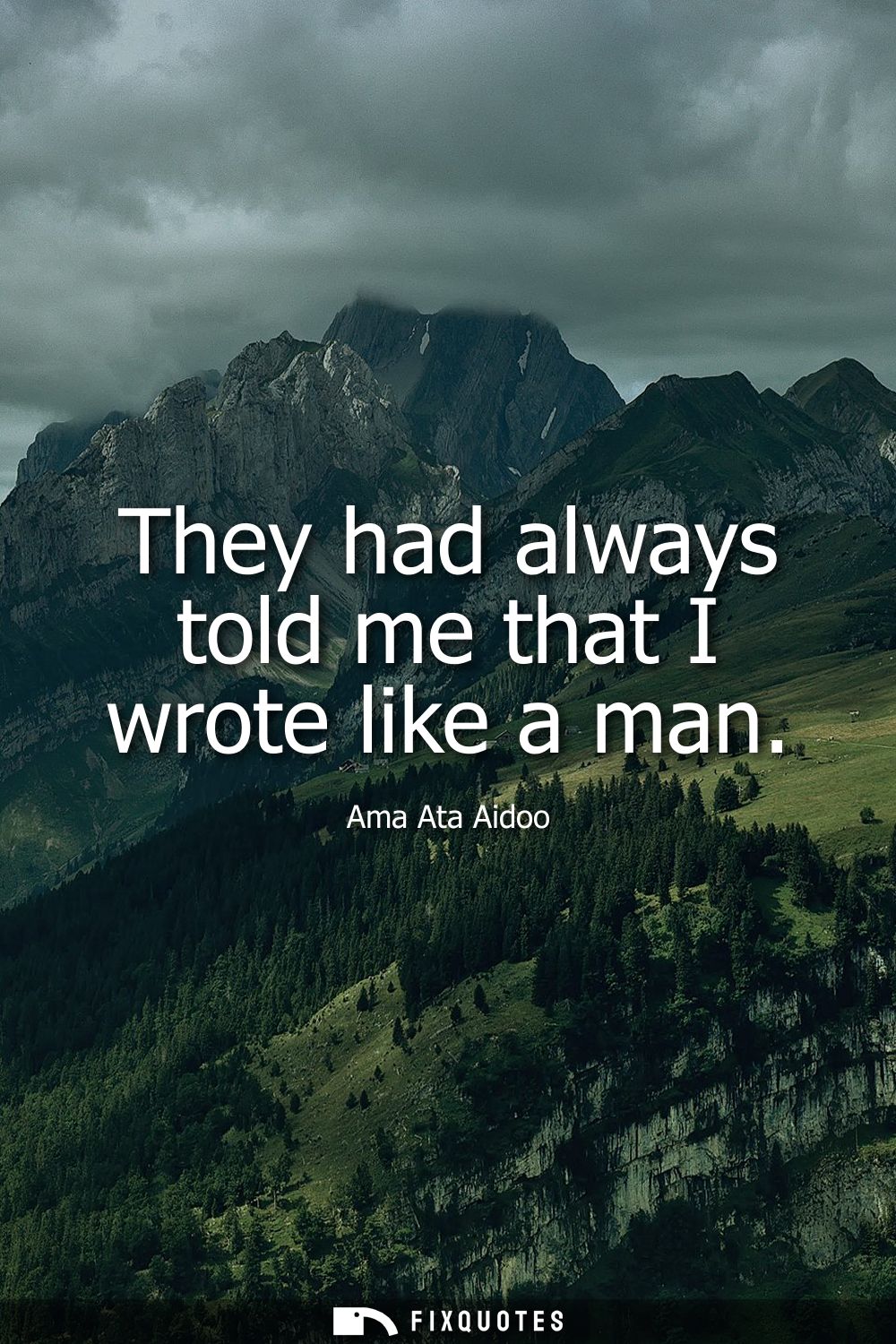
"They had always told me that I wrote like a man"
About this Quote
The line lands like a backhanded compliment turned into a weapon. “They” is doing the heavy lifting: an unnamed panel of gatekeepers - editors, teachers, critics, whole institutions - who treat “man” as the default setting for seriousness. Aidoo compresses a lifetime of literary policing into one sentence, and the sting is in the casualness. No one has to explain the rules; the rules arrive preloaded.
The intent isn’t just to report sexism, but to expose how praise can be a form of control. To be told you “write like a man” is to be rewarded for sounding as if you’re not yourself, as if authority, clarity, ambition, and intellectual bite are male properties you’ve borrowed. It’s also a demand: keep writing in the register we recognize, don’t make us learn new metrics. Aidoo’s dry phrasing refuses to perform outrage; that restraint sharpens the critique, letting the ugliness of the assumption speak for itself.
Context matters: as a Ghanaian writer working amid postcolonial cultural battles, Aidoo faced two overlapping regimes of expectation - Western literary norms and patriarchal local ones. The quote points to the colonial afterlife inside aesthetics: the “neutral” voice often means a masculinized, Anglophone standard. Her subtext is insurgent: if my work is legible only when misgendered, the problem isn’t my prose. It’s your imagination.
The intent isn’t just to report sexism, but to expose how praise can be a form of control. To be told you “write like a man” is to be rewarded for sounding as if you’re not yourself, as if authority, clarity, ambition, and intellectual bite are male properties you’ve borrowed. It’s also a demand: keep writing in the register we recognize, don’t make us learn new metrics. Aidoo’s dry phrasing refuses to perform outrage; that restraint sharpens the critique, letting the ugliness of the assumption speak for itself.
Context matters: as a Ghanaian writer working amid postcolonial cultural battles, Aidoo faced two overlapping regimes of expectation - Western literary norms and patriarchal local ones. The quote points to the colonial afterlife inside aesthetics: the “neutral” voice often means a masculinized, Anglophone standard. Her subtext is insurgent: if my work is legible only when misgendered, the problem isn’t my prose. It’s your imagination.
Quote Details
| Topic | Writing |
|---|---|
| Source | Help us find the source |
| Cite |
Citation Formats
APA Style (7th ed.)
Aidoo, Ama Ata. (2026, January 16). They had always told me that I wrote like a man. FixQuotes. https://fixquotes.com/quotes/they-had-always-told-me-that-i-wrote-like-a-man-118654/
Chicago Style
Aidoo, Ama Ata. "They had always told me that I wrote like a man." FixQuotes. January 16, 2026. https://fixquotes.com/quotes/they-had-always-told-me-that-i-wrote-like-a-man-118654/.
MLA Style (9th ed.)
"They had always told me that I wrote like a man." FixQuotes, 16 Jan. 2026, https://fixquotes.com/quotes/they-had-always-told-me-that-i-wrote-like-a-man-118654/. Accessed 25 Mar. 2026.
More Quotes by Ama
Add to List