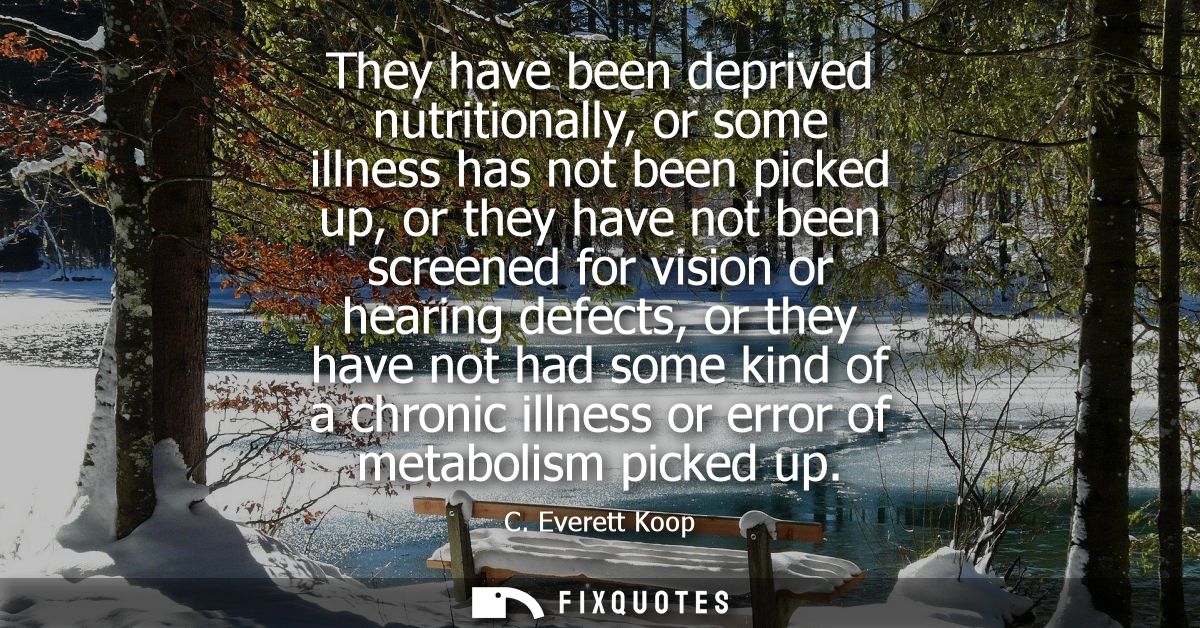
"They have been deprived nutritionally, or some illness has not been picked up, or they have not been screened for vision or hearing defects, or they have not had some kind of a chronic illness or error of metabolism picked up"
About this Quote
The intent is diagnostic, but the subtext is accusatory. Koop isn’t describing misfortune so much as preventable neglect: nutrition, screening, early detection, metabolic disorders. Each clause implies a moment when intervention was possible and didn’t happen. The phrasing "has not been picked up" is especially telling. It avoids naming a culprit directly, but it also makes the oversight sound routine, almost bureaucratic, like lost paperwork. That passive voice is a knife: it suggests a culture where responsibility dissolves into the process.
Context matters because Koop, as Surgeon General, built a reputation on speaking bluntly about health risks (famously HIV/AIDS) even when politics wanted quiet. Here, he’s channeling the same ethos: prevention is not glamorous, but it’s the difference between a child who struggles for years and one who gets a fair shot. The cadence mimics triage. You can hear the institutional frustration: if we keep missing the basics, stop acting shocked by the outcomes.
Quote Details
| Topic | Health |
|---|---|
| Source | Help us find the source |
| Cite |
Citation Formats
APA Style (7th ed.)
Koop, C. Everett. (2026, January 16). They have been deprived nutritionally, or some illness has not been picked up, or they have not been screened for vision or hearing defects, or they have not had some kind of a chronic illness or error of metabolism picked up. FixQuotes. https://fixquotes.com/quotes/they-have-been-deprived-nutritionally-or-some-120494/
Chicago Style
Koop, C. Everett. "They have been deprived nutritionally, or some illness has not been picked up, or they have not been screened for vision or hearing defects, or they have not had some kind of a chronic illness or error of metabolism picked up." FixQuotes. January 16, 2026. https://fixquotes.com/quotes/they-have-been-deprived-nutritionally-or-some-120494/.
MLA Style (9th ed.)
"They have been deprived nutritionally, or some illness has not been picked up, or they have not been screened for vision or hearing defects, or they have not had some kind of a chronic illness or error of metabolism picked up." FixQuotes, 16 Jan. 2026, https://fixquotes.com/quotes/they-have-been-deprived-nutritionally-or-some-120494/. Accessed 31 Mar. 2026.