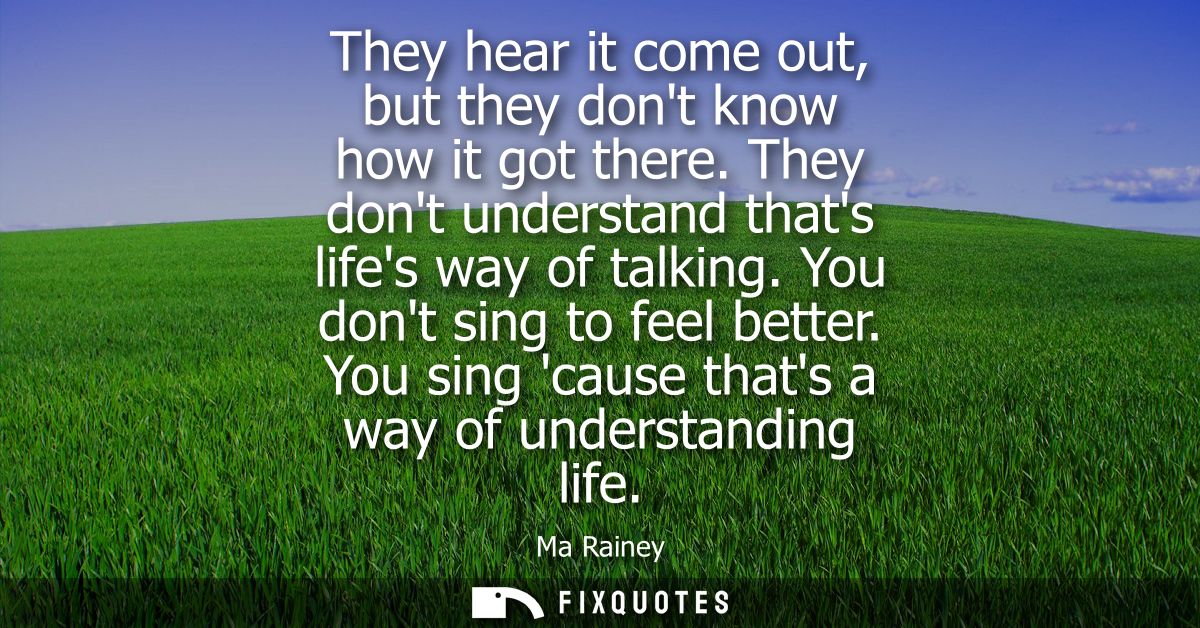
"They hear it come out, but they don't know how it got there. They don't understand that's life's way of talking. You don't sing to feel better. You sing 'cause that's a way of understanding life"
About this Quote
The subtext is about authorship and survival. Rainey rejects the comforting modern idea of art as self-care: "You don't sing to feel better". Blues isn't therapy, not a mood-lifter you can purchase with a ticket. It's closer to testimony. When she says "life's way of talking", she implies life has a language - hardship, desire, violence, joy - and singing is how you become fluent in it. The song doesn't anesthetize experience; it translates it.
That matters in Rainey's context: a Black woman building a career in the early recording era, when white-controlled venues and labels profited from Black expression while often refusing Black people full personhood. Her insistence that singing is "a way of understanding life" is both artistic credo and cultural rebuttal. The blues, for Rainey, isn't background music to someone else's night out. It's a form of knowledge, earned the hard way, delivered in a voice that refuses to be treated as an accident.
Quote Details
| Topic | Music |
|---|---|
| Source | Ma Rainey's Black Bottom (play), August Wilson, 1984 — line spoken by the character Ma Rainey (commonly cited in sources/quote collections). |
| Cite |
Citation Formats
APA Style (7th ed.)
Rainey, Ma. (2026, January 15). They hear it come out, but they don't know how it got there. They don't understand that's life's way of talking. You don't sing to feel better. You sing 'cause that's a way of understanding life. FixQuotes. https://fixquotes.com/quotes/they-hear-it-come-out-but-they-dont-know-how-it-169571/
Chicago Style
Rainey, Ma. "They hear it come out, but they don't know how it got there. They don't understand that's life's way of talking. You don't sing to feel better. You sing 'cause that's a way of understanding life." FixQuotes. January 15, 2026. https://fixquotes.com/quotes/they-hear-it-come-out-but-they-dont-know-how-it-169571/.
MLA Style (9th ed.)
"They hear it come out, but they don't know how it got there. They don't understand that's life's way of talking. You don't sing to feel better. You sing 'cause that's a way of understanding life." FixQuotes, 15 Jan. 2026, https://fixquotes.com/quotes/they-hear-it-come-out-but-they-dont-know-how-it-169571/. Accessed 7 Apr. 2026.