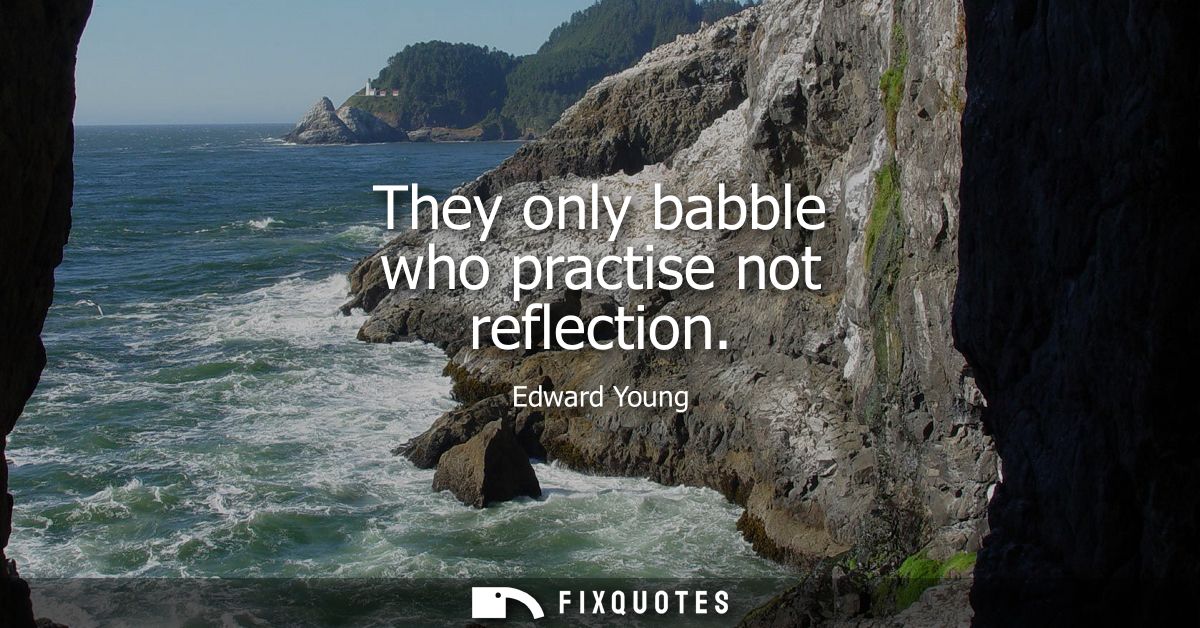
"They only babble who practise not reflection"
About this Quote
“Babble” is doing a lot of class work here: it’s not just idle talk, it’s moral and intellectual sloppiness made audible. Edward Young, an 18th-century poet with a preacher’s ear for vanity, aims this line at the social noise of his age - coffeehouse chatter, salon wit, public disputation - where conversation could become a performance of cleverness rather than a search for truth. The sting is that babbling isn’t a harmless habit; it’s a symptom. If you don’t cultivate reflection, language fills the vacuum anyway, frothing up into opinion, gossip, and rhetorical tics.
The subtext is less “be quiet” than “earn your words.” Young implies a hierarchy: reflection is disciplined, private, slow; babble is impulsive, public, fast. That contrast flatters the reader who fancies themselves thoughtful while also warning them how easy it is to mistake fluency for wisdom. It’s a line engineered for self-surveillance: the next time you’re talking, are you expressing considered judgment or just keeping the room warm?
Context matters. Young writes in a period that prized “reason” and moral improvement, yet also adored talk as entertainment. His phrasing turns that cultural contradiction into a clean ethical distinction. The aphorism format mirrors its message: compact, controlled, resistant to sprawl. Even the slightly archaic “practise” suggests reflection as a craft, not a mood. You don’t “have” depth; you train for it.
The subtext is less “be quiet” than “earn your words.” Young implies a hierarchy: reflection is disciplined, private, slow; babble is impulsive, public, fast. That contrast flatters the reader who fancies themselves thoughtful while also warning them how easy it is to mistake fluency for wisdom. It’s a line engineered for self-surveillance: the next time you’re talking, are you expressing considered judgment or just keeping the room warm?
Context matters. Young writes in a period that prized “reason” and moral improvement, yet also adored talk as entertainment. His phrasing turns that cultural contradiction into a clean ethical distinction. The aphorism format mirrors its message: compact, controlled, resistant to sprawl. Even the slightly archaic “practise” suggests reflection as a craft, not a mood. You don’t “have” depth; you train for it.
Quote Details
| Topic | Wisdom |
|---|---|
| Source | Help us find the source |
| Cite |
Citation Formats
APA Style (7th ed.)
Young, Edward. (2026, January 17). They only babble who practise not reflection. FixQuotes. https://fixquotes.com/quotes/they-only-babble-who-practise-not-reflection-33581/
Chicago Style
Young, Edward. "They only babble who practise not reflection." FixQuotes. January 17, 2026. https://fixquotes.com/quotes/they-only-babble-who-practise-not-reflection-33581/.
MLA Style (9th ed.)
"They only babble who practise not reflection." FixQuotes, 17 Jan. 2026, https://fixquotes.com/quotes/they-only-babble-who-practise-not-reflection-33581/. Accessed 26 Mar. 2026.
More Quotes by Edward
Add to List