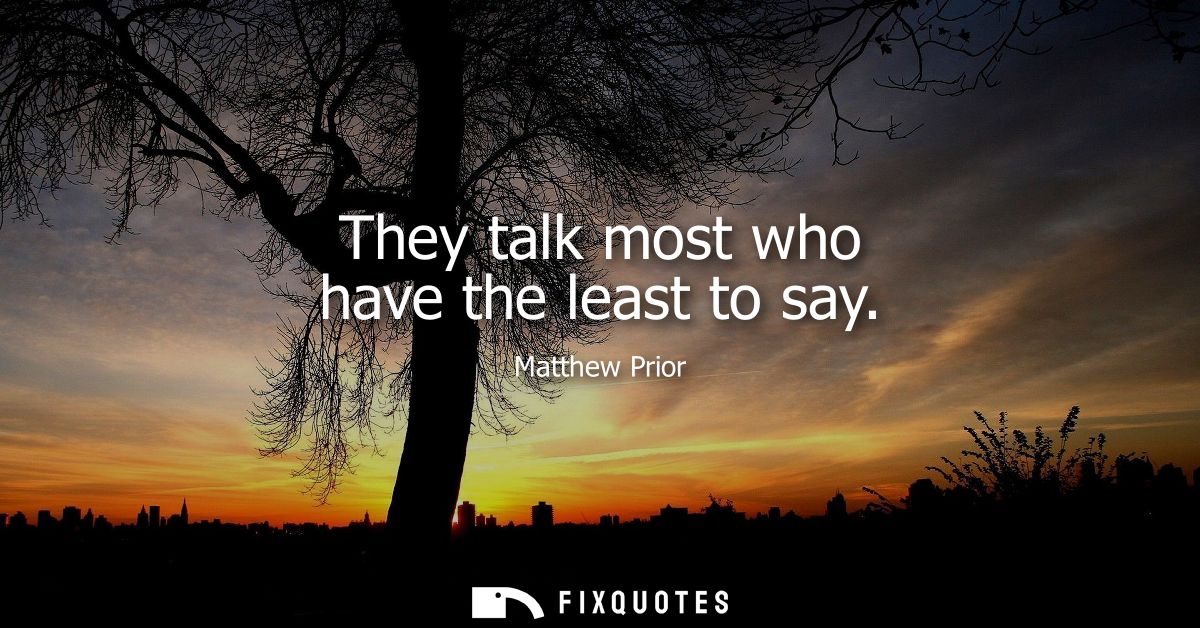
"They talk most who have the least to say"
About this Quote
Noise is often a tell. Prior’s line skewers the social economy of talk: the people who dominate the room aren’t necessarily the ones carrying insight; they’re often compensating for its absence. The aphorism works because it’s not just a complaint about chatter. It’s a diagnosis of status anxiety. Speech becomes a performance of importance, a way to stake a claim when you don’t have the substance - or the security - to let silence stand.
As a poet and court-adjacent figure in late Stuart/early Hanoverian England, Prior knew how conversation could be a currency. The coffeehouse and salon cultures of the period rewarded quickness, opinion, and public presence; verbosity could masquerade as authority. In that world, talking “most” isn’t merely annoying, it’s strategic: occupy airtime, control the frame, look indispensable. Prior punctures that strategy with a clean inversion. The more someone insists on being heard, the more you should suspect there’s little there.
The subtext is also self-protective, even slightly elitist. It flatters the reader into identifying with the understated few, those whose restraint signals intelligence and breeding. Prior is policing taste: good sense doesn’t need to advertise. That’s why the sentence lands with such bite. It gives you a tool for social reading - a way to reclassify the loud as insecure, the quiet as capable - and it does so in eight words sharp enough to survive three centuries of meetings, pundit panels, and comment sections.
As a poet and court-adjacent figure in late Stuart/early Hanoverian England, Prior knew how conversation could be a currency. The coffeehouse and salon cultures of the period rewarded quickness, opinion, and public presence; verbosity could masquerade as authority. In that world, talking “most” isn’t merely annoying, it’s strategic: occupy airtime, control the frame, look indispensable. Prior punctures that strategy with a clean inversion. The more someone insists on being heard, the more you should suspect there’s little there.
The subtext is also self-protective, even slightly elitist. It flatters the reader into identifying with the understated few, those whose restraint signals intelligence and breeding. Prior is policing taste: good sense doesn’t need to advertise. That’s why the sentence lands with such bite. It gives you a tool for social reading - a way to reclassify the loud as insecure, the quiet as capable - and it does so in eight words sharp enough to survive three centuries of meetings, pundit panels, and comment sections.
Quote Details
| Topic | Witty One-Liners |
|---|---|
| Source | Verified source: ALMA: OR, THE PROGRESS OF THE MIND (Matthew Prior, 1718)
Evidence: And 'tis remarkable, that They Talk most, who have the least to say. (Page 352, lines 345-346). Verified in Matthew Prior's own poem "ALMA: OR, THE PROGRESS OF THE MIND. In Three Cantos." The wording commonly quoted today drops the opening "And 'tis remarkable, that" and modernizes capitalization/punctuation. The consulted primary text is an edited transcription from the 1718 source edition, identified there as appearing in Prior's "Poems on Several Occasions" (London, MDCCXVIII/1718), pp. 381-352 in the source volume; the quote itself appears on page 352 of the poem display at lines 345-346. I found no earlier primary-source publication in the materials searched, so 1718 is the earliest verified publication I can confirm from a primary-source edition. Other candidates (1) The Poetical Works of Matthew Prior (Matthew Prior, 1875) compilation95.0% With a Life by Rev. John Mitford Matthew Prior. She still renews the ancient scene , Forgets the forty years ... they... |
| Cite |
Citation Formats
APA Style (7th ed.)
Prior, Matthew. (2026, March 10). They talk most who have the least to say. FixQuotes. https://fixquotes.com/quotes/they-talk-most-who-have-the-least-to-say-147224/
Chicago Style
Prior, Matthew. "They talk most who have the least to say." FixQuotes. March 10, 2026. https://fixquotes.com/quotes/they-talk-most-who-have-the-least-to-say-147224/.
MLA Style (9th ed.)
"They talk most who have the least to say." FixQuotes, 10 Mar. 2026, https://fixquotes.com/quotes/they-talk-most-who-have-the-least-to-say-147224/. Accessed 27 Mar. 2026.
More Quotes by Matthew
Add to List