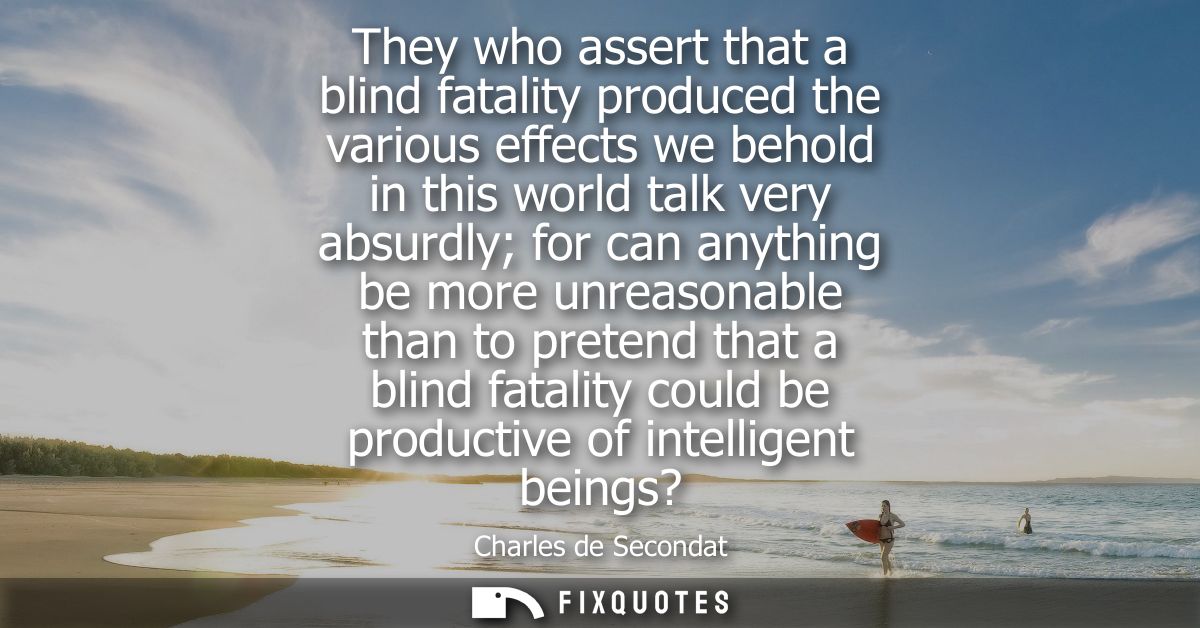
"They who assert that a blind fatality produced the various effects we behold in this world talk very absurdly; for can anything be more unreasonable than to pretend that a blind fatality could be productive of intelligent beings?"
About this Quote
The intent is defensive but also strategic. In early Enlightenment Europe, thinkers were pushing against clerical authority while still operating inside a culture where God was the default premise of moral and political order. Montesquieu, best known for dissecting institutions and power, isn’t offering a scientific argument; he’s policing the boundaries of respectable explanation. If humans are “intelligent beings,” the subtext goes, their existence implies an intelligence behind the world - and by implication, a basis for law, legitimacy, and moral constraint.
What makes the line work is how it smuggles in its conclusion. It assumes that intelligence cannot arise from non-intelligence, a premise framed as common sense rather than contested philosophy. The sneer (“talk very absurdly”) does the heavy lifting: it converts a difficult question about causation into a judgment about taste, reasonableness, and who gets to count as serious.
Quote Details
| Topic | Reason & Logic |
|---|---|
| Source | Help us find the source |
| Cite |
Citation Formats
APA Style (7th ed.)
Secondat, Charles de. (2026, January 17). They who assert that a blind fatality produced the various effects we behold in this world talk very absurdly; for can anything be more unreasonable than to pretend that a blind fatality could be productive of intelligent beings? FixQuotes. https://fixquotes.com/quotes/they-who-assert-that-a-blind-fatality-produced-42111/
Chicago Style
Secondat, Charles de. "They who assert that a blind fatality produced the various effects we behold in this world talk very absurdly; for can anything be more unreasonable than to pretend that a blind fatality could be productive of intelligent beings?" FixQuotes. January 17, 2026. https://fixquotes.com/quotes/they-who-assert-that-a-blind-fatality-produced-42111/.
MLA Style (9th ed.)
"They who assert that a blind fatality produced the various effects we behold in this world talk very absurdly; for can anything be more unreasonable than to pretend that a blind fatality could be productive of intelligent beings?" FixQuotes, 17 Jan. 2026, https://fixquotes.com/quotes/they-who-assert-that-a-blind-fatality-produced-42111/. Accessed 12 Feb. 2026.