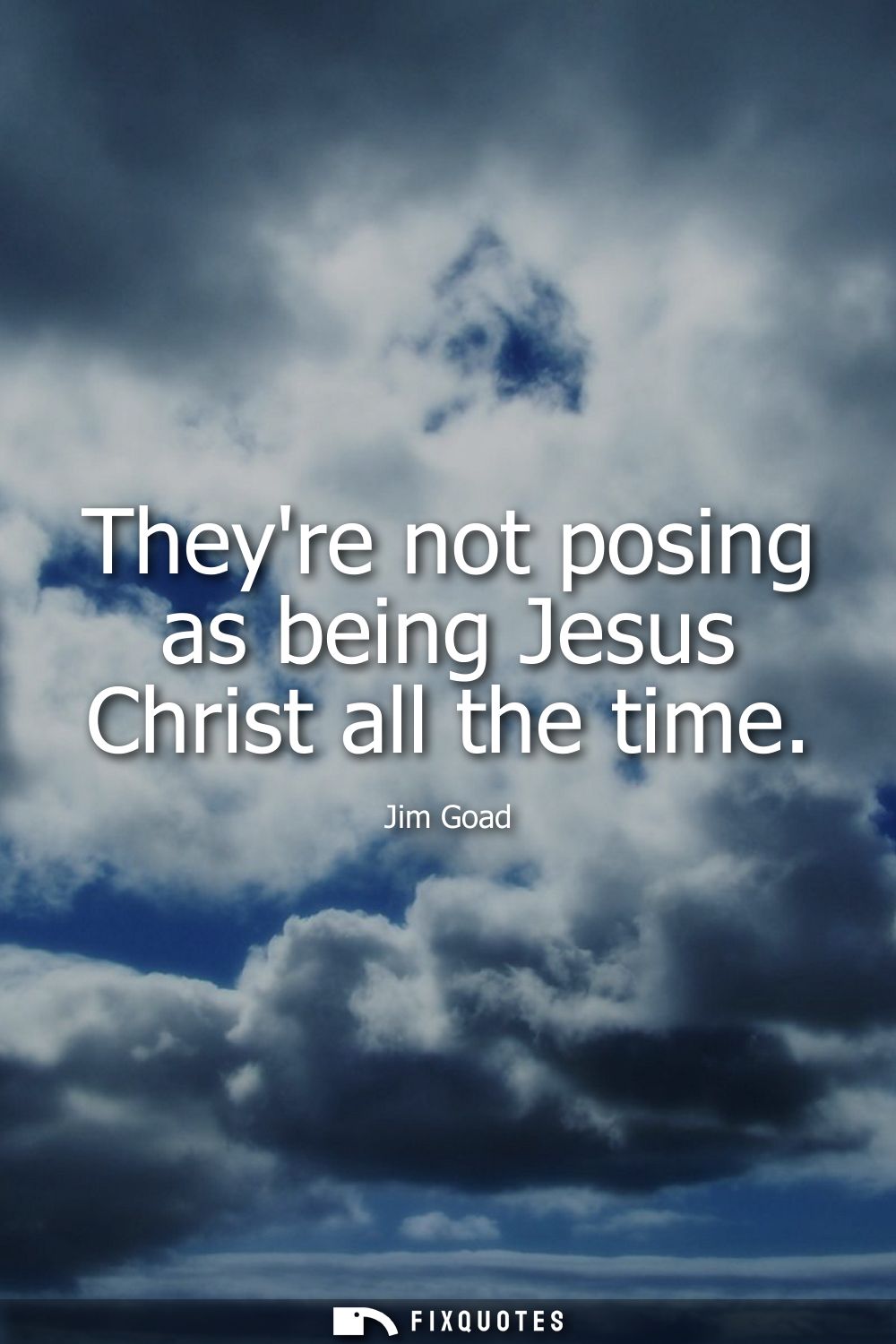
"They're not posing as being Jesus Christ all the time"
About this Quote
A sneer disguised as an observation, Jim Goad's line works by puncturing a very American pose: the compulsion to dress ordinary behavior in saintly drag. "They're not posing" is the tell. He's not really describing a group so much as accusing someone else of performance, of constantly auditioning for moral authority. Dropping "Jesus Christ" into an otherwise casual sentence is deliberate tonal sabotage: it yanks the conversation out of polite social language and into the realm of absolute virtue, where hypocrisy is easiest to spot and hardest to defend.
The specific intent is contrast. Whoever "they" are, Goad frames them as refreshingly unmessianic - people who don't demand applause for basic decency, don't narrate their lives as a redemption arc, don't treat every disagreement as a crucifixion. It's praise, but it's also an attack: on sanctimony, on public piety, on the kind of status-seeking that hides behind righteousness.
The subtext is classic Goad: suspicion of moral entrepreneurs. He implies that being "good" has become a kind of costume, one worn "all the time" to control others and preempt criticism. The line's bluntness matters; it refuses nuance in the way a heckle refuses nuance. Contextually, it fits Goad's broader posture as a provocateur who treats virtue-signaling as another form of self-marketing. The power isn't in theology; it's in the cultural shorthand. Invoke Jesus and you instantly summon martyrdom, persecution narratives, and performative humility - then dismiss it with a shrug.
The specific intent is contrast. Whoever "they" are, Goad frames them as refreshingly unmessianic - people who don't demand applause for basic decency, don't narrate their lives as a redemption arc, don't treat every disagreement as a crucifixion. It's praise, but it's also an attack: on sanctimony, on public piety, on the kind of status-seeking that hides behind righteousness.
The subtext is classic Goad: suspicion of moral entrepreneurs. He implies that being "good" has become a kind of costume, one worn "all the time" to control others and preempt criticism. The line's bluntness matters; it refuses nuance in the way a heckle refuses nuance. Contextually, it fits Goad's broader posture as a provocateur who treats virtue-signaling as another form of self-marketing. The power isn't in theology; it's in the cultural shorthand. Invoke Jesus and you instantly summon martyrdom, persecution narratives, and performative humility - then dismiss it with a shrug.
Quote Details
| Topic | God |
|---|---|
| Source | Help us find the source |
| Cite |
Citation Formats
APA Style (7th ed.)
Goad, Jim. (2026, January 15). They're not posing as being Jesus Christ all the time. FixQuotes. https://fixquotes.com/quotes/theyre-not-posing-as-being-jesus-christ-all-the-158631/
Chicago Style
Goad, Jim. "They're not posing as being Jesus Christ all the time." FixQuotes. January 15, 2026. https://fixquotes.com/quotes/theyre-not-posing-as-being-jesus-christ-all-the-158631/.
MLA Style (9th ed.)
"They're not posing as being Jesus Christ all the time." FixQuotes, 15 Jan. 2026, https://fixquotes.com/quotes/theyre-not-posing-as-being-jesus-christ-all-the-158631/. Accessed 8 Apr. 2026.
More Quotes by Jim
Add to List