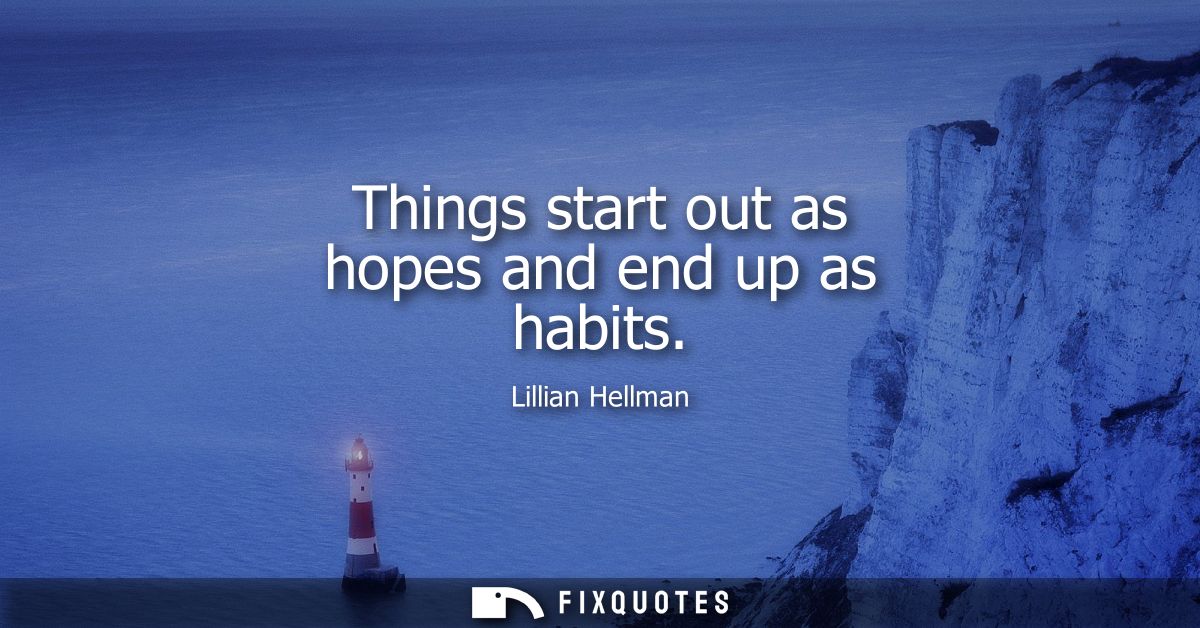
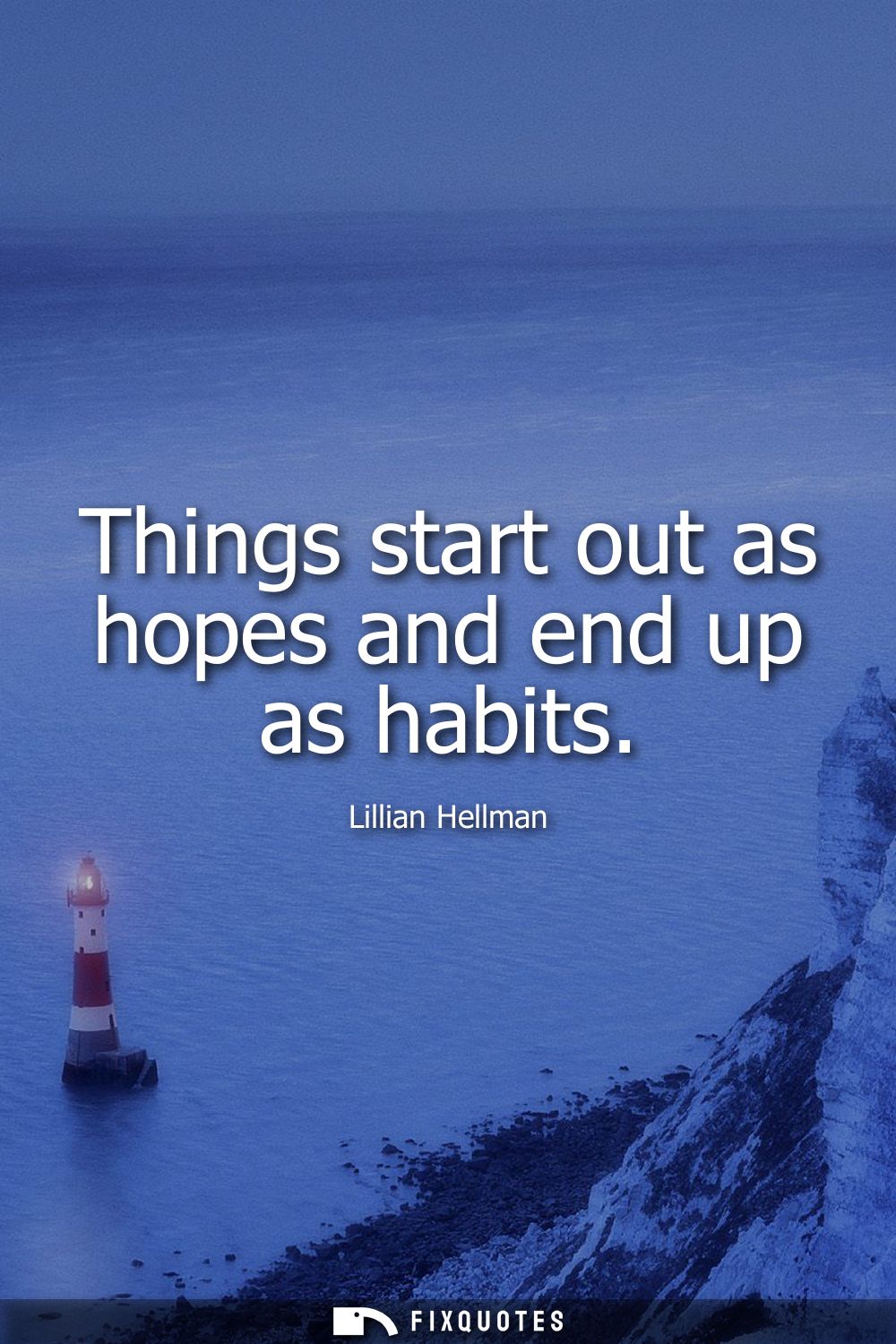
"Things start out as hopes and end up as habits"
About this Quote
Hellman’s line has the hard snap of a backstage truth: desire is rarely what carries a life forward; repetition does. “Things start out as hopes” flatters the romantic story we tell ourselves, the bright audition monologue of personal change. Then she cuts it off at the knees: they “end up as habits,” not as triumphs, not even as fulfilled wishes. The destination isn’t a prize, it’s a pattern.
The intent feels distinctly dramatist: she’s talking about character. In plays, people don’t transform because they’ve had an inspiring thought; they change (or fail to) because their daily behaviors harden into fate. Hellman’s subtext is almost moral without preaching: hope is cheap currency unless it’s converted into routine. The verb choice matters. “Start out” suggests innocence, a beginning you can still revise. “End up” carries resignation, the sense of arriving somewhere without meaning to. Habit, here, is both achievement and trap: the noble hope of being braver becomes the practiced act of speaking up; the hope of being loved becomes the habitual settling for less.
Context sharpens the cynicism. Hellman wrote through Depression, war, blacklist-era coercion, and the moral theater of American politics. She watched ideals get tested under pressure and people learn to live inside compromises. The quote reads like a warning from someone who’s seen how quickly aspiration can be domesticated: the system doesn’t need to crush your hopes; it just needs to schedule them, day after day, until they’re no longer dreams but defaults.
The intent feels distinctly dramatist: she’s talking about character. In plays, people don’t transform because they’ve had an inspiring thought; they change (or fail to) because their daily behaviors harden into fate. Hellman’s subtext is almost moral without preaching: hope is cheap currency unless it’s converted into routine. The verb choice matters. “Start out” suggests innocence, a beginning you can still revise. “End up” carries resignation, the sense of arriving somewhere without meaning to. Habit, here, is both achievement and trap: the noble hope of being braver becomes the practiced act of speaking up; the hope of being loved becomes the habitual settling for less.
Context sharpens the cynicism. Hellman wrote through Depression, war, blacklist-era coercion, and the moral theater of American politics. She watched ideals get tested under pressure and people learn to live inside compromises. The quote reads like a warning from someone who’s seen how quickly aspiration can be domesticated: the system doesn’t need to crush your hopes; it just needs to schedule them, day after day, until they’re no longer dreams but defaults.
Quote Details
| Topic | Habits |
|---|---|
| Source | Help us find the source |
| Cite |
Citation Formats
APA Style (7th ed.)
Hellman, Lillian. (2026, January 18). Things start out as hopes and end up as habits. FixQuotes. https://fixquotes.com/quotes/things-start-out-as-hopes-and-end-up-as-habits-13188/
Chicago Style
Hellman, Lillian. "Things start out as hopes and end up as habits." FixQuotes. January 18, 2026. https://fixquotes.com/quotes/things-start-out-as-hopes-and-end-up-as-habits-13188/.
MLA Style (9th ed.)
"Things start out as hopes and end up as habits." FixQuotes, 18 Jan. 2026, https://fixquotes.com/quotes/things-start-out-as-hopes-and-end-up-as-habits-13188/. Accessed 3 Apr. 2026.
More Quotes by Lillian
Add to List