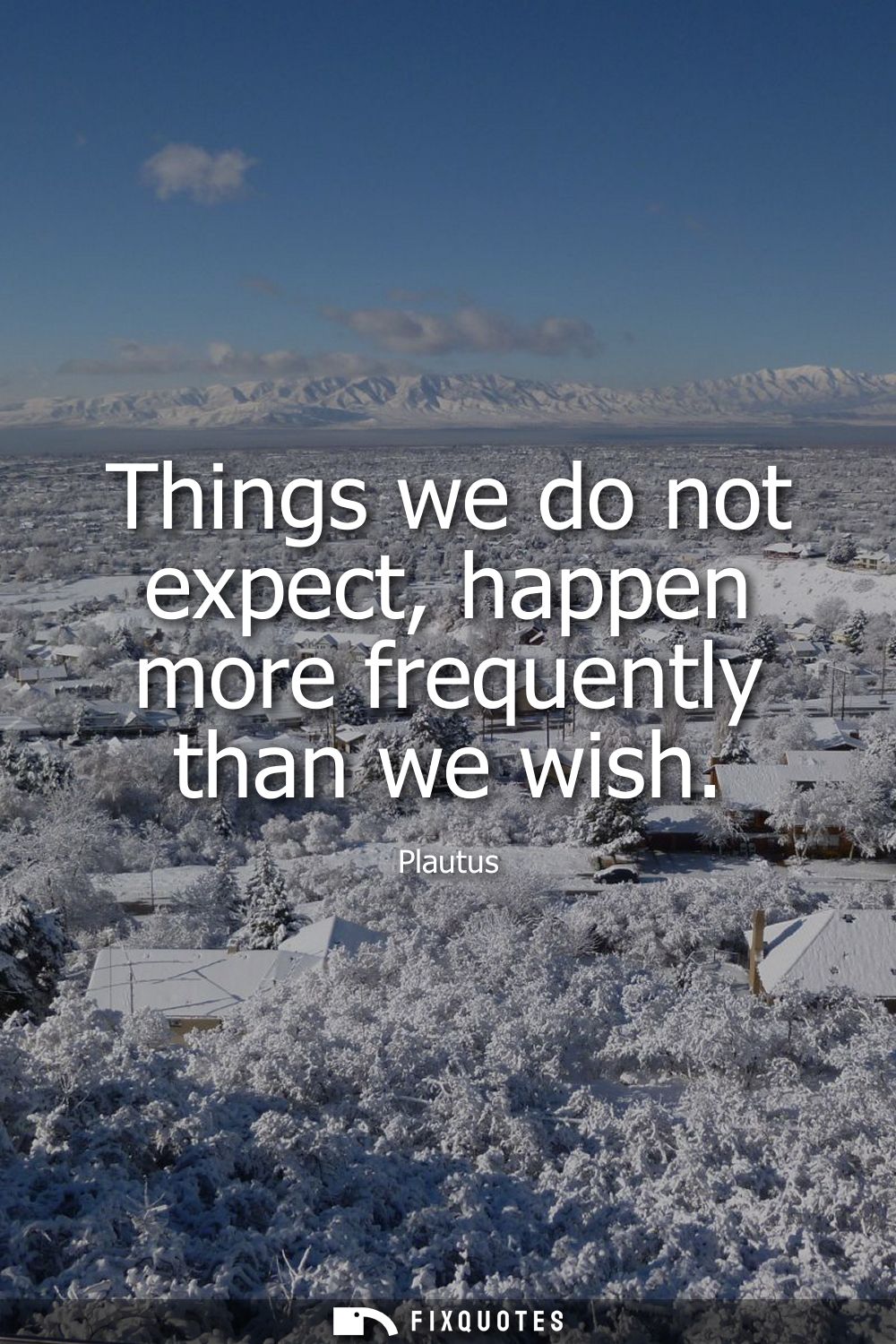
"Things we do not expect, happen more frequently than we wish"
About this Quote
Life, Plautus suggests, has a mean sense of timing. The line lands like a shrug from someone who has watched too many carefully laid plans get mugged in broad daylight. As a playwright of Roman comedy, Plautus made a career out of the gap between what characters think will happen and what actually does: the boastful soldier humiliated, the strict father outwitted, the lovers delayed by some ridiculous accident. The joke is structural. Comedy runs on surprise, but Plautus sharpens it with a hint of complaint: the surprises aren’t just frequent, they’re unwanted.
The phrasing does two things at once. “Things we do not expect” is broad enough to cover the full slapstick inventory - misrecognitions, sudden arrivals, reversals - while “more frequently than we wish” smuggles in a darker realism. The subtext is that people aren’t simply ignorant; they’re invested in their predictions. Expectation is a coping mechanism, a private contract with the world. When the contract is breached, it’s not just inconvenient, it’s humiliating.
Context matters: Plautus wrote in a Rome expanding through war and wealth, a society where fortunes could flip fast and status depended on volatile patronage. His comedies often let slaves outsmart masters and money appear or vanish in a scene. Under the laughter sits a worldview: control is mostly theater, and the gods (or chance) have better writers. The intent isn’t philosophical consolation. It’s a wry warning to the audience: your confidence is part of the setup.
The phrasing does two things at once. “Things we do not expect” is broad enough to cover the full slapstick inventory - misrecognitions, sudden arrivals, reversals - while “more frequently than we wish” smuggles in a darker realism. The subtext is that people aren’t simply ignorant; they’re invested in their predictions. Expectation is a coping mechanism, a private contract with the world. When the contract is breached, it’s not just inconvenient, it’s humiliating.
Context matters: Plautus wrote in a Rome expanding through war and wealth, a society where fortunes could flip fast and status depended on volatile patronage. His comedies often let slaves outsmart masters and money appear or vanish in a scene. Under the laughter sits a worldview: control is mostly theater, and the gods (or chance) have better writers. The intent isn’t philosophical consolation. It’s a wry warning to the audience: your confidence is part of the setup.
Quote Details
| Topic | Free Will & Fate |
|---|---|
| Source | Help us find the source |
| Cite |
Citation Formats
APA Style (7th ed.)
Plautus. (2026, January 17). Things we do not expect, happen more frequently than we wish. FixQuotes. https://fixquotes.com/quotes/things-we-do-not-expect-happen-more-frequently-24466/
Chicago Style
Plautus. "Things we do not expect, happen more frequently than we wish." FixQuotes. January 17, 2026. https://fixquotes.com/quotes/things-we-do-not-expect-happen-more-frequently-24466/.
MLA Style (9th ed.)
"Things we do not expect, happen more frequently than we wish." FixQuotes, 17 Jan. 2026, https://fixquotes.com/quotes/things-we-do-not-expect-happen-more-frequently-24466/. Accessed 5 Mar. 2026.
More Quotes by Plautus
Add to List