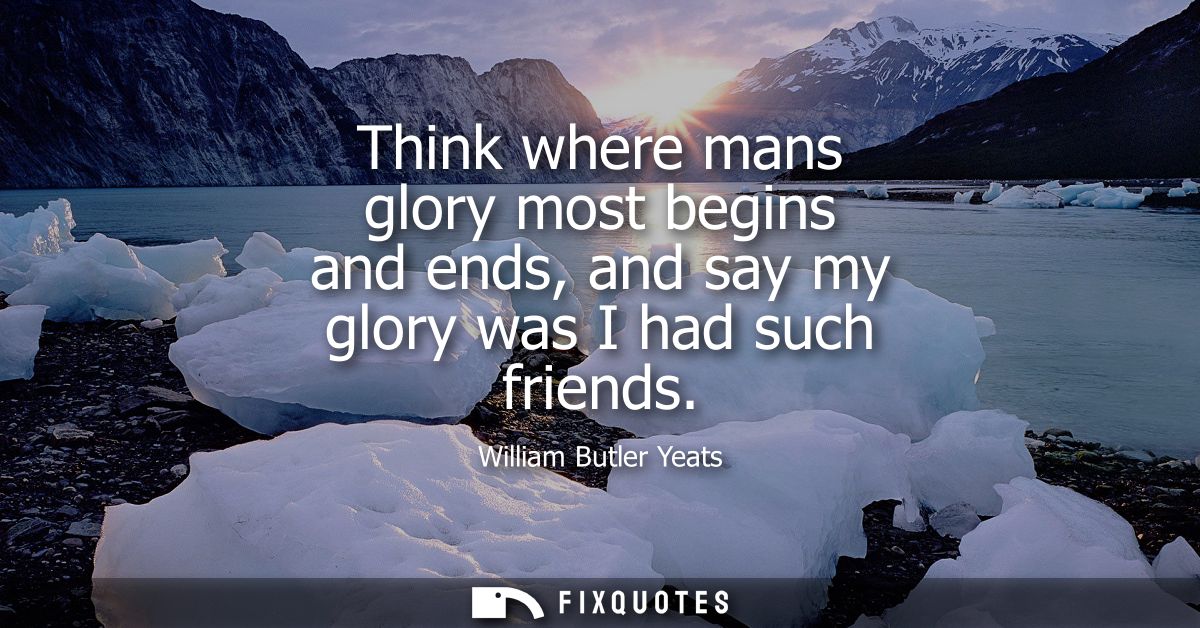
"Think where man's glory most begins and ends, and say my glory was I had such friends"
About this Quote
The clever move is the command: “Think... and say.” Yeats isn’t confessing so much as directing the reader to perform the judgment with him, as if moral clarity requires an active choice. “My glory was I had such friends” sounds simple, even humble, but it’s also a statement of curation and loyalty. “Such” implies a specific caliber: friends worthy of being counted as legacy. Yeats, who moved among artists, revolutionaries, and cultural architects of the Irish Literary Revival, knew how reputations are made in constellations, not in isolation.
Subtextually, it’s both anti-vanity and a new kind of vanity. He rejects public triumph while quietly claiming intimacy with greatness. The line works because it’s emotionally legible and politically savvy: in a time obsessed with nation, cause, and martyrdom, Yeats offers friendship as the unit of meaning - not softer than glory, but sturdier.
Quote Details
| Topic | Friendship |
|---|---|
| Source | Help us find the source |
| Cite |
Citation Formats
APA Style (7th ed.)
Yeats, William Butler. (2026, February 16). Think where man's glory most begins and ends, and say my glory was I had such friends. FixQuotes. https://fixquotes.com/quotes/think-where-mans-glory-most-begins-and-ends-and-37885/
Chicago Style
Yeats, William Butler. "Think where man's glory most begins and ends, and say my glory was I had such friends." FixQuotes. February 16, 2026. https://fixquotes.com/quotes/think-where-mans-glory-most-begins-and-ends-and-37885/.
MLA Style (9th ed.)
"Think where man's glory most begins and ends, and say my glory was I had such friends." FixQuotes, 16 Feb. 2026, https://fixquotes.com/quotes/think-where-mans-glory-most-begins-and-ends-and-37885/. Accessed 10 Mar. 2026.