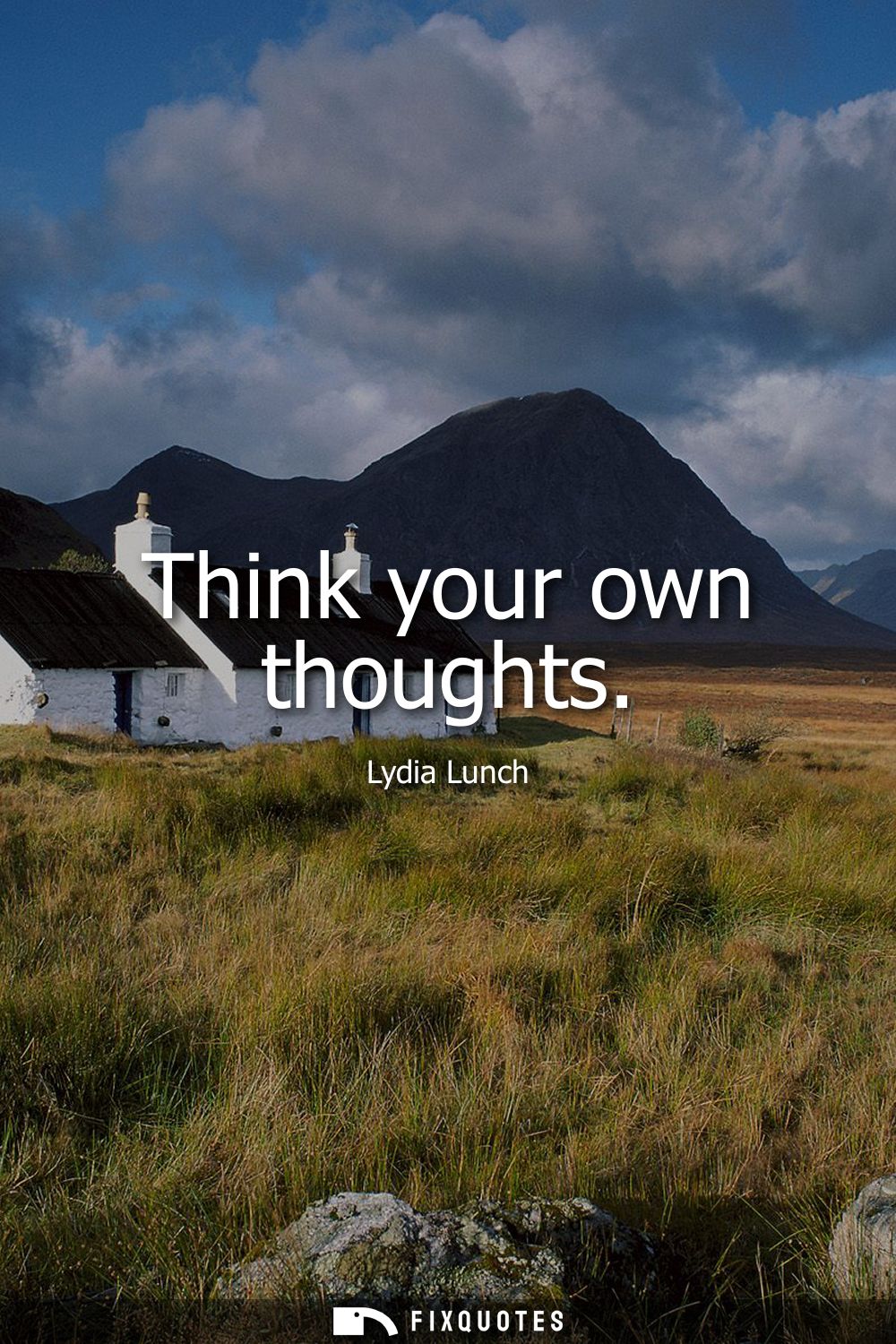
"Think your own thoughts"
About this Quote
A four-word slap in the face, "Think your own thoughts" is Lydia Lunch in miniature: abrasive, spare, and allergic to permission. As a musician who came up through New York’s late-70s no-wave scene, Lunch isn’t offering a gentle self-help mantra. She’s issuing a challenge from inside a culture that rewards mimicry, trend-chasing, and the comforting illusion that someone else has already done the hard work of meaning-making.
The intent is less "be yourself" than "stop outsourcing your mind". The grammar matters: not "think for yourself" (a familiar civic slogan), but "your own thoughts" - a claim about ownership. It implies the modern condition she’s always bristled against: our inner lives colonized by taste-makers, lovers, bosses, algorithms, scenes. Lunch’s work has long weaponized discomfort; this line does the same by presuming you’re complicit. If you’re not thinking your own thoughts, whose are they? The question stings.
The subtext is punk ethics stripped of romanticism. Authenticity isn’t a vibe; it’s a discipline, and it costs you social ease. To think your own thoughts is to risk being unliked, unbooked, unfollowed, mislabeled. Lunch’s career - confrontational performances, unsparing lyrics, a cultivated refusal of polish - makes the quote read like lived advice, not branding.
Context turns the phrase into an antidote for a time when identity is often assembled from templates. Lunch isn’t asking for originality as aesthetic flex. She’s insisting on mental sovereignty as survival.
The intent is less "be yourself" than "stop outsourcing your mind". The grammar matters: not "think for yourself" (a familiar civic slogan), but "your own thoughts" - a claim about ownership. It implies the modern condition she’s always bristled against: our inner lives colonized by taste-makers, lovers, bosses, algorithms, scenes. Lunch’s work has long weaponized discomfort; this line does the same by presuming you’re complicit. If you’re not thinking your own thoughts, whose are they? The question stings.
The subtext is punk ethics stripped of romanticism. Authenticity isn’t a vibe; it’s a discipline, and it costs you social ease. To think your own thoughts is to risk being unliked, unbooked, unfollowed, mislabeled. Lunch’s career - confrontational performances, unsparing lyrics, a cultivated refusal of polish - makes the quote read like lived advice, not branding.
Context turns the phrase into an antidote for a time when identity is often assembled from templates. Lunch isn’t asking for originality as aesthetic flex. She’s insisting on mental sovereignty as survival.
Quote Details
| Topic | Reason & Logic |
|---|
More Quotes by Lydia
Add to List