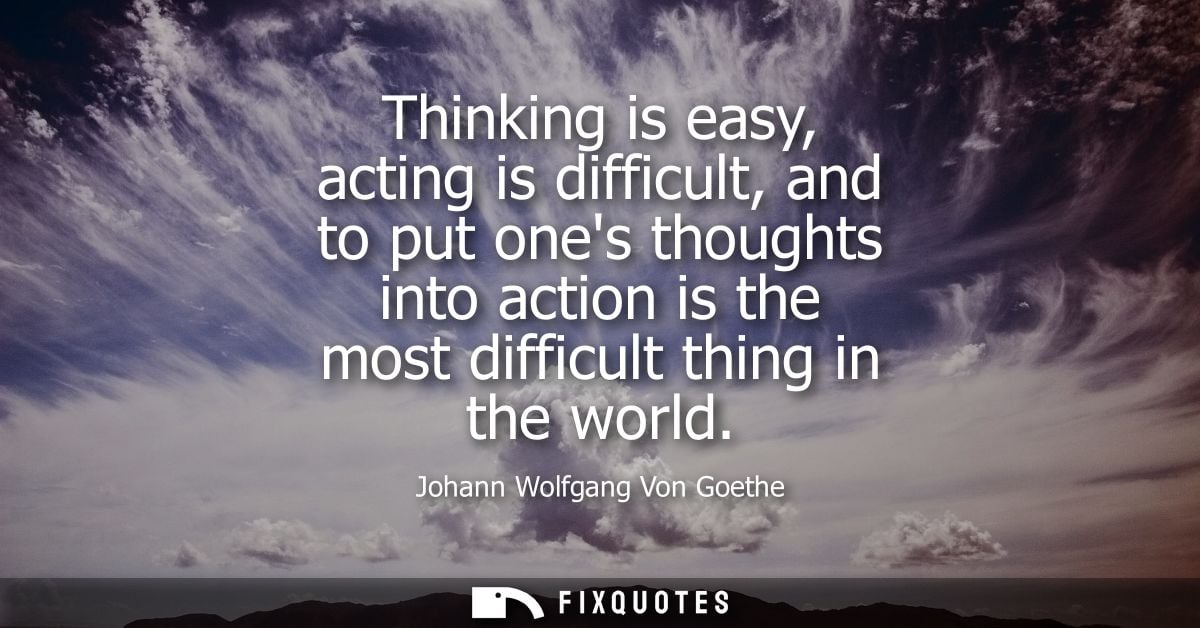
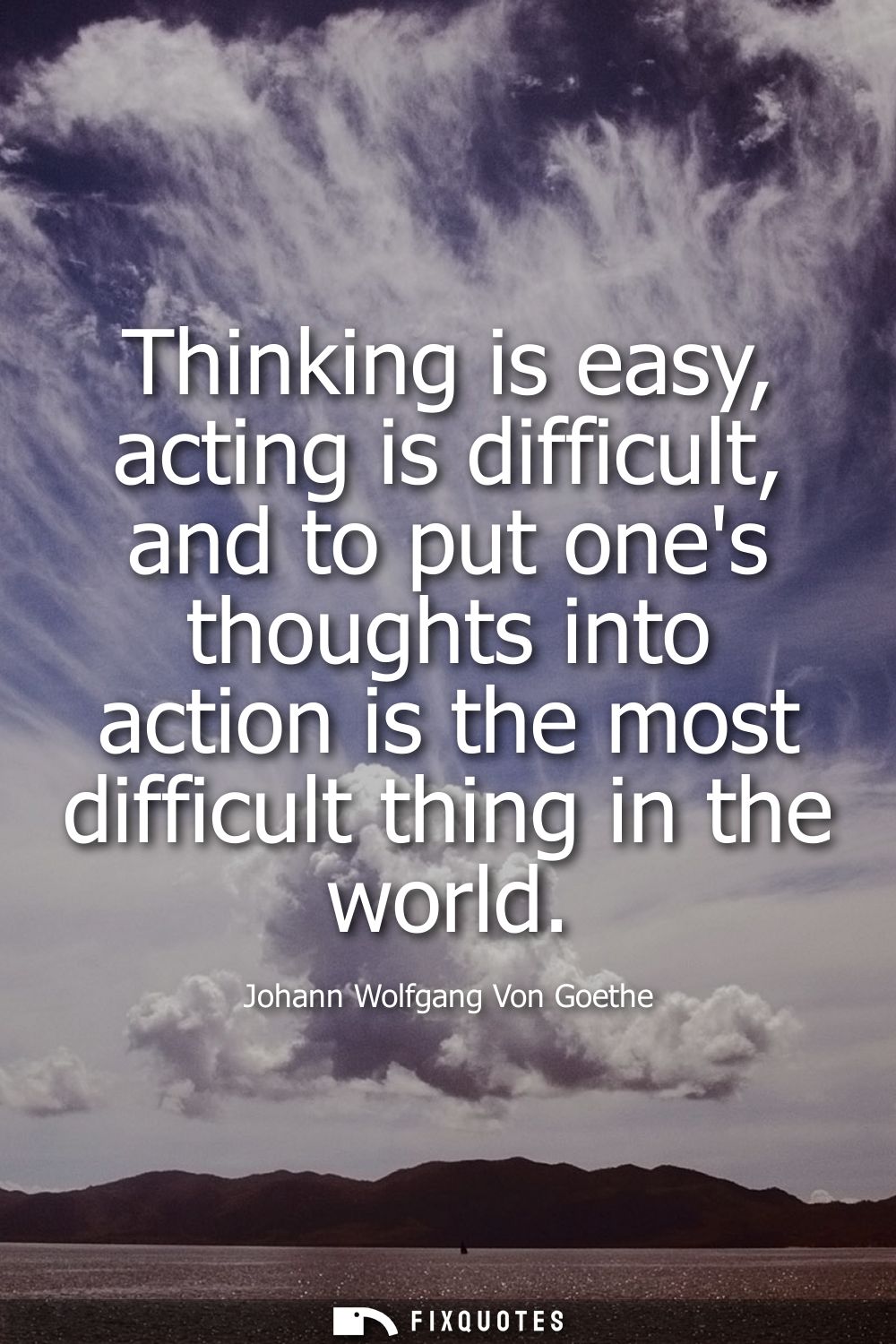
"Thinking is easy, acting is difficult, and to put one's thoughts into action is the most difficult thing in the world"
About this Quote
Goethe’s line cuts against the flattering modern myth that ideas are the hard part. It demotes “thinking” to the comfortable stage: private, consequence-free, endlessly revisable. The sting is in the escalation. Acting is “difficult” because the world pushes back; it introduces friction, risk, and other people. But translating thought into action is “the most difficult thing in the world” because it forces a merger of two incompatible tempos: the mind’s clean abstractions and reality’s messy constraints.
The subtext is a critique of self-image. We like to mistake mental effort for moral effort, especially when our thoughts are high-minded. Goethe—who lived through the Enlightenment’s confidence, the upheaval of the French Revolution, and the early shocks of modernity—had reason to distrust pure reason as a substitute for lived commitment. In that context, “put one’s thoughts into action” isn’t just productivity advice; it’s an ethical demand. If your convictions can’t survive contact with consequence, they were never convictions, only rehearsals.
Rhetorically, the quote works because it compresses an entire psychology into a simple triptych. “Thinking” sounds virtuous, “acting” sounds brave, and the final clause exposes how often we stop at stage one and call it depth. It also recognizes the hidden cost of coherence: to act on a thought is to accept being judged by results, not intentions. In Goethe’s world—and ours—that’s where most noble ideas quietly go to die.
The subtext is a critique of self-image. We like to mistake mental effort for moral effort, especially when our thoughts are high-minded. Goethe—who lived through the Enlightenment’s confidence, the upheaval of the French Revolution, and the early shocks of modernity—had reason to distrust pure reason as a substitute for lived commitment. In that context, “put one’s thoughts into action” isn’t just productivity advice; it’s an ethical demand. If your convictions can’t survive contact with consequence, they were never convictions, only rehearsals.
Rhetorically, the quote works because it compresses an entire psychology into a simple triptych. “Thinking” sounds virtuous, “acting” sounds brave, and the final clause exposes how often we stop at stage one and call it depth. It also recognizes the hidden cost of coherence: to act on a thought is to accept being judged by results, not intentions. In Goethe’s world—and ours—that’s where most noble ideas quietly go to die.
Quote Details
| Topic | Motivational |
|---|
More Quotes by Johann
Add to List