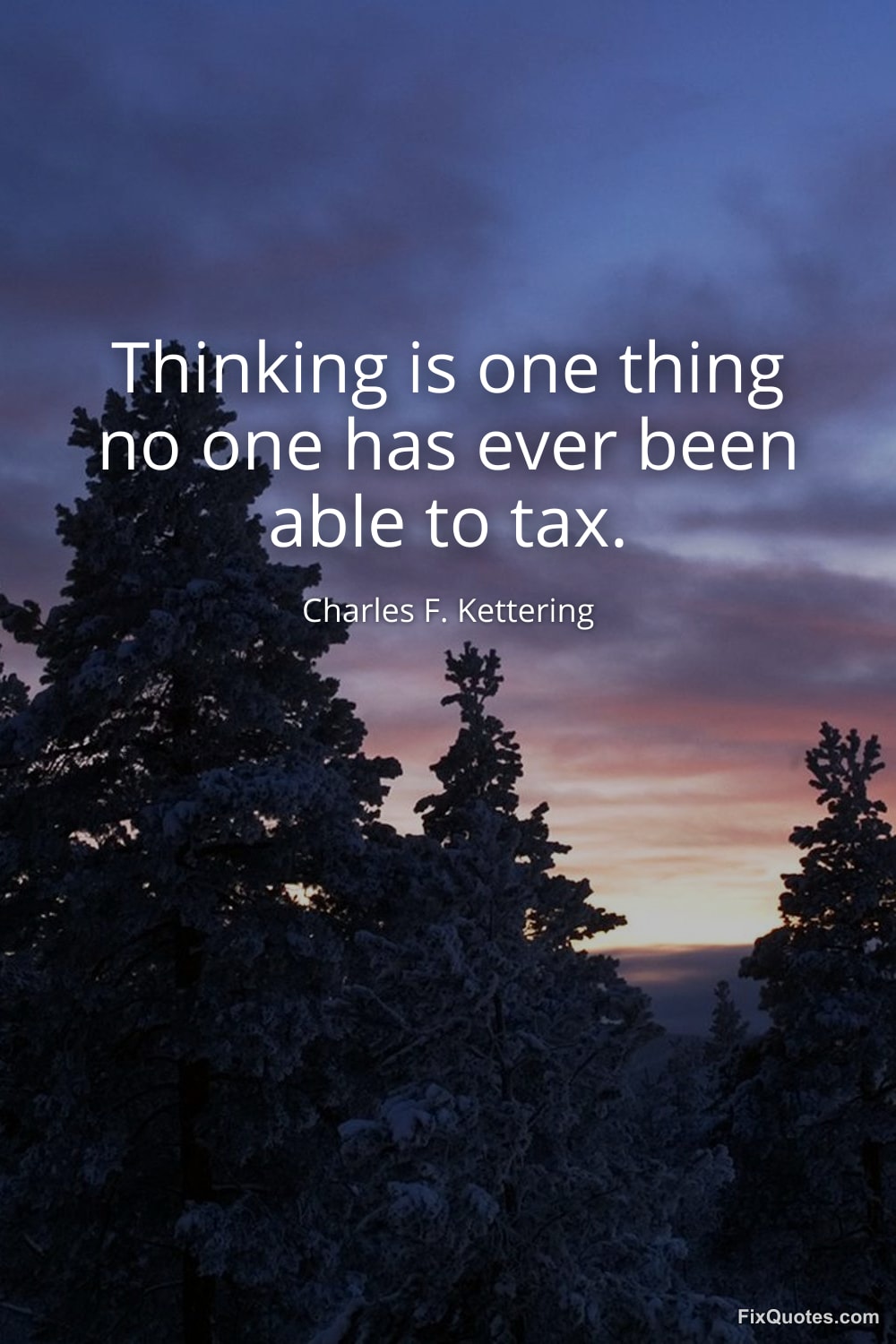
"Thinking is one thing no one has ever been able to tax"
About this Quote
Kettering’s line flatters the mind while quietly indicting everything built to corral it. An inventor who spent his life turning ideas into machines and patents, he knew the moment thinking becomes legible to institutions, it stops being “thinking” and turns into property, paperwork, and revenue streams. The wit is in the implied boundary: governments can tax income, land, goods, transactions; employers can bill your hours; companies can monetize your attention. But the raw, private act of forming an idea still slips the net.
The subtext is less libertarian triumphalism than a pragmatic theory of freedom. Kettering isn’t arguing that people live beyond constraint; he’s pointing out the one domain where constraint is hardest to enforce. You can regulate behavior, not imagination. That distinction matters in an industrial America where efficiency worship and bureaucratic growth threatened to standardize life. Coming from a man associated with General Motors and industrial R&D, it also reads as a defense of creative labor inside systems that want outputs. Innovation depends on an inner surplus the ledger can’t quite capture.
The barb, of course, is that society keeps trying. Schools grade “originality.” Corporations measure “innovation.” Platforms convert thought into data. Even self-help culture turns inner life into productivity. Kettering’s sentence works because it holds up an un-taxable ideal while daring you to notice how quickly the world invents new ways to invoice what used to be private.
The subtext is less libertarian triumphalism than a pragmatic theory of freedom. Kettering isn’t arguing that people live beyond constraint; he’s pointing out the one domain where constraint is hardest to enforce. You can regulate behavior, not imagination. That distinction matters in an industrial America where efficiency worship and bureaucratic growth threatened to standardize life. Coming from a man associated with General Motors and industrial R&D, it also reads as a defense of creative labor inside systems that want outputs. Innovation depends on an inner surplus the ledger can’t quite capture.
The barb, of course, is that society keeps trying. Schools grade “originality.” Corporations measure “innovation.” Platforms convert thought into data. Even self-help culture turns inner life into productivity. Kettering’s sentence works because it holds up an un-taxable ideal while daring you to notice how quickly the world invents new ways to invoice what used to be private.
Quote Details
| Topic | Witty One-Liners |
|---|---|
| Source | Attributed to Charles F. Kettering; recorded on Wikiquote (Charles F. Kettering) as: "Thinking is one thing that no one has ever been able to tax." |
| Cite |
Citation Formats
APA Style (7th ed.)
Kettering, Charles F. (2026, January 14). Thinking is one thing no one has ever been able to tax. FixQuotes. https://fixquotes.com/quotes/thinking-is-one-thing-no-one-has-ever-been-able-137419/
Chicago Style
Kettering, Charles F. "Thinking is one thing no one has ever been able to tax." FixQuotes. January 14, 2026. https://fixquotes.com/quotes/thinking-is-one-thing-no-one-has-ever-been-able-137419/.
MLA Style (9th ed.)
"Thinking is one thing no one has ever been able to tax." FixQuotes, 14 Jan. 2026, https://fixquotes.com/quotes/thinking-is-one-thing-no-one-has-ever-been-able-137419/. Accessed 28 Mar. 2026.
More Quotes by Charles
Add to List