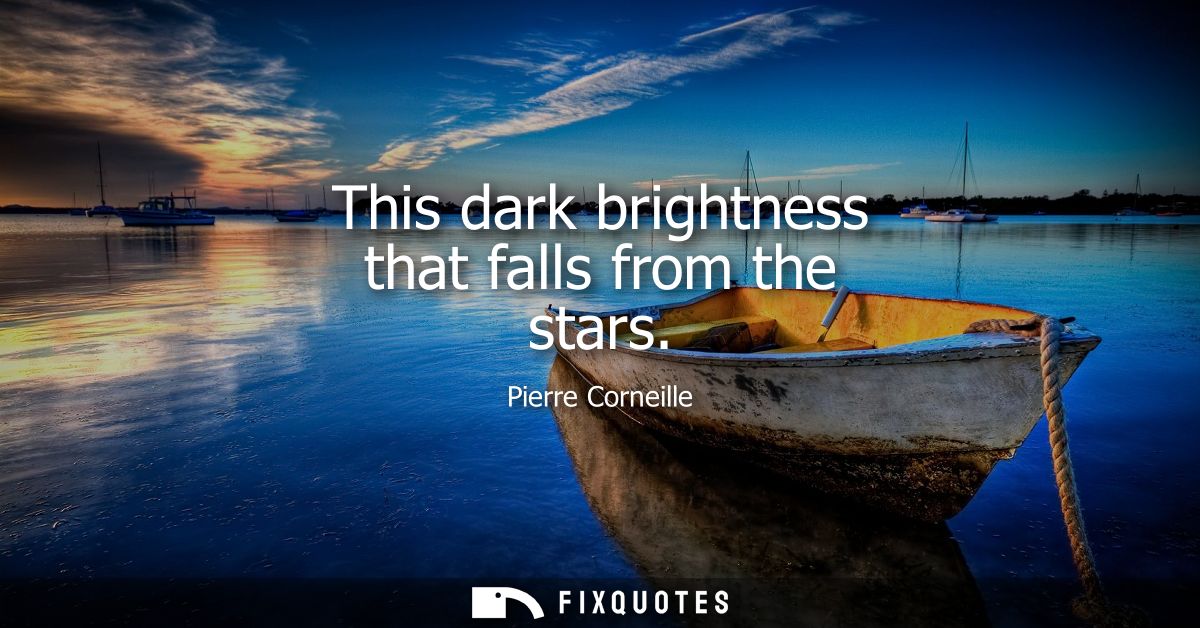
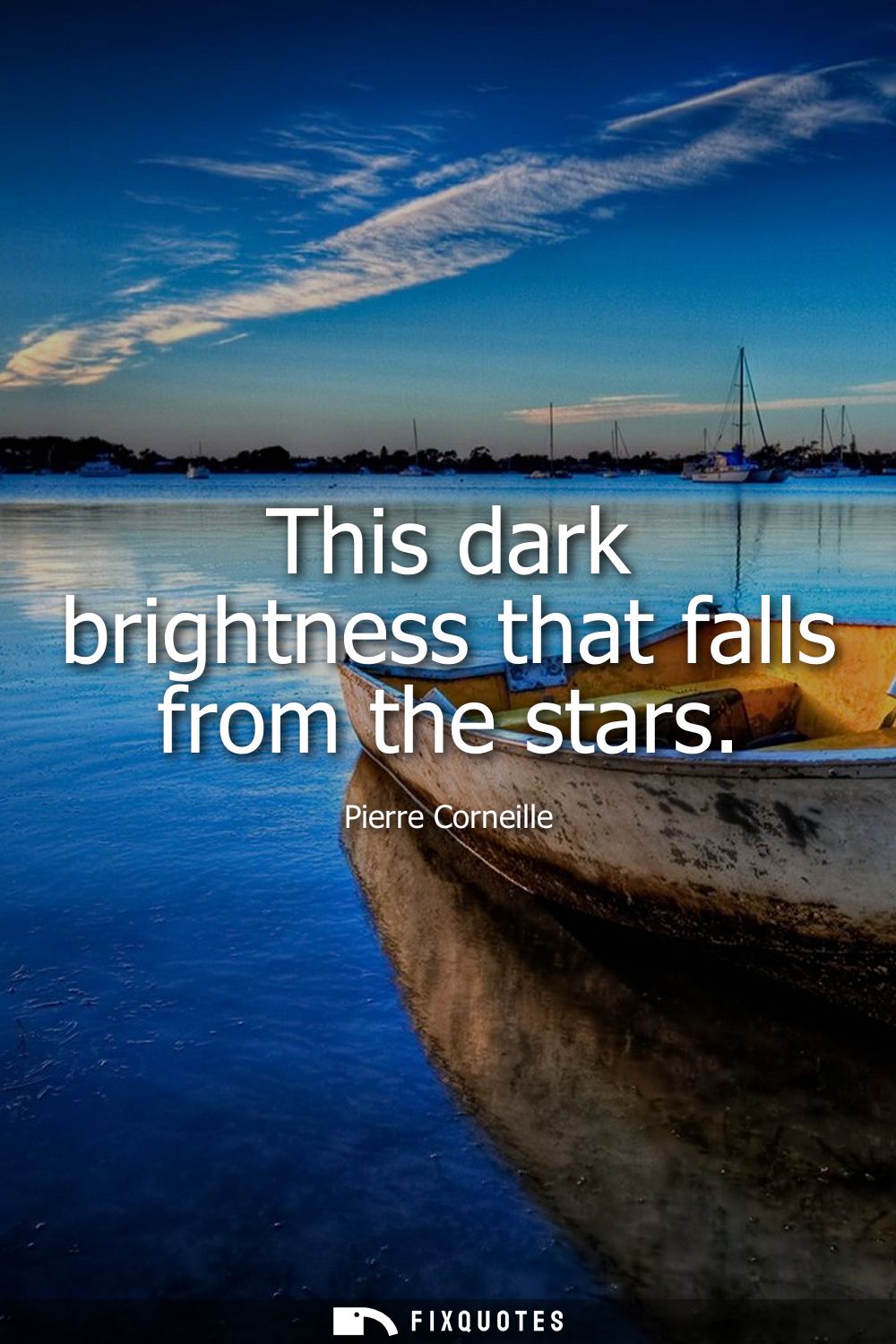
"This dark brightness that falls from the stars"
About this Quote
“Dark brightness” is Corneille in miniature: a verbal duel staged inside a single image. The phrase yokes opposites not to be “poetic,” but to make conflict feel inevitable. Stars are supposed to clarify the night; here they illuminate it without defeating it. That’s the dramatist’s worldview: lucidity that doesn’t rescue you, grandeur that arrives laced with menace.
In 17th-century French classicism, light is rarely just light. It’s reason, honor, divine order, the hard shine of public virtue. Darkness is desire, secrecy, political threat, the private self. Corneille’s theater lives on the collision between those realms, where characters speak in the polished language of duty while privately hemorrhaging. “This dark brightness” captures that emotional physics: the very things meant to guide you (fate, glory, gods, ideology, even love) can become the source of your most sophisticated despair.
The stars matter because they’re distant and indifferent. Their “fall” suggests something like grace or destiny descending, but the paradox insists it’s compromised on arrival. You can read the line as a portrait of aristocratic ambition: the higher the ideal, the colder its light. Or as political subtext from an era obsessed with order after civil unrest: authority shines, but it also casts a shadow big enough to live in.
Corneille’s intent isn’t comfort. It’s a controlled kind of vertigo: letting the audience feel how the sublime can be simultaneously illuminating and oppressive, like a spotlight that also interrogates.
In 17th-century French classicism, light is rarely just light. It’s reason, honor, divine order, the hard shine of public virtue. Darkness is desire, secrecy, political threat, the private self. Corneille’s theater lives on the collision between those realms, where characters speak in the polished language of duty while privately hemorrhaging. “This dark brightness” captures that emotional physics: the very things meant to guide you (fate, glory, gods, ideology, even love) can become the source of your most sophisticated despair.
The stars matter because they’re distant and indifferent. Their “fall” suggests something like grace or destiny descending, but the paradox insists it’s compromised on arrival. You can read the line as a portrait of aristocratic ambition: the higher the ideal, the colder its light. Or as political subtext from an era obsessed with order after civil unrest: authority shines, but it also casts a shadow big enough to live in.
Corneille’s intent isn’t comfort. It’s a controlled kind of vertigo: letting the audience feel how the sublime can be simultaneously illuminating and oppressive, like a spotlight that also interrogates.
Quote Details
| Topic | Poetry |
|---|---|
| Source | Verified source: Le Cid (Pierre Corneille, 1637)
Evidence: Cette obscure clarté qui tombe des étoiles (Acte IV, Scène III (line often numbered ~1272 in some editions; appears on p. 435 in the Hémon edition facsimile on Wikisource)). The English quote "This dark brightness that falls from the stars" is a translation/paraphrase of Corneille’s original French line "Cette obscure clarté qui tombe des étoiles" from the play *Le Cid*, spoken in Act IV, Scene III (in Rodrigue’s battle narrative). The primary, first-publication source is Corneille’s *Le Cid* in its 17th-century printed edition (published in Paris by Augustin Courbé, 1637; ‘achevé d’imprimer’ dated late March 1637 is commonly given as March 24, 1637, though some bibliographic notes cite March 23, 1637). See corroborating bibliographic discussion for the 1637 Courbé edition on Wikisource and general publication-date context on Wikipedia. Other candidates (1) A Sourcebook for English Lyric Poetry (John Tomarchio, 2023) compilation95.0% ... This dark brightness that falls from the stars. Pierre Corneille, Le Cid Cold War. Bernard Baruch The pink itself... |
| Cite |
Citation Formats
APA Style (7th ed.)
Corneille, Pierre. (2026, February 21). This dark brightness that falls from the stars. FixQuotes. https://fixquotes.com/quotes/this-dark-brightness-that-falls-from-the-stars-128640/
Chicago Style
Corneille, Pierre. "This dark brightness that falls from the stars." FixQuotes. February 21, 2026. https://fixquotes.com/quotes/this-dark-brightness-that-falls-from-the-stars-128640/.
MLA Style (9th ed.)
"This dark brightness that falls from the stars." FixQuotes, 21 Feb. 2026, https://fixquotes.com/quotes/this-dark-brightness-that-falls-from-the-stars-128640/. Accessed 27 Mar. 2026.
More Quotes by Pierre
Add to List