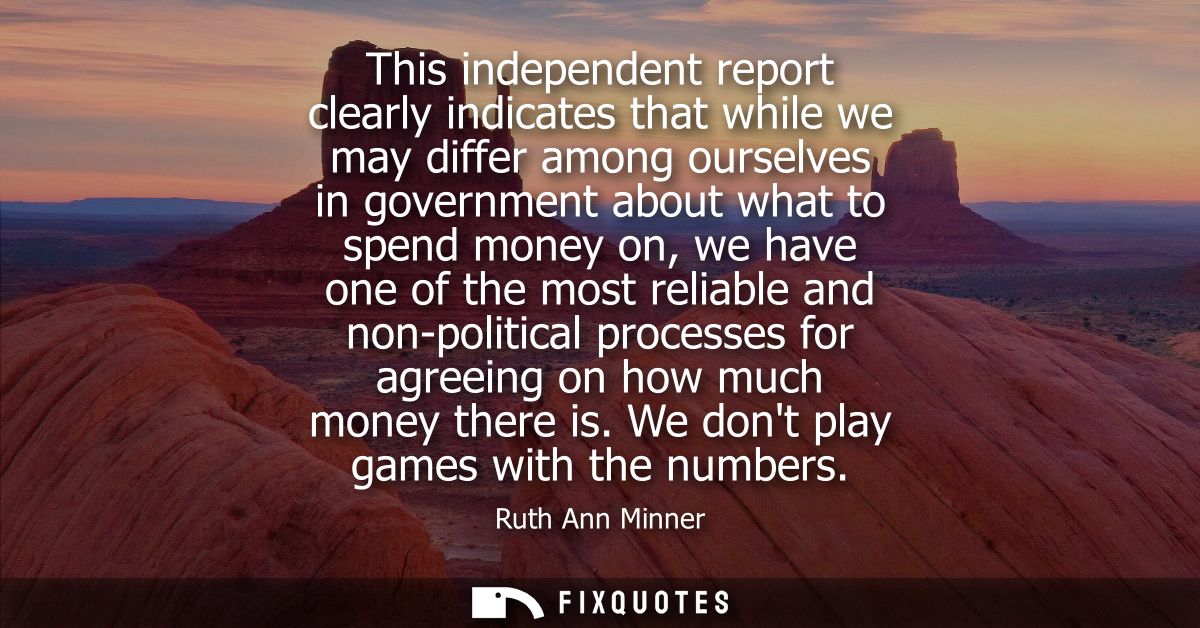
"This independent report clearly indicates that while we may differ among ourselves in government about what to spend money on, we have one of the most reliable and non-political processes for agreeing on how much money there is. We don't play games with the numbers"
About this Quote
The key move is the clean separation between two kinds of disagreement. "What to spend money on" is framed as legitimate politics, the arena where values clash and coalitions trade. "How much money there is" is framed as settled reality, where gamesmanship becomes not just wrong but almost indecent. When she says "non-political processes", she's not denying politics; she's drawing a boundary line and daring opponents to cross it. If they dispute the numbers, they're not just arguing policy-they're attacking the rules of the shared spreadsheet that makes policy possible.
"We don't play games with the numbers" lands like a rebuke aimed at a familiar villain: the politician who inflates projections, hides costs, or cooks the books to make a proposal seem painless. It's also a credibility play to taxpayers and bond markets alike: trust us, because our fights happen in the open, and our math doesn't change to fit the mood. In the subtext, Minner is selling governance as a discipline-an insistence that adulthood begins where accounting starts.
Quote Details
| Topic | Money |
|---|---|
| Source | Help us find the source |
| Cite |
Citation Formats
APA Style (7th ed.)
Minner, Ruth Ann. (2026, January 16). This independent report clearly indicates that while we may differ among ourselves in government about what to spend money on, we have one of the most reliable and non-political processes for agreeing on how much money there is. We don't play games with the numbers. FixQuotes. https://fixquotes.com/quotes/this-independent-report-clearly-indicates-that-130672/
Chicago Style
Minner, Ruth Ann. "This independent report clearly indicates that while we may differ among ourselves in government about what to spend money on, we have one of the most reliable and non-political processes for agreeing on how much money there is. We don't play games with the numbers." FixQuotes. January 16, 2026. https://fixquotes.com/quotes/this-independent-report-clearly-indicates-that-130672/.
MLA Style (9th ed.)
"This independent report clearly indicates that while we may differ among ourselves in government about what to spend money on, we have one of the most reliable and non-political processes for agreeing on how much money there is. We don't play games with the numbers." FixQuotes, 16 Jan. 2026, https://fixquotes.com/quotes/this-independent-report-clearly-indicates-that-130672/. Accessed 12 Feb. 2026.