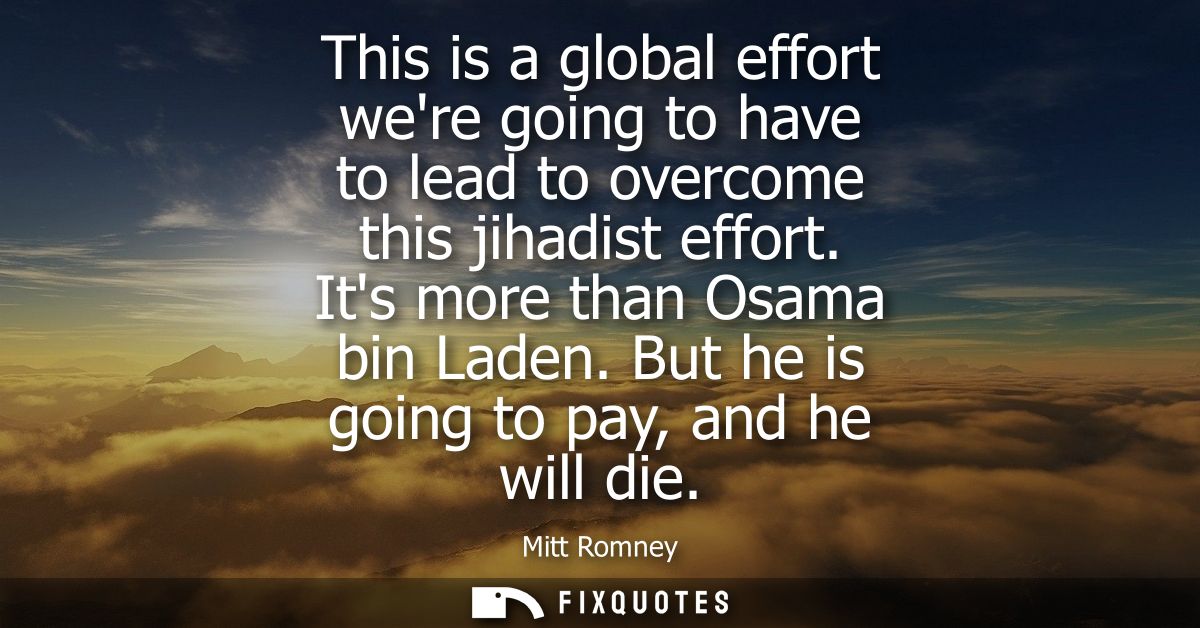
"This is a global effort we're going to have to lead to overcome this jihadist effort. It's more than Osama bin Laden. But he is going to pay, and he will die"
About this Quote
Then comes the pivot: “jihadist effort.” It’s a term that, in U.S. political speech, often functions less as description than as a sorting mechanism, bundling disparate militant groups into a single civilizational adversary. That rhetorical compression is the point. “It’s more than Osama bin Laden” acknowledges what the post-9/11 years taught Americans the hard way: removing a figurehead doesn’t dissolve the network, the ideology, or the grievances that recruit new foot soldiers. It’s also a quiet warning against premature victory laps.
Still, Romney ends by making it personal: “he is going to pay, and he will die.” The certainty is the message, not the strategy. It offers emotional closure - vengeance as governance - and signals resolve to voters who equate presidential competence with the promise of decisive force. The subtext is electoral as much as geopolitical: strength, clarity, and retribution packaged in a tight cadence, leaving little room for the messy realities of intelligence failures, coalition politics, and the long tail of conflict.
Quote Details
| Topic | War |
|---|---|
| Source | Help us find the source |
| Cite |
Citation Formats
APA Style (7th ed.)
Romney, Mitt. (2026, January 17). This is a global effort we're going to have to lead to overcome this jihadist effort. It's more than Osama bin Laden. But he is going to pay, and he will die. FixQuotes. https://fixquotes.com/quotes/this-is-a-global-effort-were-going-to-have-to-28153/
Chicago Style
Romney, Mitt. "This is a global effort we're going to have to lead to overcome this jihadist effort. It's more than Osama bin Laden. But he is going to pay, and he will die." FixQuotes. January 17, 2026. https://fixquotes.com/quotes/this-is-a-global-effort-were-going-to-have-to-28153/.
MLA Style (9th ed.)
"This is a global effort we're going to have to lead to overcome this jihadist effort. It's more than Osama bin Laden. But he is going to pay, and he will die." FixQuotes, 17 Jan. 2026, https://fixquotes.com/quotes/this-is-a-global-effort-were-going-to-have-to-28153/. Accessed 31 Mar. 2026.