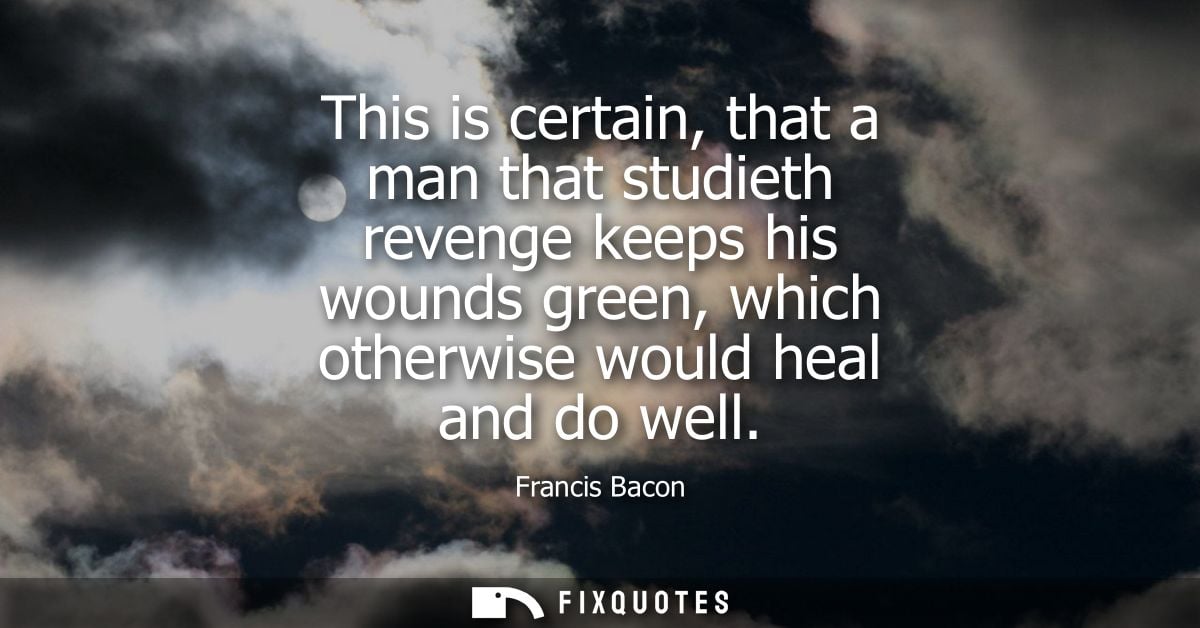
"This is certain, that a man that studieth revenge keeps his wounds green, which otherwise would heal and do well"
About this Quote
The intent is practical and surgical, which fits Bacon the philosopher-statesman: he is less interested in moralizing than in diagnosing. "Studieth" matters. Revenge is not an impulse here; its a hobby, a discipline, a mental project. Once you start researching your retaliation, you are also rehearsing your hurt, revisiting it until it becomes identity. The subtext is that the injury is no longer the primary problem. The fixation is.
Context sharpens the point. Bacon writes in an early modern world where honor cultures and duels made vengeance look socially rational, even necessary. He pushes against that script with an argument that sounds almost proto-psychological: time and ordinary life are competent healers if you stop reopening the cut. "Would heal and do well" is deliberately plain, domestic language, the kind that makes revenge seem not heroic but juvenile, a refusal to let the body do its natural repair.
The quiet cynicism is that revenge doesnt restore what was taken; it guarantees you keep paying interest on the debt. Bacon sells restraint not as sainthood, but as self-preservation.
Quote Details
| Topic | Forgiveness |
|---|---|
| Source | Francis Bacon, essay "Of Revenge," in Essays. The sentence appears in Bacon's essay commonly titled "Of Revenge" in his collected Essays (public-domain editions). |
| Cite |
Citation Formats
APA Style (7th ed.)
Bacon, Francis. (2026, January 17). This is certain, that a man that studieth revenge keeps his wounds green, which otherwise would heal and do well. FixQuotes. https://fixquotes.com/quotes/this-is-certain-that-a-man-that-studieth-revenge-35972/
Chicago Style
Bacon, Francis. "This is certain, that a man that studieth revenge keeps his wounds green, which otherwise would heal and do well." FixQuotes. January 17, 2026. https://fixquotes.com/quotes/this-is-certain-that-a-man-that-studieth-revenge-35972/.
MLA Style (9th ed.)
"This is certain, that a man that studieth revenge keeps his wounds green, which otherwise would heal and do well." FixQuotes, 17 Jan. 2026, https://fixquotes.com/quotes/this-is-certain-that-a-man-that-studieth-revenge-35972/. Accessed 7 Apr. 2026.