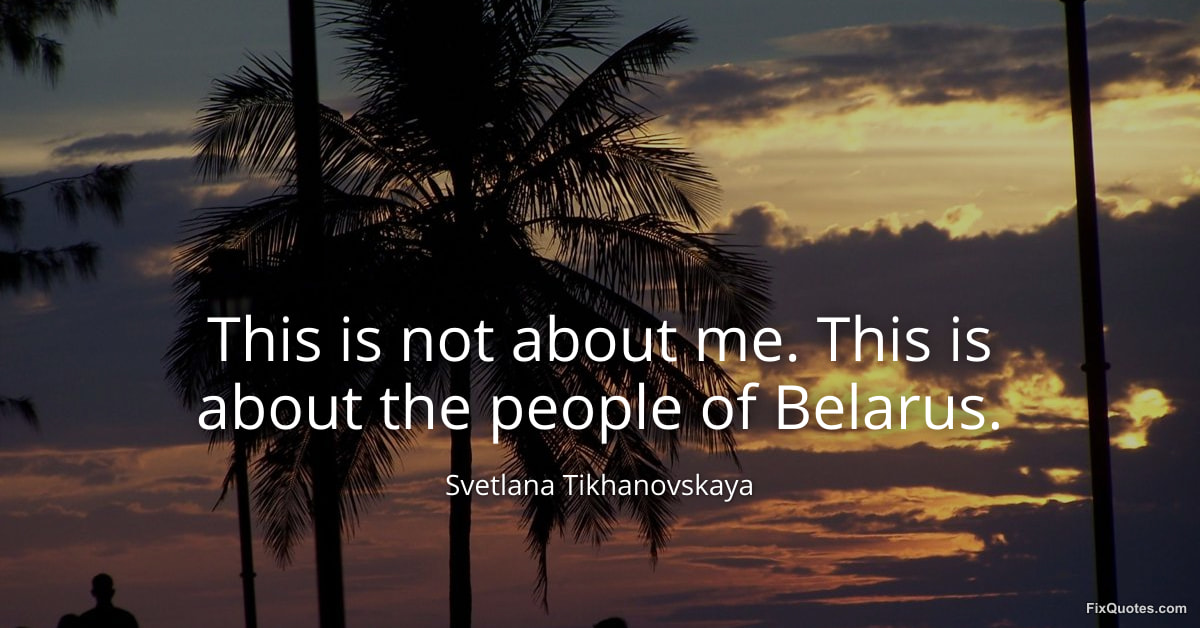
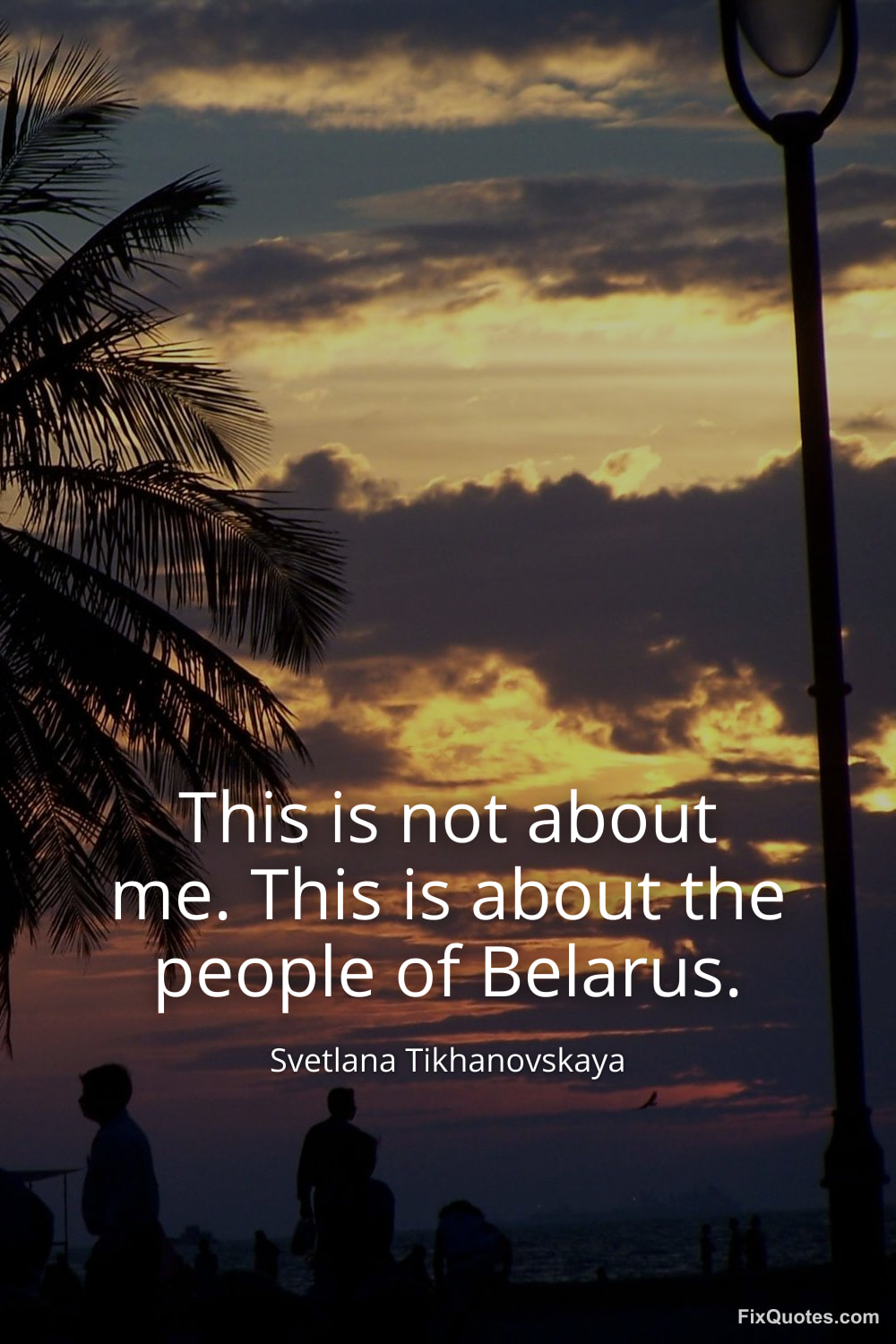
"This is not about me. This is about the people of Belarus"
About this Quote
It’s a line designed to disarm both cult-of-personality politics and the regime’s favorite smear: that opposition is just ego in a new suit. When Svetlana Tikhanovskaya says, “This is not about me. This is about the people of Belarus,” she’s compressing an entire legitimacy argument into two blunt sentences. In an authoritarian system, the state tries to make every challenge look personal: a rivalry, a grudge, a vanity project. Her phrasing refuses that frame. She’s not asking Belarusians to trade one “strong leader” for another; she’s offering herself as a conduit, almost an accidental placeholder, for a broader democratic demand.
The subtext carries a second audience: foreign governments and media. Tikhanovskaya became internationally visible after the 2020 election crisis, when protests and state violence turned Belarus into a global story. By stripping herself out of the center, she makes it harder for outsiders to reduce the conflict to a single charismatic dissident. It’s also a quiet rebuke to the way the world consumes resistance movements: as personalities, not publics.
There’s an emotional tactic here, too. Tikhanovskaya’s political origin story was famously unglamorous - she stepped in when her husband was jailed. “Not about me” functions as credibility: reluctant, duty-bound, not power-hungry. That restraint reads as moral seriousness in a landscape saturated with propaganda. The line doesn’t just appeal to solidarity; it tries to reassign ownership of the struggle, turning a leader into a witness and a nation into the protagonist.
The subtext carries a second audience: foreign governments and media. Tikhanovskaya became internationally visible after the 2020 election crisis, when protests and state violence turned Belarus into a global story. By stripping herself out of the center, she makes it harder for outsiders to reduce the conflict to a single charismatic dissident. It’s also a quiet rebuke to the way the world consumes resistance movements: as personalities, not publics.
There’s an emotional tactic here, too. Tikhanovskaya’s political origin story was famously unglamorous - she stepped in when her husband was jailed. “Not about me” functions as credibility: reluctant, duty-bound, not power-hungry. That restraint reads as moral seriousness in a landscape saturated with propaganda. The line doesn’t just appeal to solidarity; it tries to reassign ownership of the struggle, turning a leader into a witness and a nation into the protagonist.
Quote Details
| Topic | Leadership |
|---|---|
| Source | Press statements and interviews, 2020–2021 [translated] |
| Cite |
Citation Formats
APA Style (7th ed.)
Tikhanovskaya, Svetlana. (2026, January 26). This is not about me. This is about the people of Belarus. FixQuotes. https://fixquotes.com/quotes/this-is-not-about-me-this-is-about-the-people-of-184597/
Chicago Style
Tikhanovskaya, Svetlana. "This is not about me. This is about the people of Belarus." FixQuotes. January 26, 2026. https://fixquotes.com/quotes/this-is-not-about-me-this-is-about-the-people-of-184597/.
MLA Style (9th ed.)
"This is not about me. This is about the people of Belarus." FixQuotes, 26 Jan. 2026, https://fixquotes.com/quotes/this-is-not-about-me-this-is-about-the-people-of-184597/. Accessed 28 Mar. 2026.
More Quotes by Svetlana
Add to List