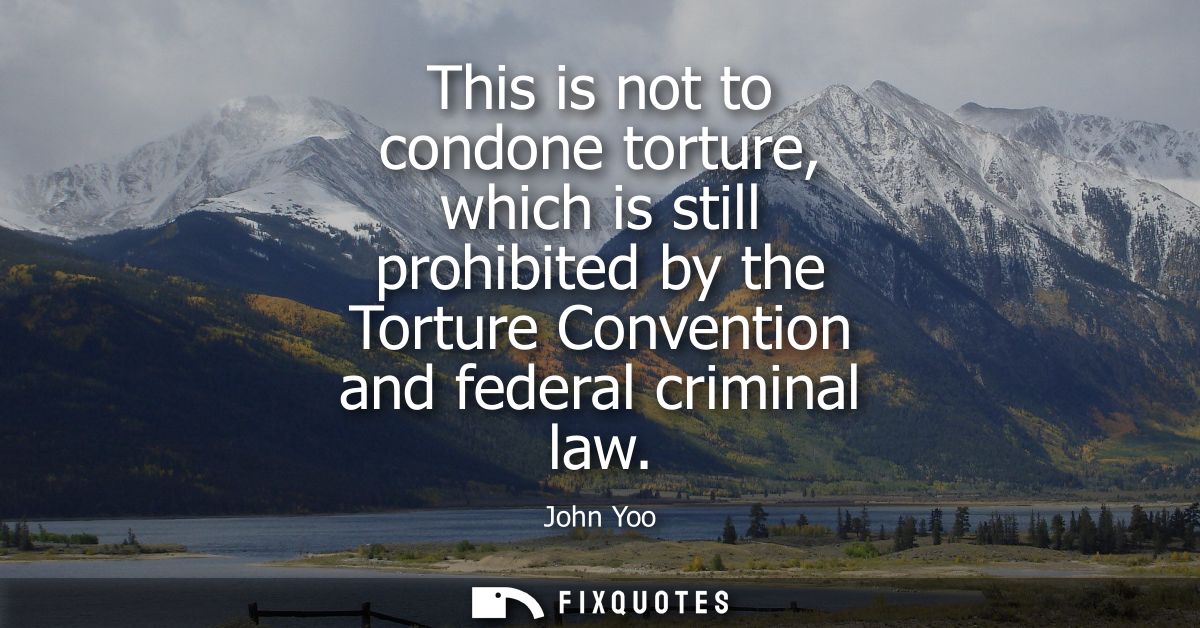
"This is not to condone torture, which is still prohibited by the Torture Convention and federal criminal law"
About this Quote
The subtext is procedural innocence. By foregrounding the Torture Convention and federal criminal law, Yoo invokes the authority of the very prohibitions his broader memo culture was accused of undermining. That move matters because it aims at two audiences at once: internal policymakers who need rhetorical cover and external overseers who might later read the paper trail. The sentence is a time capsule of the post-9/11 legal project: translate moral catastrophe into statutory interpretation, then treat the translation as exculpatory.
Context does the heavy lifting. Yoo, as an Office of Legal Counsel figure during the Bush administration, wrote opinions that notoriously narrowed “torture” and expanded executive power. Read against that backdrop, the sentence functions like a legal seatbelt. It anticipates condemnation, then tries to preempt it: we didn’t endorse illegality, we merely explored the boundaries. The genius, and the danger, is that it sounds responsible while training the system to treat cruelty as a definitional problem.
Quote Details
| Topic | Human Rights |
|---|---|
| Source | Help us find the source |
| Cite |
Citation Formats
APA Style (7th ed.)
Yoo, John. (2026, January 16). This is not to condone torture, which is still prohibited by the Torture Convention and federal criminal law. FixQuotes. https://fixquotes.com/quotes/this-is-not-to-condone-torture-which-is-still-98819/
Chicago Style
Yoo, John. "This is not to condone torture, which is still prohibited by the Torture Convention and federal criminal law." FixQuotes. January 16, 2026. https://fixquotes.com/quotes/this-is-not-to-condone-torture-which-is-still-98819/.
MLA Style (9th ed.)
"This is not to condone torture, which is still prohibited by the Torture Convention and federal criminal law." FixQuotes, 16 Jan. 2026, https://fixquotes.com/quotes/this-is-not-to-condone-torture-which-is-still-98819/. Accessed 14 Mar. 2026.