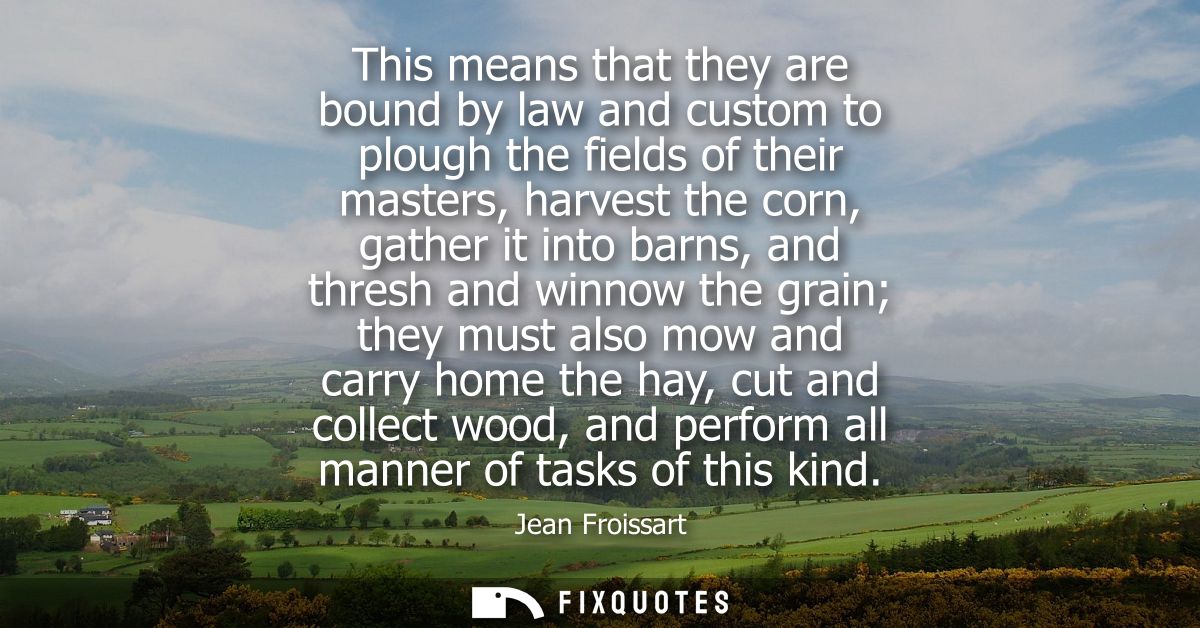
"This means that they are bound by law and custom to plough the fields of their masters, harvest the corn, gather it into barns, and thresh and winnow the grain; they must also mow and carry home the hay, cut and collect wood, and perform all manner of tasks of this kind"
About this Quote
The key phrase is “bound by law and custom.” Froissart isn’t saying these people are simply poor; he’s marking their condition as engineered and defended. “Law” gives coercion a clean, official face. “Custom” makes it feel ancient, natural, and therefore harder to challenge. Together, they describe a feudal logic that doesn’t need constant violence to function; it can lean on habit and legitimacy until exploitation reads as order.
Context matters: Froissart writes in the long shadow of the Black Death and in the century of the Jacquerie and the English Peasants’ Revolt, moments when labor suddenly understood its leverage and elites panicked. The subtext is anxiety management. By cataloging obligations so thoroughly, the passage reassures its audience - likely noble and clerical readers - that the world still has rules, that the “masters” still have hands to work their land. It’s history as maintenance: recording the social contract not to question it, but to keep it intelligible, even defensible, when it’s beginning to crack.
Quote Details
| Topic | Freedom |
|---|---|
| Source | Help us find the source |
| Cite |
Citation Formats
APA Style (7th ed.)
Froissart, Jean. (2026, January 14). This means that they are bound by law and custom to plough the fields of their masters, harvest the corn, gather it into barns, and thresh and winnow the grain; they must also mow and carry home the hay, cut and collect wood, and perform all manner of tasks of this kind. FixQuotes. https://fixquotes.com/quotes/this-means-that-they-are-bound-by-law-and-custom-3529/
Chicago Style
Froissart, Jean. "This means that they are bound by law and custom to plough the fields of their masters, harvest the corn, gather it into barns, and thresh and winnow the grain; they must also mow and carry home the hay, cut and collect wood, and perform all manner of tasks of this kind." FixQuotes. January 14, 2026. https://fixquotes.com/quotes/this-means-that-they-are-bound-by-law-and-custom-3529/.
MLA Style (9th ed.)
"This means that they are bound by law and custom to plough the fields of their masters, harvest the corn, gather it into barns, and thresh and winnow the grain; they must also mow and carry home the hay, cut and collect wood, and perform all manner of tasks of this kind." FixQuotes, 14 Jan. 2026, https://fixquotes.com/quotes/this-means-that-they-are-bound-by-law-and-custom-3529/. Accessed 7 Apr. 2026.