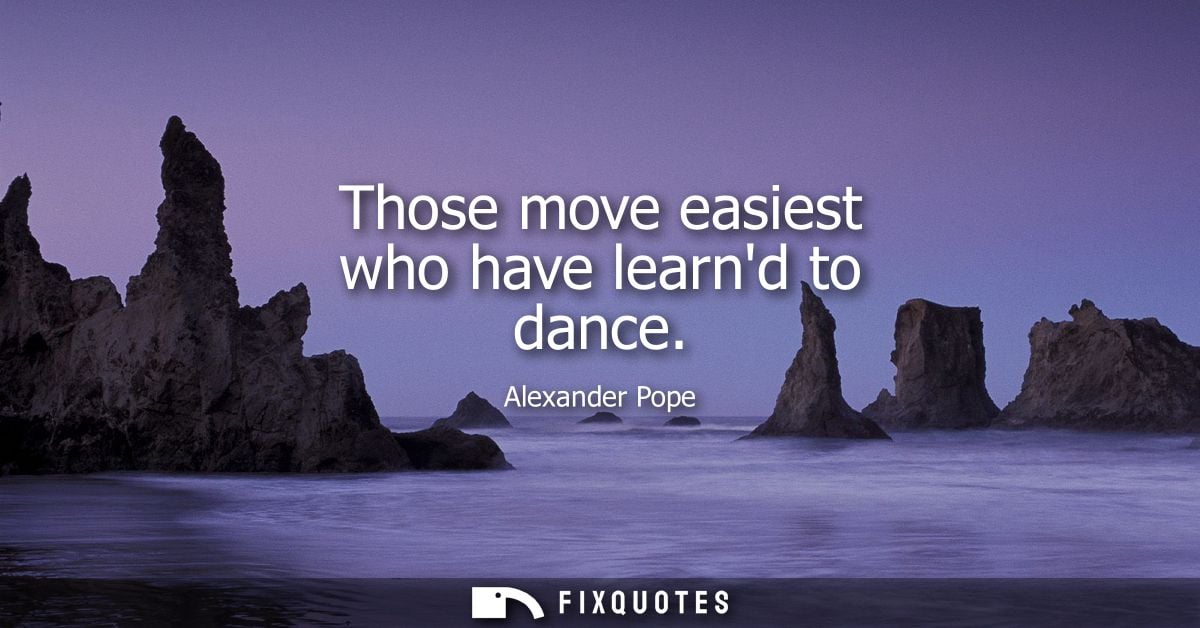
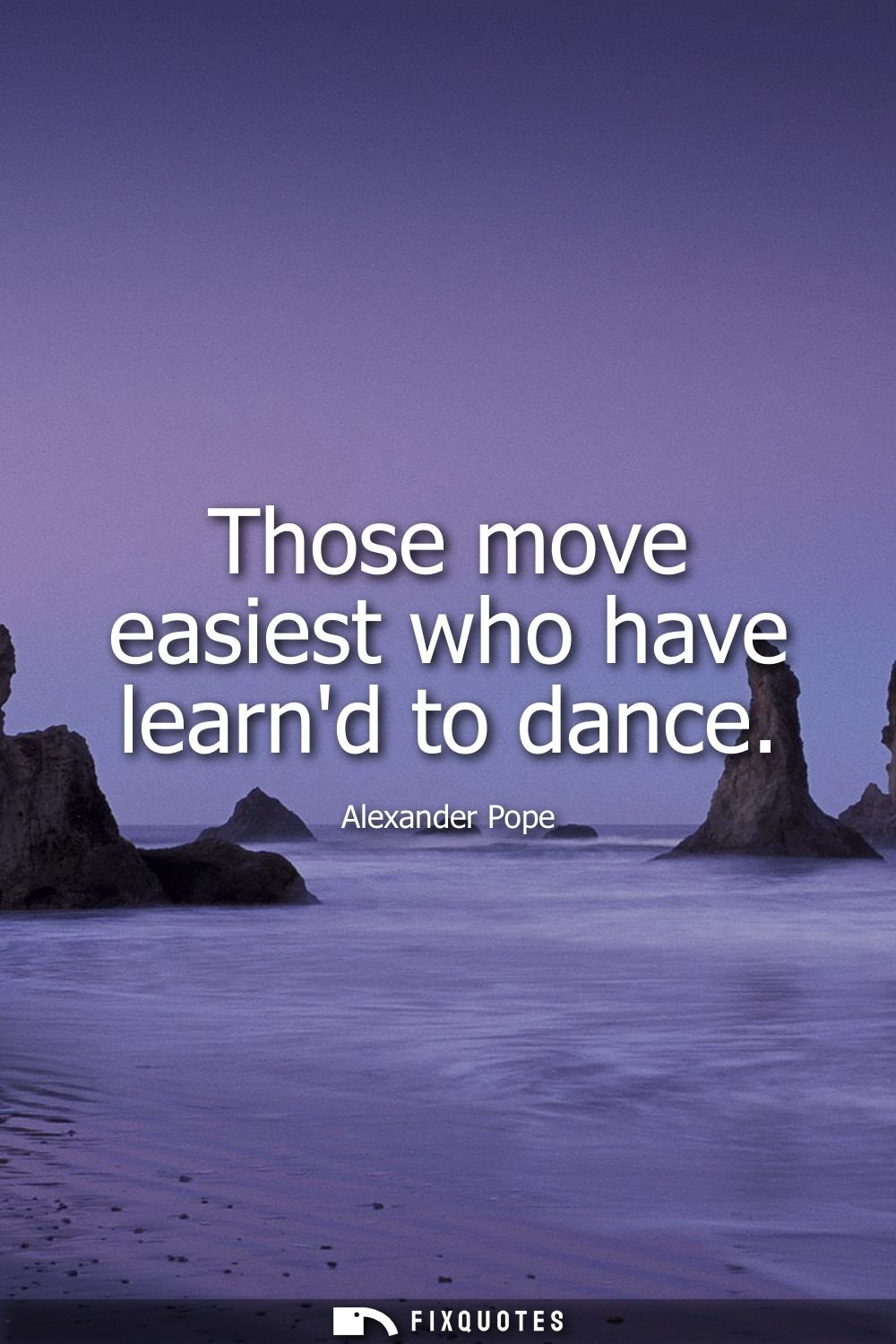
"Those move easiest who have learn'd to dance"
About this Quote
Grace, Pope implies, is not a gift bestowed by birthright but a skill drilled into the body. "Those move easiest who have learn'd to dance" looks like a compliment to elegance, but it’s also a sly piece of moral accounting: effort disappears into fluency, and the world rewards the appearance of ease. Pope is fascinated by that transformation - the way discipline, once internalized, reads as nature.
The line works because it smuggles instruction inside a social observation. Dance in Pope’s era wasn’t merely art; it was training for public life. In the drawing room and at court, dancing signaled rank, self-control, and knowledge of the rules. To "learn" it was to submit to a system of steps and timing so completely that you could glide through scrutiny without seeming to try. Subtext: the people who navigate power best are the ones who practiced the choreography when nobody was watching.
There’s also a sharper edge. Pope, a master of polished couplets and social satire, knows how often "ease" is misread as virtue. If movement comes easiest to the trained, then clumsiness can be less a personal failing than a lack of access - to tutors, leisure, and the cultural codes that confer legitimacy. The sentence flatters refinement while quietly exposing it as constructed.
And, as a poet, Pope is describing his own craft. Meter, rhyme, and wit are a kind of dance: the more stringent the steps, the more effortless the performance must appear.
The line works because it smuggles instruction inside a social observation. Dance in Pope’s era wasn’t merely art; it was training for public life. In the drawing room and at court, dancing signaled rank, self-control, and knowledge of the rules. To "learn" it was to submit to a system of steps and timing so completely that you could glide through scrutiny without seeming to try. Subtext: the people who navigate power best are the ones who practiced the choreography when nobody was watching.
There’s also a sharper edge. Pope, a master of polished couplets and social satire, knows how often "ease" is misread as virtue. If movement comes easiest to the trained, then clumsiness can be less a personal failing than a lack of access - to tutors, leisure, and the cultural codes that confer legitimacy. The sentence flatters refinement while quietly exposing it as constructed.
And, as a poet, Pope is describing his own craft. Meter, rhyme, and wit are a kind of dance: the more stringent the steps, the more effortless the performance must appear.
Quote Details
| Topic | Learning |
|---|---|
| Source | Help us find the source |
| Cite |
Citation Formats
APA Style (7th ed.)
Pope, Alexander. (2026, January 17). Those move easiest who have learn'd to dance. FixQuotes. https://fixquotes.com/quotes/those-move-easiest-who-have-learnd-to-dance-34589/
Chicago Style
Pope, Alexander. "Those move easiest who have learn'd to dance." FixQuotes. January 17, 2026. https://fixquotes.com/quotes/those-move-easiest-who-have-learnd-to-dance-34589/.
MLA Style (9th ed.)
"Those move easiest who have learn'd to dance." FixQuotes, 17 Jan. 2026, https://fixquotes.com/quotes/those-move-easiest-who-have-learnd-to-dance-34589/. Accessed 27 Mar. 2026.
More Quotes by Alexander
Add to List