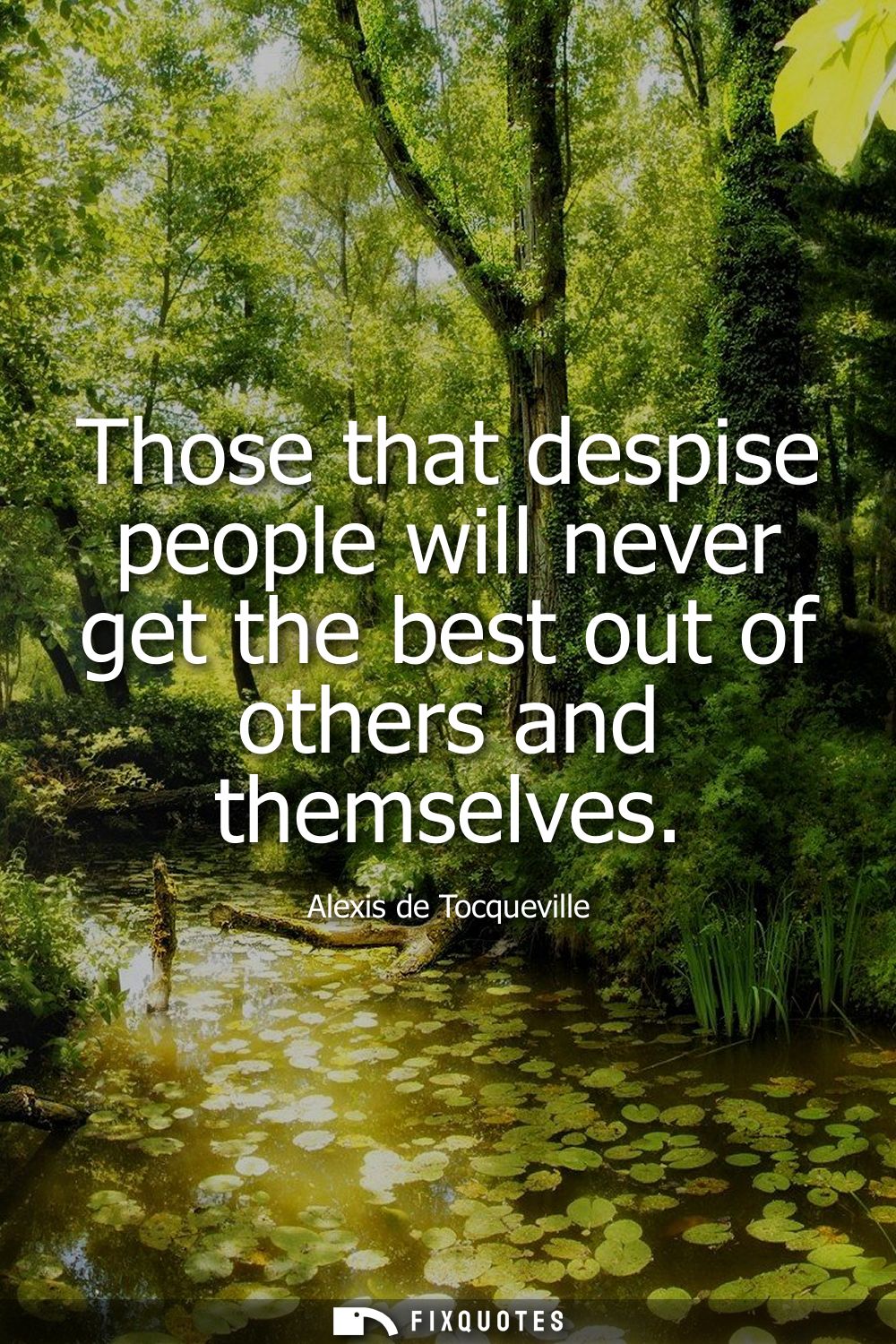
"Those that despise people will never get the best out of others and themselves"
About this Quote
The phrasing is shrewdly practical. He links contempt to performance: you will "never get the best" out of others. In a democracy, power depends less on coercion than on buy-in, habits, and trust. Disdain burns that social capital. People respond to being treated as disposable with either withdrawal, resentment, or sabotage. Even compliance becomes brittle. Tocqueville understood that democratic life runs on invisible infrastructure: associations, civic pride, a belief that participation matters. Contempt corrodes all of it.
Then comes the twist that makes the sentence sting: contempt also blocks you from getting the best out of yourself. That’s Tocqueville’s deeper subtext about character. The contemptuous leader mistakes superiority for strength, but the habit of dismissing others narrows curiosity, empathy, and self-critique - the very tools needed to navigate a complex public. You end up trapped in your own caricature of the people you rule, and the punishment is mediocrity: poorer judgment, weaker institutions, smaller ambitions.
Quote Details
| Topic | Respect |
|---|---|
| Source | Help us find the source |
| Cite |
Citation Formats
APA Style (7th ed.)
Tocqueville, Alexis de. (2026, January 15). Those that despise people will never get the best out of others and themselves. FixQuotes. https://fixquotes.com/quotes/those-that-despise-people-will-never-get-the-best-34981/
Chicago Style
Tocqueville, Alexis de. "Those that despise people will never get the best out of others and themselves." FixQuotes. January 15, 2026. https://fixquotes.com/quotes/those-that-despise-people-will-never-get-the-best-34981/.
MLA Style (9th ed.)
"Those that despise people will never get the best out of others and themselves." FixQuotes, 15 Jan. 2026, https://fixquotes.com/quotes/those-that-despise-people-will-never-get-the-best-34981/. Accessed 2 Apr. 2026.