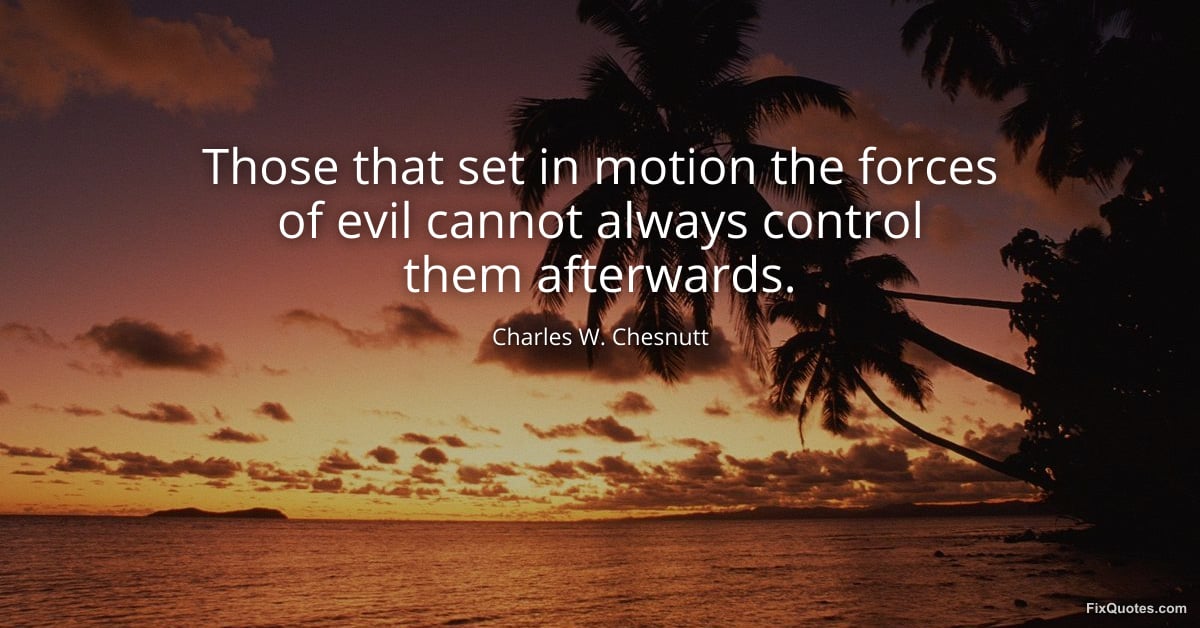
"Those that set in motion the forces of evil cannot always control them afterwards"
About this Quote
The subtext is pointedly American. Chesnutt, writing in the long shadow of slavery and the brutal improvisations of Reconstruction and Jim Crow, knew that evil is often rationalized as policy, tradition, or "necessary" order. Once made social, it becomes self-protecting. Violence invites counter-violence; racism requires enforcement; exploitation creates resentments and myths to justify itself. The original architects may imagine they can calibrate cruelty, keep it profitable, keep it contained. Chesnutt argues the opposite: institutionalized harm breeds its own momentum, recruiting people who did not start it and cannot stop it without paying a price.
There is a quiet rebuke in "cannot always". He is not claiming karmic certainty; he is warning about risk. The intent is less sermon than diagnosis: power loves to believe it can manage what it unleashes. Chesnutt's sentence punctures that fantasy, reminding readers that moral compromises do not stay discreet. They metastasize into systems, and systems do not take orders from their founders.
Quote Details
| Topic | Ethics & Morality |
|---|---|
| Source | Help us find the source |
| Cite |
Citation Formats
APA Style (7th ed.)
Chesnutt, Charles W. (2026, January 17). Those that set in motion the forces of evil cannot always control them afterwards. FixQuotes. https://fixquotes.com/quotes/those-that-set-in-motion-the-forces-of-evil-40601/
Chicago Style
Chesnutt, Charles W. "Those that set in motion the forces of evil cannot always control them afterwards." FixQuotes. January 17, 2026. https://fixquotes.com/quotes/those-that-set-in-motion-the-forces-of-evil-40601/.
MLA Style (9th ed.)
"Those that set in motion the forces of evil cannot always control them afterwards." FixQuotes, 17 Jan. 2026, https://fixquotes.com/quotes/those-that-set-in-motion-the-forces-of-evil-40601/. Accessed 26 Mar. 2026.