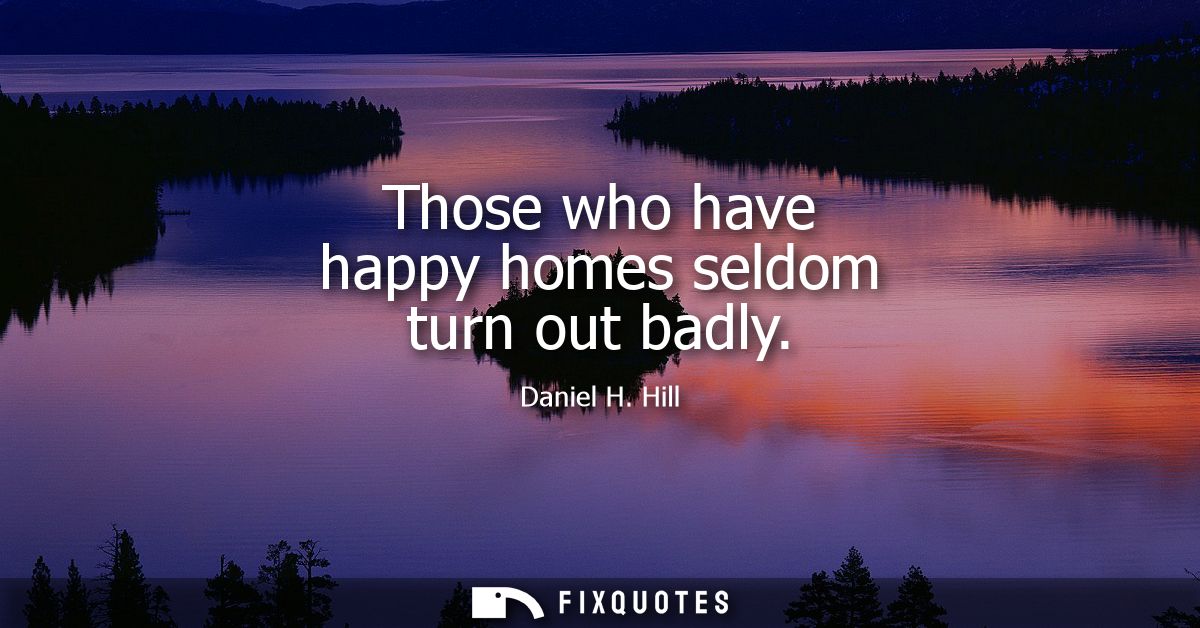
"Those who have happy homes seldom turn out badly"
About this Quote
There is a comforting moral geometry to Hill's line: build the right domestic architecture and you get good citizens as reliably as you get shelter from a roof. Coming from a 19th-century soldier, the claim reads less like a Hallmark sentiment than a piece of social strategy. Armies run on discipline, loyalty, and habit; the home is imagined as the first training ground where those traits are installed. "Seldom" does a lot of work here, offering statistical modesty while still smuggling in a prescriptive worldview: if people go wrong, look first to their private foundations.
The subtext is both paternal and political. Hill is gesturing at a theory of order where stability is cultivated in the parlor, not legislated in the capitol. It's also a quiet indictment: "badly" isn't just crime or vice, it's deviation from the norms that keep communities legible and governable. In that sense, the sentence flatters the middle-class ideal of a coherent household and frames it as a civic virtue.
Context sharpens the edge. Hill lived through a century of national rupture, when Americans argued over what kind of society could hold together under stress. A soldier's faith in "happy homes" is a faith in unit cohesion scaled down to the family: small hierarchies, clear roles, mutual dependence. The line works because it offers an appealingly simple causal story in a chaotic era, while quietly placing responsibility for social disorder on intimate life rather than public systems.
The subtext is both paternal and political. Hill is gesturing at a theory of order where stability is cultivated in the parlor, not legislated in the capitol. It's also a quiet indictment: "badly" isn't just crime or vice, it's deviation from the norms that keep communities legible and governable. In that sense, the sentence flatters the middle-class ideal of a coherent household and frames it as a civic virtue.
Context sharpens the edge. Hill lived through a century of national rupture, when Americans argued over what kind of society could hold together under stress. A soldier's faith in "happy homes" is a faith in unit cohesion scaled down to the family: small hierarchies, clear roles, mutual dependence. The line works because it offers an appealingly simple causal story in a chaotic era, while quietly placing responsibility for social disorder on intimate life rather than public systems.
Quote Details
| Topic | Family |
|---|---|
| Source | Help us find the source |
| Cite |
Citation Formats
APA Style (7th ed.)
Hill, Daniel H. (2026, January 15). Those who have happy homes seldom turn out badly. FixQuotes. https://fixquotes.com/quotes/those-who-have-happy-homes-seldom-turn-out-badly-148747/
Chicago Style
Hill, Daniel H. "Those who have happy homes seldom turn out badly." FixQuotes. January 15, 2026. https://fixquotes.com/quotes/those-who-have-happy-homes-seldom-turn-out-badly-148747/.
MLA Style (9th ed.)
"Those who have happy homes seldom turn out badly." FixQuotes, 15 Jan. 2026, https://fixquotes.com/quotes/those-who-have-happy-homes-seldom-turn-out-badly-148747/. Accessed 30 Mar. 2026.
More Quotes by Daniel
Add to List