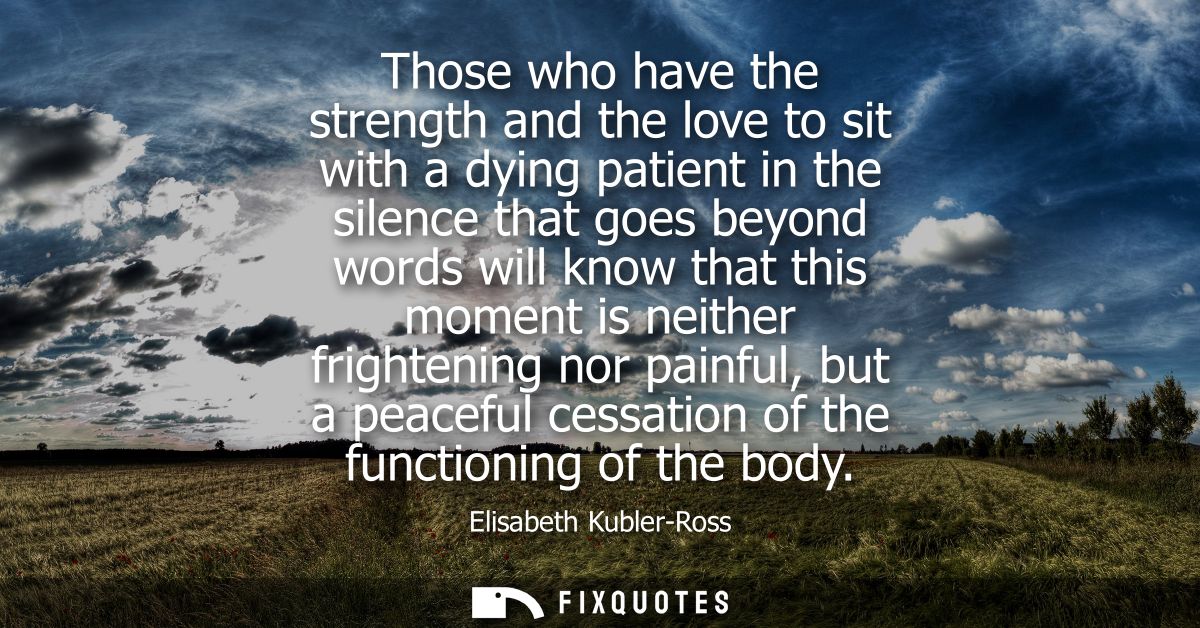
"Those who have the strength and the love to sit with a dying patient in the silence that goes beyond words will know that this moment is neither frightening nor painful, but a peaceful cessation of the functioning of the body"
About this Quote
Kubler-Ross doesn’t romanticize death so much as demystify it, stripping away the cultural panic that turns dying into an emergency even when nothing can be “fixed.” The sentence is built like an initiation: only “those who have the strength and the love” earn access to a truth most of us avoid. That gatekeeping is the point. Modern life outsources dying to institutions, euphemisms, and sedation, leaving families fluent in treatment plans but illiterate in presence. Her claim isn’t that death is easy; it’s that our fear often comes from distance, noise, and the compulsion to narrate.
The key phrase is “silence that goes beyond words.” It’s not just quiet, it’s the failure of our usual tools - reassurance, theology, small talk, even empathy scripts. Kubler-Ross reframes that failure as competence. Sitting there without performing is portrayed as a kind of love, and also a discipline: tolerating helplessness without turning it into spectacle.
Calling death “a peaceful cessation of the functioning of the body” is deliberate clinical plainness. It refuses both melodrama and metaphysics, which is why it lands with such force. In the context of her work with terminally ill patients, this reads as a corrective to medicalized denial and to families who confuse emotional motion with care. The subtext is blunt: what terrifies us isn’t death itself as much as our inability to be present for it, unarmored and unproductive.
The key phrase is “silence that goes beyond words.” It’s not just quiet, it’s the failure of our usual tools - reassurance, theology, small talk, even empathy scripts. Kubler-Ross reframes that failure as competence. Sitting there without performing is portrayed as a kind of love, and also a discipline: tolerating helplessness without turning it into spectacle.
Calling death “a peaceful cessation of the functioning of the body” is deliberate clinical plainness. It refuses both melodrama and metaphysics, which is why it lands with such force. In the context of her work with terminally ill patients, this reads as a corrective to medicalized denial and to families who confuse emotional motion with care. The subtext is blunt: what terrifies us isn’t death itself as much as our inability to be present for it, unarmored and unproductive.
Quote Details
| Topic | Mortality |
|---|---|
| Source | Help us find the source |
More Quotes by Elisabeth
Add to List