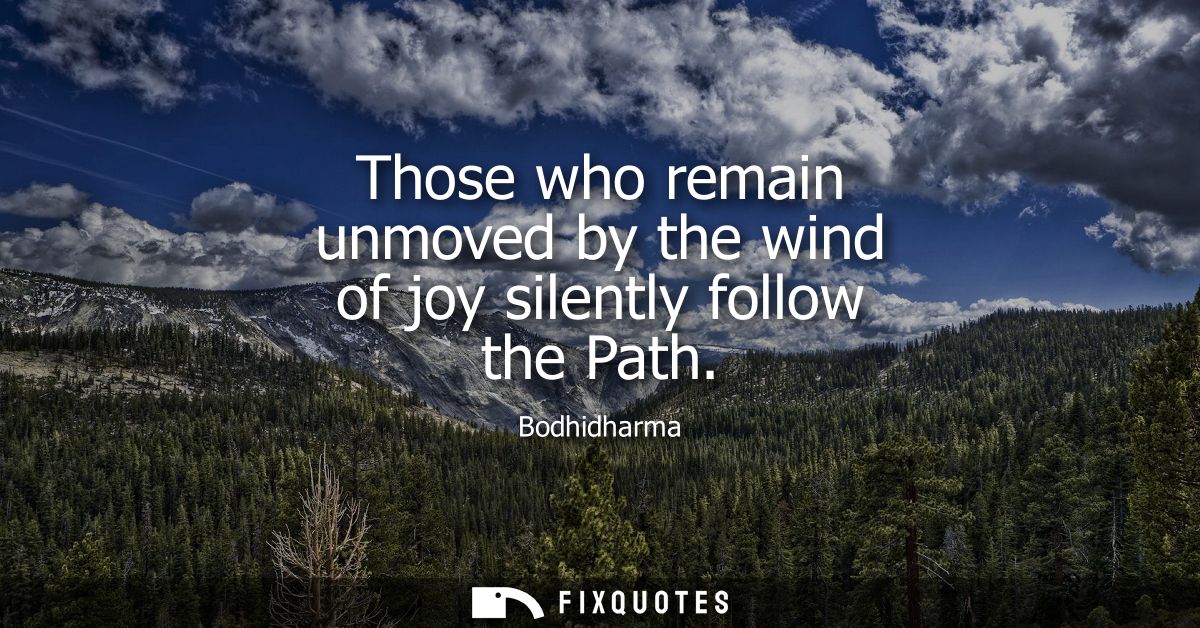
"Those who remain unmoved by the wind of joy silently follow the Path"
About this Quote
A gust of happiness is usually treated as proof of a life going right. Bodhidharma flips that instinct on its head: if you are "unmoved by the wind of joy", you are not numb or joyless; you are unpurchasable. The key move is in the weather metaphor. Joy is framed as wind, not ground - a passing force that can lift you, push you off course, or make you chase it like a kite. To stay steady in it is to refuse being steered by conditions.
The line also carries the hard Zen suspicion that emotional highs can be as distracting as suffering. We tend to think attachment only means clinging to pleasure; Zen treats clinging to pleasure as its own kind of suffering in embryo, because it sets up the inevitable crash, the demand that the world keep providing the same sensation. "Silently follow the Path" is equally pointed: no self-advertising spirituality, no performative serenity. Quietness here is discipline, not decorum.
Placed in Bodhidharma's mythic role as the outsider-founder of Chan/Zen in China, the quote reads like a corrective to religious life as mood management. The intent is training: cultivate an inner posture that does not bargain with experience. The subtext is almost political in its austerity - if your direction depends on being pleased, you are easy to govern. The Path, by contrast, belongs to the person who can feel joy fully without letting it drive.
The line also carries the hard Zen suspicion that emotional highs can be as distracting as suffering. We tend to think attachment only means clinging to pleasure; Zen treats clinging to pleasure as its own kind of suffering in embryo, because it sets up the inevitable crash, the demand that the world keep providing the same sensation. "Silently follow the Path" is equally pointed: no self-advertising spirituality, no performative serenity. Quietness here is discipline, not decorum.
Placed in Bodhidharma's mythic role as the outsider-founder of Chan/Zen in China, the quote reads like a corrective to religious life as mood management. The intent is training: cultivate an inner posture that does not bargain with experience. The subtext is almost political in its austerity - if your direction depends on being pleased, you are easy to govern. The Path, by contrast, belongs to the person who can feel joy fully without letting it drive.
Quote Details
| Topic | Wisdom |
|---|---|
| Source | Help us find the source |
| Cite |
Citation Formats
APA Style (7th ed.)
Bodhidharma. (2026, January 15). Those who remain unmoved by the wind of joy silently follow the Path. FixQuotes. https://fixquotes.com/quotes/those-who-remain-unmoved-by-the-wind-of-joy-28565/
Chicago Style
Bodhidharma. "Those who remain unmoved by the wind of joy silently follow the Path." FixQuotes. January 15, 2026. https://fixquotes.com/quotes/those-who-remain-unmoved-by-the-wind-of-joy-28565/.
MLA Style (9th ed.)
"Those who remain unmoved by the wind of joy silently follow the Path." FixQuotes, 15 Jan. 2026, https://fixquotes.com/quotes/those-who-remain-unmoved-by-the-wind-of-joy-28565/. Accessed 25 Mar. 2026.
More Quotes by Bodhidharma
Add to List