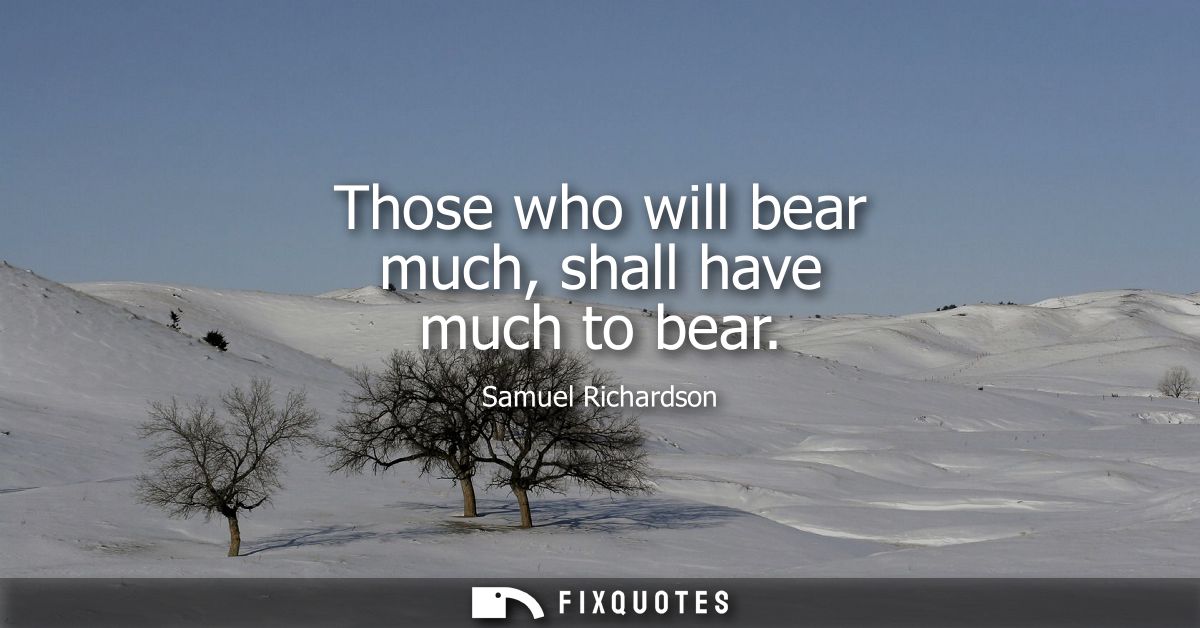
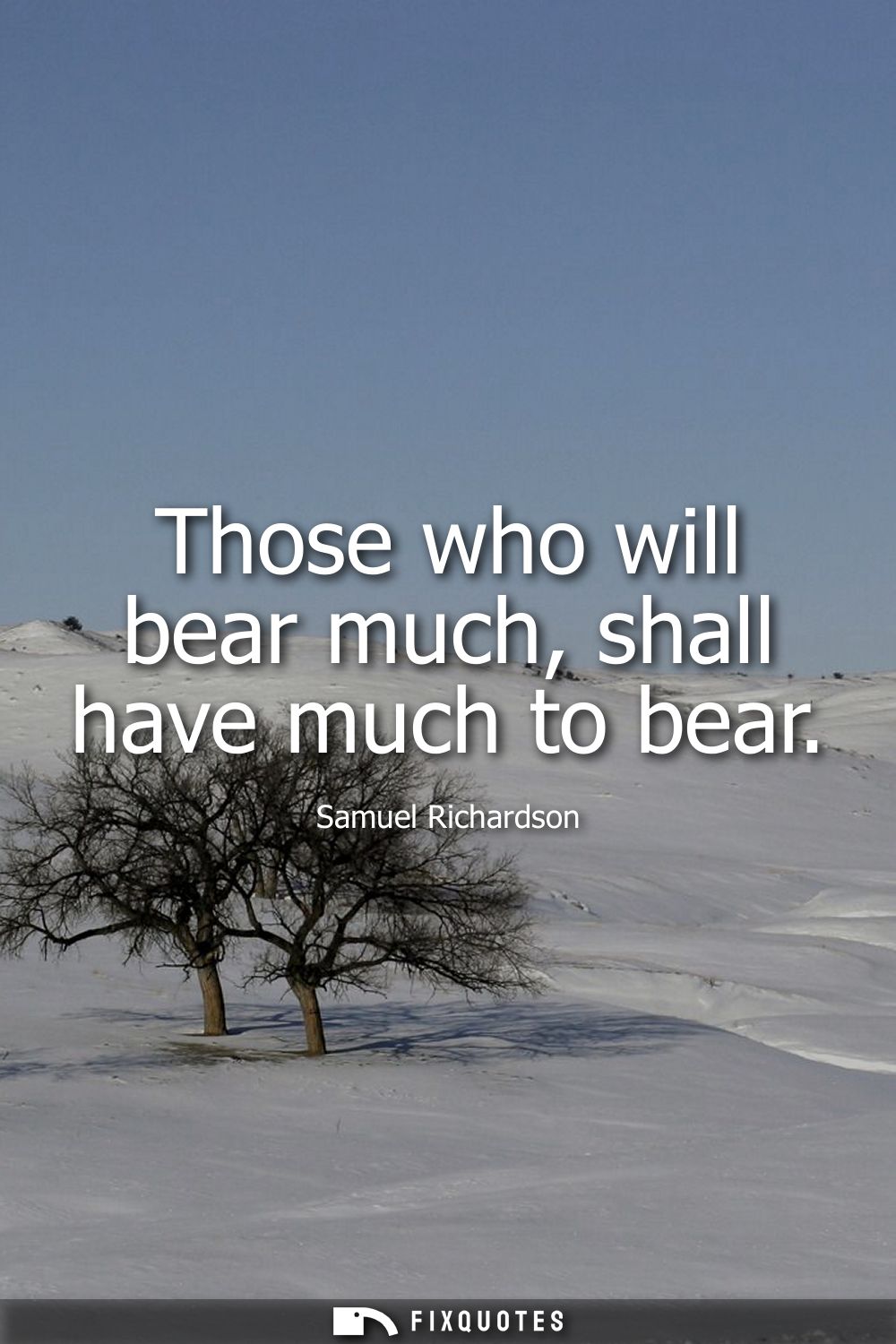
"Those who will bear much, shall have much to bear"
About this Quote
Stoic on the surface, quietly barbed underneath, Richardson's line turns endurance into both virtue and trap. "Those who will bear much" sounds like a compliment: the willing sufferer, the person with moral stamina. Then the sentence snaps shut: "shall have much to bear". Patience doesn't buy peace; it earns a heavier load.
That reversal is the engine of the quote. Richardson writes in a culture where Protestant self-discipline and social hierarchy often recast obedience as goodness, especially for people with less power. The subtext is less self-help than social physics: once you prove you're reliable under pressure, institutions and intimates alike feel licensed to lean on you. It's a warning about how "good character" gets operationalized by others.
As a novelist of manners and morality, Richardson was preoccupied with the way private virtue collides with public expectation. His world (think of the emotional machinery around reputation, duty, and gendered propriety) rewards long-suffering propriety while simultaneously demanding it. The line captures that uneasy bargain: the more you demonstrate you can absorb pain without breaking, the more pain becomes your assigned role.
The intent, then, is double. It affirms endurance as a real human capacity, but it also exposes the cost of advertising it. Richardson isn't romanticizing suffering; he's diagnosing a feedback loop in which tolerance becomes a form of consent, and resilience becomes a resource other people extract.
That reversal is the engine of the quote. Richardson writes in a culture where Protestant self-discipline and social hierarchy often recast obedience as goodness, especially for people with less power. The subtext is less self-help than social physics: once you prove you're reliable under pressure, institutions and intimates alike feel licensed to lean on you. It's a warning about how "good character" gets operationalized by others.
As a novelist of manners and morality, Richardson was preoccupied with the way private virtue collides with public expectation. His world (think of the emotional machinery around reputation, duty, and gendered propriety) rewards long-suffering propriety while simultaneously demanding it. The line captures that uneasy bargain: the more you demonstrate you can absorb pain without breaking, the more pain becomes your assigned role.
The intent, then, is double. It affirms endurance as a real human capacity, but it also exposes the cost of advertising it. Richardson isn't romanticizing suffering; he's diagnosing a feedback loop in which tolerance becomes a form of consent, and resilience becomes a resource other people extract.
Quote Details
| Topic | Tough Times |
|---|---|
| Source | Help us find the source |
| Cite |
Citation Formats
APA Style (7th ed.)
Richardson, Samuel. (2026, January 15). Those who will bear much, shall have much to bear. FixQuotes. https://fixquotes.com/quotes/those-who-will-bear-much-shall-have-much-to-bear-11475/
Chicago Style
Richardson, Samuel. "Those who will bear much, shall have much to bear." FixQuotes. January 15, 2026. https://fixquotes.com/quotes/those-who-will-bear-much-shall-have-much-to-bear-11475/.
MLA Style (9th ed.)
"Those who will bear much, shall have much to bear." FixQuotes, 15 Jan. 2026, https://fixquotes.com/quotes/those-who-will-bear-much-shall-have-much-to-bear-11475/. Accessed 20 Mar. 2026.
More Quotes by Samuel
Add to List