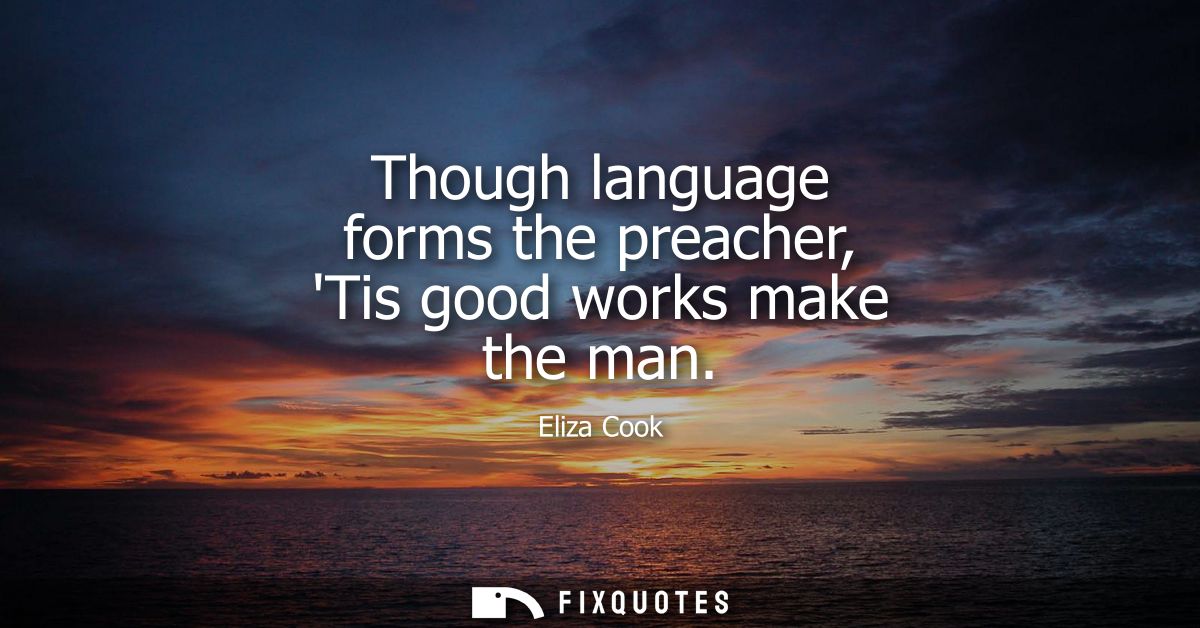
"Though language forms the preacher, 'Tis good works make the man"
About this Quote
Cook lands a neat jab with Victorian politeness: eloquence may manufacture authority, but it can’t manufacture virtue. “Though language forms the preacher” acknowledges a social fact of her era, that public standing was often built from performance. The preacher is “formed” by language the way a statue is formed by a mold; rhetoric creates a recognizable role, complete with the costume of moral certainty. Cook’s choice of preacher isn’t incidental. In 19th-century Britain, the pulpit was both a spiritual megaphone and a civic one, a place where class respectability and moral judgment were broadcast weekly.
Then she flips the hierarchy. “’Tis good works make the man” drags morality out of the mouth and back into the street. The line implies suspicion toward the easy prestige of talk: sermons, speeches, and tasteful pieties that signal goodness without requiring it. The subtext is pointedly democratic. If moral worth is proven in “works,” it becomes legible outside elite institutions and outside the well-schooled command of language. That matters coming from Cook, a working-class poet who wrote for broad audiences and often championed everyday decency over fashionable virtue.
The couplet’s effectiveness is structural: two clauses, two kinds of making, two competing economies of value. One is reputational (language “forms” a public persona), the other ethical (actions “make” a person). Cook isn’t anti-language; she’s warning that language can be a mask so convincing we forget to check what’s underneath.
Then she flips the hierarchy. “’Tis good works make the man” drags morality out of the mouth and back into the street. The line implies suspicion toward the easy prestige of talk: sermons, speeches, and tasteful pieties that signal goodness without requiring it. The subtext is pointedly democratic. If moral worth is proven in “works,” it becomes legible outside elite institutions and outside the well-schooled command of language. That matters coming from Cook, a working-class poet who wrote for broad audiences and often championed everyday decency over fashionable virtue.
The couplet’s effectiveness is structural: two clauses, two kinds of making, two competing economies of value. One is reputational (language “forms” a public persona), the other ethical (actions “make” a person). Cook isn’t anti-language; she’s warning that language can be a mask so convincing we forget to check what’s underneath.
Quote Details
| Topic | Ethics & Morality |
|---|---|
| Source | Help us find the source |
| Cite |
Citation Formats
APA Style (7th ed.)
Cook, Eliza. (2026, January 15). Though language forms the preacher, 'Tis good works make the man. FixQuotes. https://fixquotes.com/quotes/though-language-forms-the-preacher-tis-good-works-161987/
Chicago Style
Cook, Eliza. "Though language forms the preacher, 'Tis good works make the man." FixQuotes. January 15, 2026. https://fixquotes.com/quotes/though-language-forms-the-preacher-tis-good-works-161987/.
MLA Style (9th ed.)
"Though language forms the preacher, 'Tis good works make the man." FixQuotes, 15 Jan. 2026, https://fixquotes.com/quotes/though-language-forms-the-preacher-tis-good-works-161987/. Accessed 5 Mar. 2026.
More Quotes by Eliza
Add to List