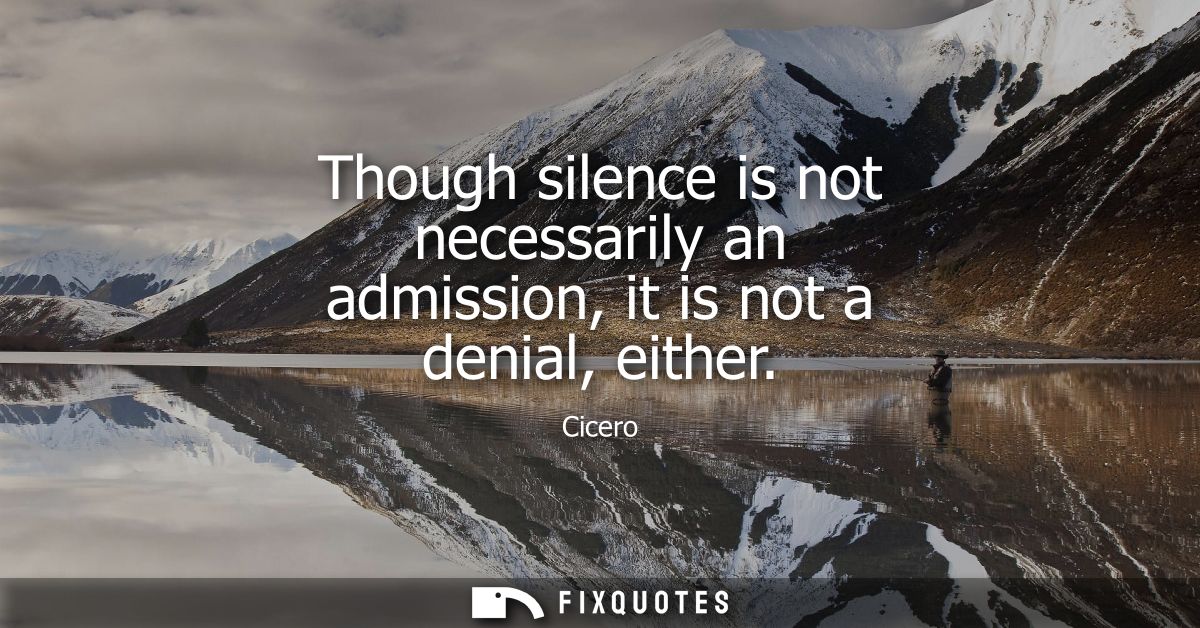
"Though silence is not necessarily an admission, it is not a denial, either"
About this Quote
The intent is strategic. Cicero is warning that public life runs on perception and implication as much as on testimony. If you refuse to answer an accusation, you may be protecting yourself from self-incrimination or simply withholding judgment, but you are also surrendering the narrative to your opponents. They get to fill the vacuum. In a culture where honor, reputation, and loyalty were political currency, a quiet man could look like a guilty one, or at least a cowardly one.
The subtext is sharper: civic responsibility includes speech. Rome’s elites liked to imagine themselves as stewards of the republic, yet in moments of crisis self-preservation could masquerade as restraint. Cicero is prying that mask off. Silence becomes a kind of soft complicity, not by moral logic but by rhetorical physics: what goes unchallenged begins to sound true.
Context matters. Cicero lived through the Republic’s slow collapse, when accusations were weapons and factions demanded declarations. Against that backdrop, the quote reads less like etiquette and more like survival advice for an age when saying nothing was still saying something.
Quote Details
| Topic | Wisdom |
|---|---|
| Source | Help us find the source |
| Cite |
Citation Formats
APA Style (7th ed.)
Cicero. (2026, January 18). Though silence is not necessarily an admission, it is not a denial, either. FixQuotes. https://fixquotes.com/quotes/though-silence-is-not-necessarily-an-admission-it-9058/
Chicago Style
Cicero. "Though silence is not necessarily an admission, it is not a denial, either." FixQuotes. January 18, 2026. https://fixquotes.com/quotes/though-silence-is-not-necessarily-an-admission-it-9058/.
MLA Style (9th ed.)
"Though silence is not necessarily an admission, it is not a denial, either." FixQuotes, 18 Jan. 2026, https://fixquotes.com/quotes/though-silence-is-not-necessarily-an-admission-it-9058/. Accessed 12 Feb. 2026.