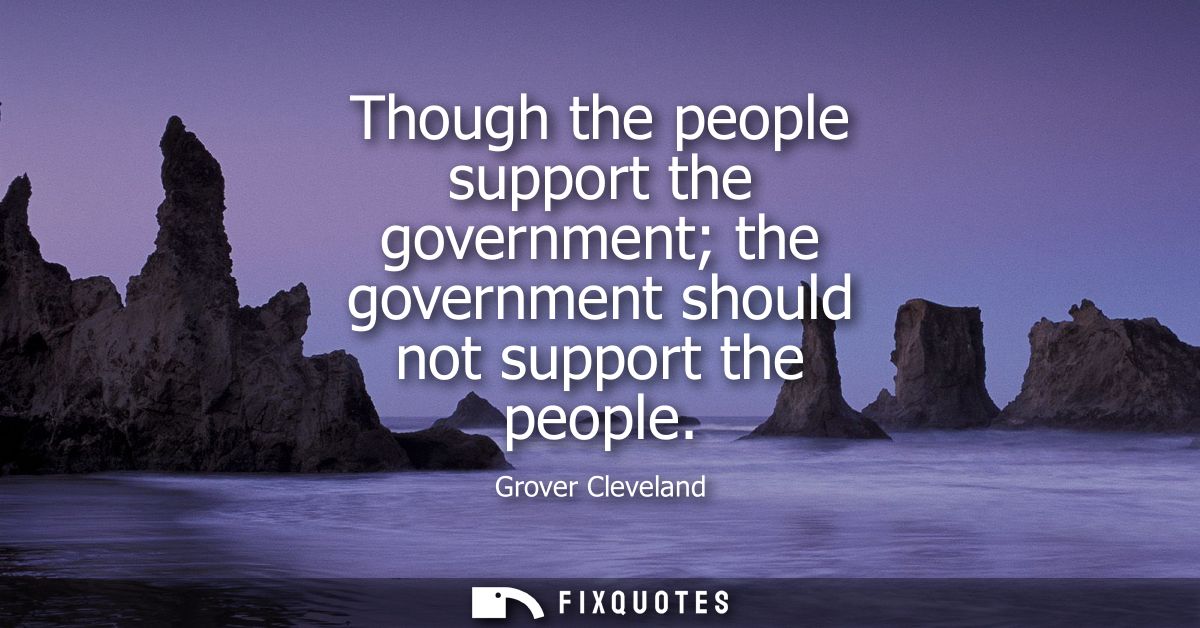
"Though the people support the government, the government should not support the people"
About this Quote
The intent is disciplinarian. Cleveland is drawing a bright boundary around what he saw as legitimate government: protect rights, enforce laws, keep the books clean. Relief, redistribution, or public provision aren’t just policy choices; they’re treated as corruptions of civic character. That framing turns debates about hunger, unemployment, or catastrophe into debates about virtue and dependence, which is a neat way to win an argument without touching the messy facts.
The subtext is late-19th-century political economy in a single sentence: laissez-faire reflexes, suspicion of patronage, and a fear that state aid becomes a pipeline for political machines. Cleveland made this posture famous with his veto of a drought-relief seed bill in 1887, arguing that federal charity would weaken self-reliance. He’s also speaking to an era rattled by rapid industrialization, labor unrest, and widening inequality, when calls for pensions, relief, and regulation sounded to elites like the opening act of a larger state.
Rhetorically, the line launders power into principle. It makes austerity feel like democratic purity, even as the government of his day actively “supported” business through tariffs, land policy, and the hard-money system. The quote’s bite comes from that contradiction: it condemns dependence in the abstract while quietly tolerating it in the forms that look respectable.
Quote Details
| Topic | Freedom |
|---|---|
| Source | Verified source: The Writings and Speeches of Grover Cleveland (Grover Cleveland, 1892)ID: NdpBAAAAIAAJ
Evidence: Grover Cleveland George Frederick Parker. has existed in certain portions of the State of Texas , resulting in a ... though the people support the government , the government should not support the people . The friendliness and ... Other candidates (1) Veto Message on the Texas Seed Bill (Grover Cleveland, 1887)95.0% A prevalent tendency to disregard the limited mission of this power and duty should, I think, be steadfastly resisted... |
| Cite |
Citation Formats
APA Style (7th ed.)
Cleveland, Grover. (2026, February 16). Though the people support the government, the government should not support the people. FixQuotes. https://fixquotes.com/quotes/though-the-people-support-the-government-the-125144/
Chicago Style
Cleveland, Grover. "Though the people support the government, the government should not support the people." FixQuotes. February 16, 2026. https://fixquotes.com/quotes/though-the-people-support-the-government-the-125144/.
MLA Style (9th ed.)
"Though the people support the government, the government should not support the people." FixQuotes, 16 Feb. 2026, https://fixquotes.com/quotes/though-the-people-support-the-government-the-125144/. Accessed 9 Mar. 2026.